
 Yuyun Lusiyani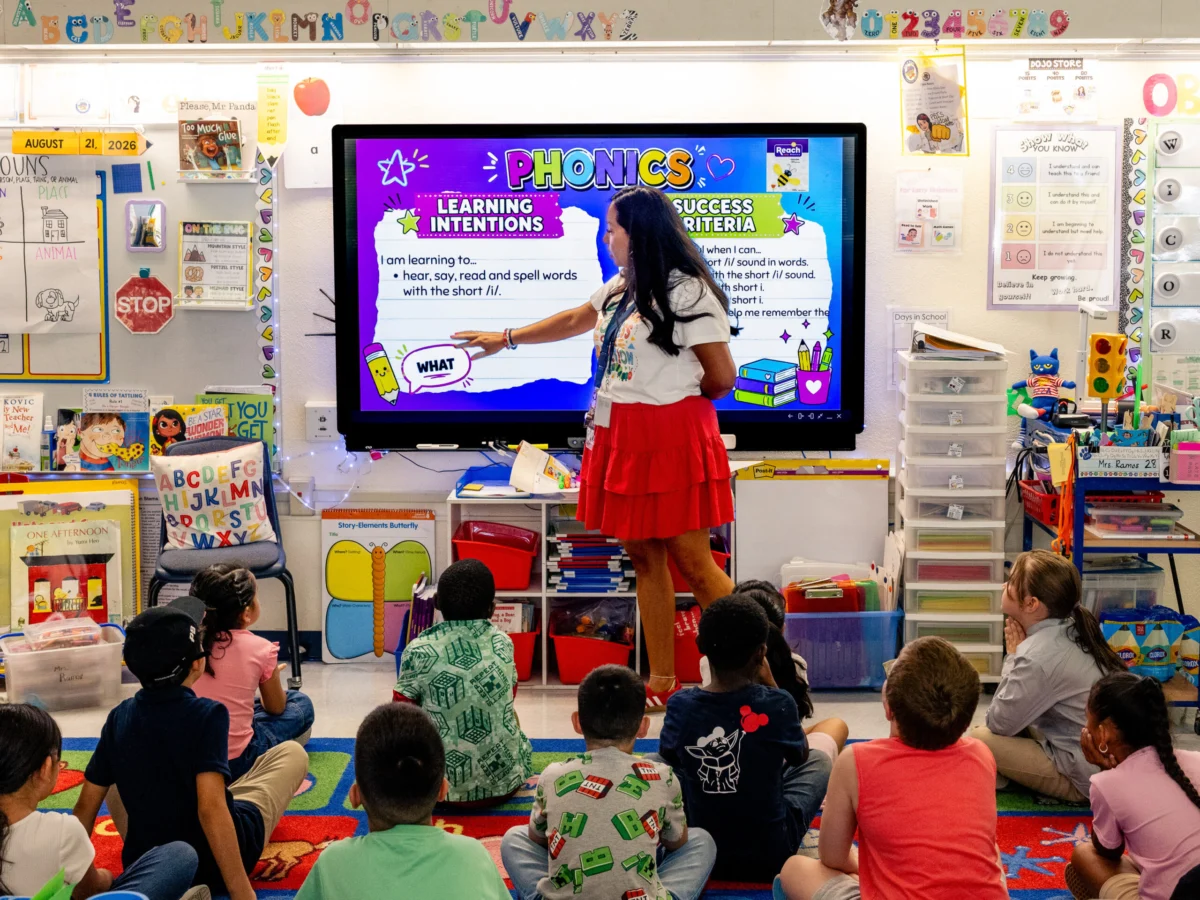
Samantha Ramos stood at the front of her second-grade classroom at John B. Wright Elementary School in Tucson, Arizona, a small microphone amplifying her voice as she commenced a phonics lesson. With 15 years of experience, specializing in teaching English as a second language, Ramos guided her young students through a multisensory exercise for the short "i" sound. "Can we get our arms ready?" she asked, bringing her right palm to her left shoulder, a gesture mirrored by the attentive children. Each letter of a word like "will" was assigned a distinct physical movement – shoulder for "w," elbow for "i," hand for the double "l" – before the students collectively sounded it out. They repeated this kinesthetic process for other short "i" words such as "dig," "wig," and "fit," a methodical approach designed to embed foundational English skills.
This daily block of intensive language instruction, ranging from two to four hours, is a mandatory component of the curriculum for Arizona students designated as English Language Learners (ELLs). Predominantly Spanish-speaking Latino children, these students are segregated for a significant portion of their school day from their English-speaking peers, remaining in the program until they achieve a passing score on a standardized test, the Arizona English Language Learner Assessment (AZELLA), signifying sufficient English fluency to transition into mainstream classrooms. This educational model, known officially as "structured English immersion" (SEI) and colloquially as "English-only," mandates that all instruction be conducted exclusively in English. Critics argue that this restrictive approach significantly curtails the time ELLs can dedicate to core subjects like mathematics and science, subjects crucial for academic advancement and ultimately, college readiness. Arizona holds the distinction of being the sole state in the nation that continues to enforce such English-only laws in its public schools.
A Controversial Shift in Proficiency Standards
Despite the stringent nature of the SEI program, the number of students officially exiting the curriculum has seen a dramatic surge this year. In the Tucson Unified School District, where Ramos teaches, the percentage of students deemed proficient in English more than doubled, climbing from 10% in 2025 to an astonishing 24% in 2026. This statewide trend saw the reclassification rate jump from a steady 12% for the past three school years to 26% in 2026. However, this apparent leap in fluency is not attributed to enhanced student learning or improved instructional methods. Instead, it directly reflects a controversial decision by the Arizona Department of Education (ADE) to significantly lower the passing score required on the AZELLA test. These changes were approved by the outgoing Superintendent of Public Instruction, Tom Horne, a long-standing Republican advocate and defender of Arizona’s English-only educational policies.
Educational experts and applied linguists have issued stark warnings, predicting that this policy alteration will inflict lasting harm on tens of thousands of Arizona students. They contend that students exiting the structured English immersion program prematurely, before attaining genuine English proficiency, will face severe academic disadvantages. ELLs already constitute the lowest-performing demographic on standardized tests across the state. The abrupt cessation of specialized language instruction, according to education researchers, risks exacerbating these existing achievement gaps and jeopardizing their long-term academic trajectories and future opportunities.
Echoes of Past Federal Interventions

This is not the first instance of Arizona’s education department making adjustments that raise concerns about the proper classification of English Language Learners. Past attempts by the ADE to reclassify large cohorts of children learning English as fluent, often under previous administrations of Tom Horne, triggered rigorous federal investigations by both the U.S. Departments of Justice and Education. Federal officials previously asserted that placing students in mainstream classrooms where they struggled due to insufficient English knowledge constituted a violation of their civil and educational rights. More than a decade ago, Arizona entered into a voluntary settlement agreement with federal authorities to rectify these issues.
Katie Bernstein, an applied linguist and professor of early childhood education at Arizona State University, draws parallels between the current situation and these historical controversies. "If you’re put in a class where you don’t understand what’s going on at all, you’re not learning language or content," Bernstein stated, emphasizing the dire consequences of such policies. "And so those are the worst outcomes of all, are students who are not given any language services." Her concerns underscore the fundamental principle that effective language acquisition requires sustained, appropriate support, not merely a redefinition of "proficiency."
The Arizona English Language Learner Assessment (AZELLA): A Troubled History
Nearly one in ten students enrolled in Arizona’s public and charter schools report speaking a language other than English at home on their registration forms. State law mandates that these students undergo fluency assessment and, if not proficient, be placed into the structured English immersion program. Each spring, they take the AZELLA test, which measures their progress in reading, writing, speaking, and listening. This system has been a cornerstone of Arizona’s educational landscape since voters passed Proposition 203 in 2000, effectively banning bilingual education in public schools and ushering in the English-only mandate.
Despite its critical role, the AZELLA test has faced persistent scrutiny and undergone periodic revisions, often with contentious results. The U.S. Departments of Justice and Education previously determined that the version of AZELLA administered between 2006 and 2012 – a period coinciding with Tom Horne’s first two terms as the state’s top education official – was "not a valid measure of English language proficiency and readiness." This invalidated assessment led to the premature removal of at least 28,000 students from SEI programs who, in reality, still lacked proficiency in reading and writing English.
The state was subsequently found to be in violation of civil rights laws prohibiting discrimination based on race and national origin in federally funded schools. As a result, Arizona entered into a voluntary settlement agreement, which explicitly stipulated that "education agencies [are required] to take appropriate action to overcome language barriers that impede students’ equal participation in instructional programs." The settlement mandated immediate assistance for school districts to identify affected students and provide them with "reading and writing intervention services." Crucially, it also required a comprehensive revamp of the AZELLA test itself. A second voluntary settlement four years later addressed similar issues, further instructing the state to elevate the proficiency threshold for the test and re-evaluate English learners using more rigorous standards.
Ida Rose Florez, a psychologist and former professor and researcher at Arizona State University, conducted a pivotal study published in 2012 that meticulously examined the AZELLA test. Her research concluded that the test was "ineffective and obsolete" and its results could be arbitrary. Florez’s findings indicated a severe lack of evidence that the test could "accurately differentiate" between children who genuinely required English language services and those who did not. "What I examined, and what I saw, was a test that was absolutely not developed correctly," Florez told Arizona Luminaria and ProPublica. "I don’t see any basis for validity whatsoever."

The 2026 Policy Reversal: Justification and Criticisms
Following a period where AZELLA passing rates remained stagnant at 12% statewide for three consecutive school years – including in 2025, when over 118,000 students took the test and only about 14,000 were reclassified – the ADE implemented its most recent changes. In September training sessions for teachers, the department officially announced that the statewide reclassification rate for 2026 had surged to 26%. This dramatic increase meant that approximately 30,000 of the nearly 113,000 students who took the 2026 AZELLA were reclassified as proficient and subsequently removed from English language services for the current school year.
The ADE’s rationale for lowering the passing scores stems from an internal review process. According to Deputy Superintendent Margaret Dugan, who chaired the group that championed Proposition 203 and has served with Horne during all three of his terms as superintendent, each new version of the AZELLA is typically administered to native English speakers first to establish a baseline. Dugan explained that this crucial step was skipped in 2020 during the last major test revision, due to the disruptions caused by the COVID-19 pandemic. "Because of COVID and all of that that went on in 2020, things were not done in order," Dugan stated. "When we walked in, it was a new test and they had never tested the native speakers, so now they had to."
When that version of the test was belatedly administered to native English speakers, nearly half failed, as confirmed by Adela Santa Cruz, who leads the Office of English Language Acquisition, the department overseeing the AZELLA. "With a native not being able to pass that test at a high percentage, there’s something that was just quite awry," Santa Cruz commented. She attributed the plateauing 12% pass rate among English learners to these underlying issues.
Utilizing this data, education officials decided to adjust the grading criteria for ELLs, requiring a lower score to pass all four components of the test: reading, writing, speaking, and listening. Previously, all students needed a combined score of at least 1,000 out of a possible 1,405 to pass. For 2026, the minimum passing scores were significantly reduced, ranging from 962 for high schoolers down to 944 for kindergartners. Anju Kuriakose, the director of psychometrics at the Arizona Department of Education, expressed optimism when announcing the changes to school district representatives in April: "My hope is that all of you will see an increase in proficiency."
However, Kuriakose also noted a critical detail: half of the native speakers tested to inform these changes were in kindergarten and first grade, while students in fifth grade or higher constituted less than one-fifth of the test-takers. This demographic imbalance echoes concerns raised by Florez’s 2012 study, which found that scoring guidelines based disproportionately on the results of native-speaking kindergartners, lacking sufficient data from older children with more advanced language skills, could artificially inflate pass rates. Florez sees similar methodological flaws in the 2026 adjustments, questioning the validity of the revised proficiency thresholds.
The Political Dimension: Superintendent Tom Horne’s Enduring Influence

Superintendent Tom Horne, who approved these pivotal changes, declined an interview request from reporters. Nevertheless, his historical involvement and advocacy have profoundly shaped Arizona’s structured English immersion program. Currently serving his third nonconsecutive term as superintendent, Horne previously held the office from 2003 to 2011, returning in 2023. In a 2024 interview with Arizona Luminaria, he proudly claimed that student reclassification rates reached their peak during his initial tenure. "After I left office, things deteriorated," Horne asserted. "I implemented structured English immersion, and equally important, undertook intensive training for the teachers as to how to do it, and then we got it" – referring to the reclassification rate – "up to 31% in three or four years."
However, the validity of these high reclassification rates during Horne’s earlier terms was questioned by the Arizona auditor general. A 2011 audit specifically concluded that "because data is either unavailable or unreliable, the effect of SEI models is unknown." This historical context adds a layer of skepticism to the current policy shifts. Horne, having lost his bid for reelection in July’s Republican primary, is set to leave office in December, leaving a legacy deeply intertwined with the state’s English-only education policies.
Real-World Impact on Students and Families
For families like Juana Casas, the AZELLA test holds significant weight. Casas expressed relief when her son, Arturo, a fourth grader at Tucson’s John B. Wright Elementary School, passed the AZELLA this spring after three years in structured English immersion classes. Casas had vivid memories of her oldest daughter’s struggles with English, which caused her to fall behind academically. To prevent a similar fate for Arturo, Casas and her husband arranged after-school tutoring, and his two older sisters provided additional English language support at home. "I couldn’t help my oldest daughter, and she really struggled," Casas shared in Spanish. "Their two experiences are totally different. Arturo doesn’t speak Spanish very well because they’ve always spoken to him just in English so that he wouldn’t have to struggle like my oldest struggled." This family narrative underscores the immense pressure and effort often required from families to navigate a system that may not adequately support their children’s language acquisition.
The academic disparities faced by English learners are well-documented. ELLs consistently lag significantly behind their English-speaking peers, contributing to lower graduation rates and reduced postsecondary attainment. Data from 2025 standardized reading tests administered to all Arizona third graders revealed a 31% disparity between English-language learners and other students, according to the Center for the Future of Arizona’s Education Progress Meter. Similarly, the standardized math exam given to all Arizona eighth graders in 2025 showed a 23% disparity. These statistics highlight the urgent need for effective language support, rather than policies that might inadvertently push unprepared students into mainstream settings.
The Broader Debate: English-Only vs. Bilingual Education
For over a quarter-century since Proposition 203 was debated, proponents have argued that English-only policies accelerate English acquisition and facilitate quicker integration into mainstream classes. However, comprehensive research offers limited support for these claims. Conversely, ample studies demonstrate that students educated under English-only policies often exhibit larger and more persistent achievement gaps compared to students who receive instruction through bilingual or multilingual education models. These alternative models actively reinforce students’ primary language while simultaneously accelerating their learning in academic subjects and a second language.

A landmark 32-year study conducted by researchers Virginia Collier and Wayne Thomas, spanning 16 states and analyzing various language-learning models, including structured English immersion, concluded definitively that "the key to accelerated progress is for English learners to receive peer-equivalent, grade-level bilingual schooling." This extensive body of research strongly suggests that policies like Arizona’s Proposition 203 may be counterproductive to the very goals they aim to achieve.
Florez, the former ASU professor who critically analyzed Arizona’s model, succinctly articulated a fundamental critique: "The fundamental problem with the AZELLA is that it’s trying to measure a system that should never be in place to begin with." Bernstein, the ASU early childhood education professor, echoed this sentiment, adding a political dimension: "There is no linguistic, educational, economic, or research-based reason why we shouldn’t have dual-language programs in the state. And so I think that potentially leaves politics as the only answer to why." These expert opinions challenge the foundational principles of Arizona’s English-only mandate, suggesting that political rather than pedagogical considerations drive its perpetuation.
Financial and Administrative Ramifications for School Districts
With a higher number of students now officially passing the AZELLA proficiency test, school districts like Tucson Unified are bracing for significant operational and financial challenges. Patricia Sandoval-Taylor, the district’s director for language development, outlined the ongoing responsibilities: state law mandates that teachers track the academic progress of reclassified students for two years post-reclassification, intervening with additional support such as tutoring or summer school if necessary. Crucially, Arizona schools do not receive additional state funding for these intervention services for reclassified students, unlike the funding provided for students still categorized as non-proficient in English.
Moreover, a substantial portion of the district’s funding for English learners is directly tied to the number of students enrolled in structured English immersion programs. Consequently, the increased number of students passing the 2026 AZELLA will inevitably translate into a reduction in funding for the 2027 school year. "They’re not going to have the direct services to ensure they become fully English proficient," Sandoval-Taylor lamented, highlighting the paradox where success on a modified test leads to reduced support for students who may still require it.
At John B. Wright Elementary, Samantha Ramos continues to assess her second graders’ evolving abilities, adjusting her teaching methods to meet their diverse needs. Teaching students learning English carries additional responsibilities but no additional compensation. Yet, Ramos remains committed to this critical area, believing it is where she can make the most profound difference. For her, celebrating when students pass the AZELLA and are reclassified as English proficient remains a point of pride. "I think they need to be celebrated because they’re going above and beyond," she stated. Reflecting on the previous, more rigorous standards, she added, "Before they did the change to the cut scores, it was like, ‘Well they passed this really incredibly difficult test that even English speakers couldn’t even pass themselves.’" This sentiment underscores the inherent tension between a challenging test designed for true proficiency and a system that, under political pressure, might prioritize reclassification rates over comprehensive language mastery. The long-term academic and social outcomes for these thousands of reclassified students will serve as a critical measure of whether Arizona’s latest policy shift genuinely benefits its most vulnerable learners or merely moves them out of sight, and potentially, out of mind.




 Joko Widodo
 Jia Lissa
 Pevita Pearce
 admin
admin