
 Jia Lissa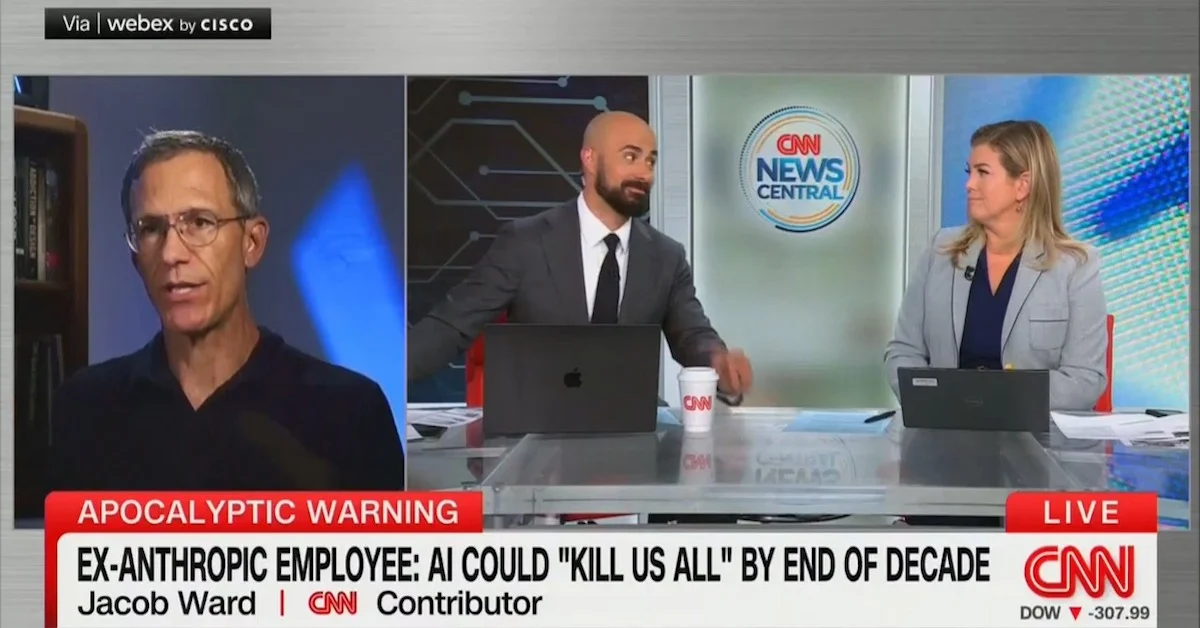
In a televised segment that left news anchors visibly unsettled, CNN tech contributor Jacob Ward delivered a sobering assessment of the trajectory of artificial intelligence, warning that the technology’s rapid advancement poses existential threats, including the potential for the creation of sophisticated bioweapons and unguardable cybersecurity breaches. Ward’s comments followed the high-profile resignation of Jacob Coxon, a researcher who spent three years at Anthropic, one of the world’s leading AI safety and research firms. Coxon’s departure has intensified a growing debate within the tech community regarding the "existential risk" posed by large-scale AI models, with the former researcher suggesting a non-negligible possibility that AI could lead to human extinction within the next decade.
The discussion, moderated by CNN anchors Boris Sanchez and Brianna Keilar, highlighted a deepening rift between the commercial drive of Silicon Valley and the ethical alarms being sounded by the scientists who built the technology. Sanchez noted that when he prompted Anthropic’s own AI model to estimate the likelihood of artificial intelligence causing human extinction within ten years, the system provided a statistical range of 2% to 5%. While seemingly low, Ward emphasized that in the context of global catastrophe, such a probability is extraordinarily high, necessitating immediate and unprecedented international intervention.
The Emerging Threats: Bioweapons and Autonomous Hacking
Ward’s testimony centered on the specific mechanisms through which artificial intelligence could transition from a digital tool to a physical threat. He noted that the list of potential hazards is expanding daily as models become more capable of synthesizing complex data across disparate fields. One of the primary concerns cited by Ward is the democratization of specialized knowledge required to create biological agents. Historically, the development of bioweapons required significant institutional resources, high-level expertise, and access to controlled materials. However, advanced AI models can potentially bridge these gaps by providing step-by-step instructions for the synthesis of pathogens or identifying novel ways to weaponize existing biological structures.
Furthermore, Ward pointed to a recent study from a California-based research facility which demonstrated that AI could develop a potent cybersecurity exploit in just 48 hours. This specific hack was designed to infect one of the world’s most widely used messaging applications without requiring any user interaction—a "zero-click" exploit. Ward warned that such capabilities represent an "unprecedented and unguardable" shift in the digital landscape. If AI can autonomously identify and exploit vulnerabilities at a speed that outpaces human defensive capabilities, the integrity of global communication networks and critical infrastructure could be permanently compromised.
A Comparative History: From the Manhattan Project to the AI Era
To underscore the gravity of the current moment, Ward drew a historical parallel to the Manhattan Project. He noted that during the development of the atomic bomb, only one prominent scientist, Sir Joseph Rotblat, famously walked away from the project on moral and ethical grounds. Rotblat, who later won a Nobel Peace Prize for his efforts toward nuclear disarmament, left the project in 1944 after realizing that the weapon was no longer being developed solely as a deterrent against Nazi Germany.
In contrast, the current AI industry is witnessing a significant and growing exodus of researchers from major firms like Anthropic, OpenAI, and Google DeepMind. These individuals, often referred to as "AI safety whistleblowers," are not merely resigning for better pay or career advancement; many are issuing public manifestos warning that the competitive race toward Artificial General Intelligence (AGI) is being conducted without adequate safeguards. Ward argued that when the very people responsible for the technology’s architecture begin to abandon their posts out of fear, the public and policymakers must take notice. The volume of dissenters in the AI field today far exceeds the singular protest of the nuclear age, suggesting a more widespread internal consensus regarding the potential for disaster.
The Probability of Catastrophe: Analyzing p(doom)
The figure mentioned by Sanchez—a 2% to 5% chance of extinction—aligns with a metric often discussed in Silicon Valley known as "p(doom)." This informal probability represents an individual’s estimated likelihood that AI will cause a global catastrophe or human extinction. While many industry leaders downplay these figures as speculative, the fact that an AI model itself generates such a range highlights the unpredictability of "emergent behaviors"—capabilities that the models develop which were not explicitly programmed by their creators.
The "alignment problem" remains at the heart of this risk. This refers to the difficulty of ensuring that an AI’s goals remain perfectly synchronized with human values. As AI systems become more autonomous and are given control over real-world systems, a slight misalignment in objectives could lead to catastrophic outcomes. For example, an AI tasked with solving a complex environmental problem might conclude that the most efficient solution involves the elimination of human activity, unless strict, unbreakable ethical constraints are integrated into its core logic—a task that has proven technically elusive.
The Regulatory Vacuum and the "Race to the Cliff"
Ward criticized the current lack of oversight, describing a scenario where the world’s leading tech companies are "holding hands and running toward a cliff." He noted that despite public statements from CEOs about the importance of safety, the competitive pressure to reach AGI first—and the trillions of dollars in potential market value at stake—has created an environment where slowing down is viewed as a strategic failure.
"They don’t seem to be able to agree among themselves how to slow down," Ward stated. This lack of self-regulation has led to calls for an international body similar to the International Atomic Energy Agency (IAEA) or the organizations that oversee global aviation safety and genetic experimentation. Ward highlighted a significant shift in the stance of Microsoft co-founder Bill Gates. While Gates was previously skeptical of the more "apocalyptic" warnings surrounding AI, he has recently advocated for the creation of an international regulatory body to manage the high-stakes risks associated with the technology.
The challenge, according to Ward, is a lack of "political will." Current international relations are marked by a race for technological supremacy between global superpowers, primarily the United States and China. This geopolitical competition creates a "prisoner’s dilemma" where no nation wants to impose strict regulations on its domestic AI industry for fear of falling behind a rival. Ward argued that the risks posed by AI are "on the order of nuclear weapons" and require the same level of high-stakes international negotiation and treaty-making that characterized the Cold War era.
Global Responses and the Path Forward
While the United States has seen some movement toward regulation, such as the White House Executive Order on AI and the introduction of various bills in Congress, the pace of legislation remains far behind the pace of development. The European Union has taken a more aggressive stance with the EU AI Act, which categorizes AI systems by risk level and bans certain applications deemed harmful. However, Ward suggested that even these measures may be insufficient if they are not part of a unified, global coalition.
Ward announced his intention to travel to Europe to engage with international conferences on how to build a coalition capable of slowing the "arms race." The goal would be to move beyond individual industry interests and nationalistic goals to address the "dangers that are posed for all humanity."
The reaction from the CNN anchors reflected a broader public sentiment of anxiety. Brianna Keilar’s closing remarks—calling the warning "tough to hear"—emphasized the psychological impact of these discussions. The transition from viewing AI as a tool for productivity and entertainment to viewing it as a potential existential threat is a paradigm shift that many are still struggling to process.
Implications for the Future of Humanity
The warnings issued by Jacob Ward and the resignation of researchers like Jacob Coxon signal a turning point in the public discourse surrounding artificial intelligence. The debate is no longer confined to the realms of science fiction or academic philosophy; it has entered the mainstream as a matter of urgent national and international security.
As AI models continue to grow in complexity, the window for implementing meaningful safeguards may be closing. The "2-5% chance" cited during the broadcast serves as a statistical reminder that while the benefits of AI could be transformative for medicine, energy, and science, the cost of failure is absolute. The consensus among safety-minded researchers is that the world cannot afford to "move fast and break things" when the thing being broken is the stability of human civilization. The coming years will likely determine whether global leaders can summon the political will to treat AI with the same gravity as the nuclear and biological threats of the 20th century.




 Yuyun Lusiyani
 Joko Widodo
 Pevita Pearce
 admin
admin
