
 Nana Wu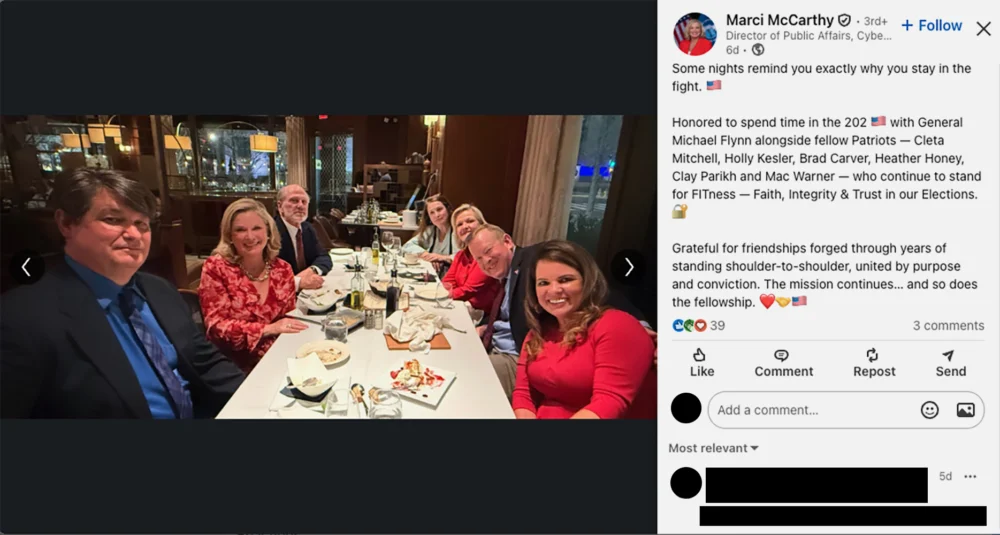
Several high-ranking federal election officials attended a summit last week at which prominent figures who worked to overturn Donald Trump’s loss in the 2020 election pressed the president to declare a national emergency to take over this year’s midterms. According to videos, photos, and social media posts reviewed by ProPublica, the meeting’s participants included Kurt Olsen, a White House lawyer charged with reinvestigating the 2020 election, and Heather Honey, the Department of Homeland Security official in charge of election integrity. The event was convened by Michael Flynn, Trump’s former national security adviser, and attended by Cleta Mitchell, who directs the Election Integrity Network, a group that has spread false claims about election fraud and noncitizen voting.
Summit Highlights Intensifying Push for Electoral Overhaul
Election experts assert that this gathering signifies an escalating effort to persuade former President Donald Trump to take unprecedented actions concerning the upcoming November elections. These efforts come as Trump’s previous attempts to reshape elections through executive orders have been largely thwarted by the courts. Concurrently, federal legislation aimed at mandating strict voter ID requirements nationwide has stalled in Congress.
The Washington Post reported on Thursday that activists associated with the summit attendees have been circulating a draft executive order. This draft reportedly proposes banning mail-in ballots and eliminating voting machines, as part of a broader federal takeover of election administration. Peter Ticktin, an attorney involved in drafting the executive order and who had a client present at the summit, told ProPublica that these actions are "all part of the same effort."
This summit follows a series of previously unreported meetings and discussions between administration officials and election activists, dating back to at least last fall, according to emails and recordings obtained by ProPublica. Experts on U.S. elections view the coordination between individuals within and outside the government as a critical erosion of established safeguards.
"The meeting shows that the same people who tried to overturn the 2020 election have only grown better organized and are now embedded in the machinery of government," stated Brendan Fischer, a director at the Campaign Legal Center, a nonpartisan pro-democracy organization. "This creates substantial risk that the administration is laying the groundwork to improperly reshape elections ahead of the midterms or even go against the will of the voters."
Five of the six federal officials who attended the summit declined to answer ProPublica’s questions regarding the event.
Official Responses and Denials
A White House official, speaking anonymously, indicated that the attendance of federal officials at the gathering should not be interpreted as support for a national emergency declaration. The official characterized it as "common practice" for staffers to engage with outside advocates who wish to share policy ideas. This official pointed to statements made by former President Trump to PBS News, where he denied considering a national emergency or reviewing the draft executive order. "Any speculation about policies the administration may or may not undertake is just that – speculation," the official added.
In the past, Trump has expressed an inclination towards a federal takeover of elections as a means to mitigate projected Republican losses in November. Earlier this month, in an interview with conservative podcaster Dan Bongino, he stated that Republicans need "to take over" elections and "to nationalize the voting."
Cleta Mitchell did not respond to ProPublica’s inquiries about the summit. A spokesperson for Michael Flynn responded to detailed questions by disparaging experts who voiced concerns, texting, "LOL ‘EXPERTS.’"
Chronology of Engagement and the Summit
The summit, described as a "30-person roundtable discussion," took place on February 19th at an office building in downtown Washington, D.C. It was sponsored by the Gold Institute for International Strategy, a conservative think tank. Photos reviewed by ProPublica indicated that activists and government officials subsequently dined together.
Michael Flynn, the Gold Institute’s chair, explained his rationale for organizing the event to a social media personality. "I wanted to bring this group together physically, because most of us have met online" while "fighting battles" in swing states from Arizona to Georgia, Flynn stated to Tommy Robinson on the sidelines of the gathering. Robinson subsequently posted videos of these interactions online. Flynn added, "The overall theme of this event was to make sure that all of us aren’t operating in our own little bubbles."
Flynn has consistently advocated for Trump to declare a national emergency. Following the event, he posted on social media addressing Trump: "We The People want fair elections and we know there is only one office in the land that can make that happen given the current political environment in the United States."
In addition to Kurt Olsen and Heather Honey, four other federal officials from agencies involved in election administration attended the event. At least four of these six individuals also participated in the subsequent dinner.
Among the attendees was Clay Parikh, a special government employee at the Office of the Director of National Intelligence who is assisting Olsen with the 2020 election inquiry. A spokesperson for ODNI stated that Parikh attended the summit "in his personal capacity."

Another attendee, Mac Warner, previously handled election litigation at the Department of Justice. A department spokesperson indicated that Warner had resigned the day after the event and had not obtained the required approval from agency ethics officials to participate. The spokesperson reiterated the department’s commitment to upholding the integrity of the electoral system and ensuring all elections remain free, fair, and transparent.
Marci McCarthy, who directs communications for the nation’s cyber defense agency responsible for the security of election infrastructure, was also present.
Kari Lake, whom Trump appointed as senior adviser to the U.S. Agency for Global Media, was a featured speaker. Lake had previously worked with Olsen and Parikh in her unsuccessful attempt to overturn her loss in the 2022 Arizona gubernatorial election. In an email, Lake stated she "showed up to the event, spoke for about 20 minutes about the overall importance of election integrity, a non-partisan issue that matters to all citizens – both in the United States and abroad. I left without listening to any other speeches." She further commented, "Elections should be free from fraud or any other malfeasance that subverts the will of the people."
Divergent Strategies Within the Movement
During the meeting, activists presented various strategies for transforming American elections to benefit conservatives, as indicated by social media posts and interviews given on conservative media platforms, such as LindellTV. The group reportedly divided into two factions: one advocating for a more incremental legal and legislative approach, and the other pushing for Trump to declare a national emergency.
Several activists reportedly left the meeting convinced that Trump should pursue the latter option, believing it would enable him to bypass the constitutional provision that directs states to manage elections.
Patrick Byrne, former CEO of Overstock.com and a significant funder of efforts to overturn the 2020 election results, told LindellTV that Trump has "played nice" thus far by not seizing control of American elections. Byrne suggested, "But at some point, he’s got to do something, the muscular thing: declare a national emergency." Byrne responded to ProPublica’s inquiries by sharing a poll he claimed indicated that "2/3 of Americans correctly do not trust" voting machines, which the proposed national emergency declaration seeks to eliminate.
Will Huff, an advocate for phasing out voting machines, told a conservative vlogger that Olsen and other administration representatives would convey the "consensus" from the gathering to Trump. "It’s got to be a national emergency," Huff stated. Huff, who serves as the campaign manager for a Republican candidate for Arkansas secretary of state, noted in an email responding to ProPublica that Olsen and Trump would exercise their judgment in deciding whether to declare a national emergency. "The President has been briefed on findings of shortcomings in election infrastructure," Huff wrote. "I believe there are steady hands around the President wanting to ensure that any action taken is, first, constitutional and legal, but also backed by evidence."
McCarthy, the cybersecurity official, expressed broader solidarity with fellow attendees in a social media post about the summit: "Grateful for friendships forged through years of standing shoulder-to-shoulder, united by purpose and conviction. The mission continues… and so does the fellowship."
Broader Context and Ethical Concerns
Last week’s gathering represents the latest in a series of private interactions between conservative election activists and administration officials, as revealed by emails, documents, and recordings obtained by ProPublica. Many of these interactions have involved Mitchell’s Election Integrity Network. ProPublica has previously reported that before assuming her government role, Honey was a leader in the Election Integrity Network, as was McCarthy.
Previously undisclosed emails obtained by ProPublica indicate that within weeks of Honey joining the Department of Homeland Security, she briefed election activists, a Republican secretary of state, and another federal official. This briefing occurred during a conference call arranged by her former boss, Mitchell. In an email introducing presenters on the call, Mitchell wrote, "We are excited to welcome her on our call this morning to hear about her work for election integrity inside DHS."
Honey did not respond to ProPublica’s questions about the call. Experts suggested that Honey’s briefing may have provided her former employer with privileged access, which could have violated ethics rules under previous administrations, including the first Trump administration.
Brendan Fischer of the Campaign Legal Center commented, "The prior ‘ethics guardrails would have prevented some of the revolving door issues we’re seeing between the election denial movement and the government officials." He added that those prior rules "were supposed to prevent former employers and clients from receiving privileged access."
The ongoing engagement between individuals associated with election denial movements and federal officials responsible for election integrity raises significant concerns about the potential for undue influence and the erosion of public trust in the electoral process. The lack of transparency surrounding these meetings and the continued promotion of unsubstantiated claims about election fraud by some participants further exacerbate these concerns. The long-term implications for the administration of elections and the democratic process remain a subject of intense scrutiny.


 Yuyun Lusiyani
 Joko Widodo
 Eva Lovia
 Jia Lissa
 Pevita Pearce
 admin
admin