
 Nana Wu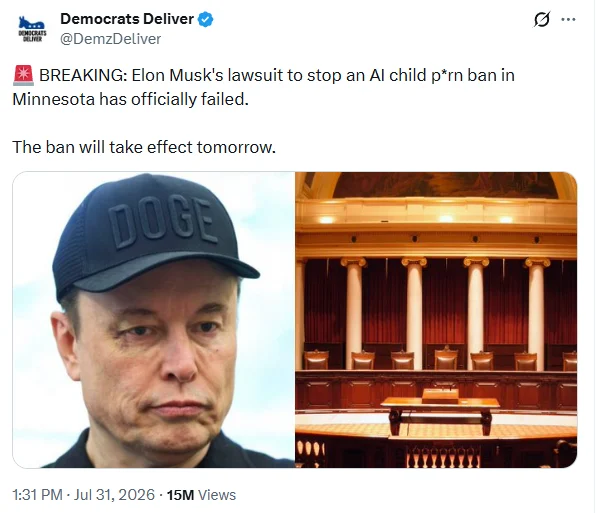
Elon Musk’s artificial intelligence company, xAI, has encountered an initial setback in its legal bid to block Minnesota’s recently enacted law targeting "nudify" applications. A federal judge denied xAI’s request for a temporary restraining order (TRO), citing the company’s delayed filing as a primary reason, rather than addressing the core First Amendment concerns raised by the lawsuit. This ruling, while not a final determination on the law’s constitutionality, highlights the procedural complexities and potential strategic missteps that could impact the broader legal challenge.
Background: The Minnesota Law and xAI’s Lawsuit
Minnesota’s legislative session saw the passage of a bill aimed at prohibiting the creation and distribution of non-consensual deepfake pornography, often referred to as "nudify" apps or technology. The law, signed by Governor Tim Walz, was set to take effect on August 1, 2026. However, the broad language of the legislation quickly drew criticism from civil liberties advocates and technology companies, including xAI, which operates the AI image generation tool Grok Imagine.
xAI’s lawsuit, filed on July 29, 2026, just days before the law’s effective date, argued that the Minnesota statute was unconstitutionally vague and overly broad. The company contended that the law, as written, could inadvertently criminalize legitimate uses of AI image manipulation technology, potentially chilling free speech and innovation. Specifically, xAI pointed to the law’s stringent liability provisions, which impose penalties of up to $500,000 per instance of "access, download, or use" of a prohibited application, without clear safe harbors for developers or users.
The TRO Denial: A Matter of Timing
The federal court’s decision to deny the temporary restraining order hinged on the timing of xAI’s legal action. Judge Donovan Frank, in his order, noted that xAI filed its motion for a TRO nearly three months after the law was signed and only three days before its scheduled implementation. "Such a delay in bringing the action and the motion suggests that harm is not immediate," the judge stated, implying that the company had ample time to seek injunctive relief earlier.

Minnesota Attorney General Keith Ellison’s office, representing the state, echoed this sentiment in its arguments against the TRO. They characterized xAI’s delay as a lack of diligence, suggesting that the company had not demonstrated an urgent need for immediate court intervention. This procedural argument effectively sidestepped the substantive constitutional questions xAI sought to raise at the TRO stage.
Examining the Law’s Constitutional Challenges
Despite the TRO denial, the underlying legal challenges to Minnesota’s law remain significant. Critics, including xAI, argue that the legislation fails to meet the strict scrutiny standard typically applied to laws that potentially infringe upon First Amendment rights. This legal test requires that any such law be narrowly tailored to serve a compelling government interest and be the least restrictive means of achieving that interest.
Concerns have been raised that the Minnesota law is not sufficiently narrowly tailored. It reportedly extends beyond prohibiting the creation and distribution of non-consensual deepfakes to potentially encompassing a wider range of image editing activities. This includes scenarios where individuals might alter images of themselves, or where the intent is not malicious or exploitative. The broad definition of prohibited "access, download, or use" coupled with the substantial financial penalties creates a significant risk of unintended consequences for technology providers and users alike.
Legal precedent offers a potential roadmap for crafting narrowly tailored legislation in this area. In a previous case, the Minnesota Supreme Court outlined specific requirements for a law addressing non-consensual intimate imagery to survive strict scrutiny. This ruling emphasized the need for precise definitions and a clear focus on harmful, non-consensual uses. Critics suggest that the current "nudify" app law failed to incorporate these crucial elements, leading to its broad and potentially unconstitutional scope.
xAI’s Stated Intentions and Observed Actions
In its legal filings, xAI had articulated a clear intention to restrict Grok Imagine’s image-editing features should the law go into effect without modification. The company stated, "Confronted with $500,000-per-image strict liability and no safe harbor, xAI has no practical choice but to restrict Grok Imagine’s image-editing features in various ways when the statute takes effect on August 1, 2026."

However, as of the law’s effective date and following the TRO denial, there has been no public announcement from xAI regarding any specific changes or restrictions implemented in Grok Imagine. This apparent lack of immediate action, despite the looming legal threat and the company’s own stated concerns, has led some to question the urgency or severity of the impact xAI perceives the law to have on its operations, or perhaps a strategic decision to await further legal proceedings. While it is possible that internal adjustments have been made and not yet publicized, the absence of a public statement adds another layer of complexity to the ongoing narrative.
The ACLU’s Evolving Stance
The legal debate surrounding the Minnesota law has also been marked by the evolving position of the American Civil Liberties Union of Minnesota (ACLU-MN). Initially, the organization had supported an earlier iteration of the legislation, recognizing the harm caused by non-consensual deepfake pornography. Their statement at the time indicated a desire to balance First Amendment rights with the need for remedial measures for victims, akin to defamation laws.
However, following the passage of the final version of the bill and xAI’s lawsuit, the ACLU-MN reversed its stance. The organization issued a statement explaining that the final version of the law "does not strike that balance." They articulated that while the creation of technology to alter images is protected by the First Amendment, the non-consensual creation and dissemination of such material is not. Their position now aligns more closely with xAI’s critique, emphasizing that the law’s broad scope fails to narrowly target the harmful conduct it aims to prevent. This shift underscores the complex legal and ethical considerations at play, where even civil liberties organizations struggle to find a universally accepted equilibrium.
Broader Implications and Political Ramifications
The legal battle over Minnesota’s "nudify" app ban is unfolding against a backdrop of increasing scrutiny over AI-generated content and its potential misuse. The involvement of a high-profile figure like Elon Musk, and the public nature of his company’s challenge, has amplified the discourse. This has, in turn, been leveraged for political messaging, particularly on social media platforms.
Reports suggest that some political factions have found amusement in the situation, using the legal proceedings as an opportunity to criticize and mock Musk. This political dimension, while not directly related to the legal merits of the case, highlights how such high-profile lawsuits can become entangled with broader political narratives and public perceptions.

However, the article’s author emphasizes that the core issue is not the motivation behind the law – which is ostensibly to combat harmful content – nor is it about stopping Musk from engaging in problematic behavior. Instead, the fundamental problem lies in the law’s flawed drafting. Its overbroad reach, lack of narrow tailoring, and apparent disregard for established constitutional principles make it legally vulnerable. The author posits that the legislature had a clear path to crafting a constitutionally sound law, as evidenced by prior judicial guidance, but chose a more expansive and perhaps politically expedient approach that has led to the current legal challenges.
The Path Forward: Preliminary Injunction and Constitutional Review
The denial of the TRO does not spell the end of xAI’s legal challenge. The court has mandated that both parties submit briefs on a preliminary injunction in the coming weeks, with a hearing scheduled for August 19, 2026. This hearing will provide a more substantive forum for xAI to present its arguments regarding the First Amendment implications of the Minnesota law. It will also likely require xAI to formally articulate, in its legal filings, the specific measures it has taken or plans to take to comply with the law, or to justify its current stance.
The outcome of the preliminary injunction hearing will be critical in determining whether the law will be temporarily halted pending a full trial on the merits. The court’s eventual ruling on the preliminary injunction, and any subsequent legal proceedings, will likely delve deeply into the constitutional validity of Minnesota’s approach to regulating AI-generated manipulated imagery. This case is poised to have significant implications for the future regulation of AI technologies and the delicate balance between protecting individuals from harm and safeguarding freedom of speech and expression in the digital age. The legislature’s ability to enact laws that are both effective and constitutional will be tested, and the public and the courts will be watching closely.



 Yuyun Lusiyani
 Joko Widodo
 Jia Lissa
 Pevita Pearce
 admin
admin
