
 Jia Lissa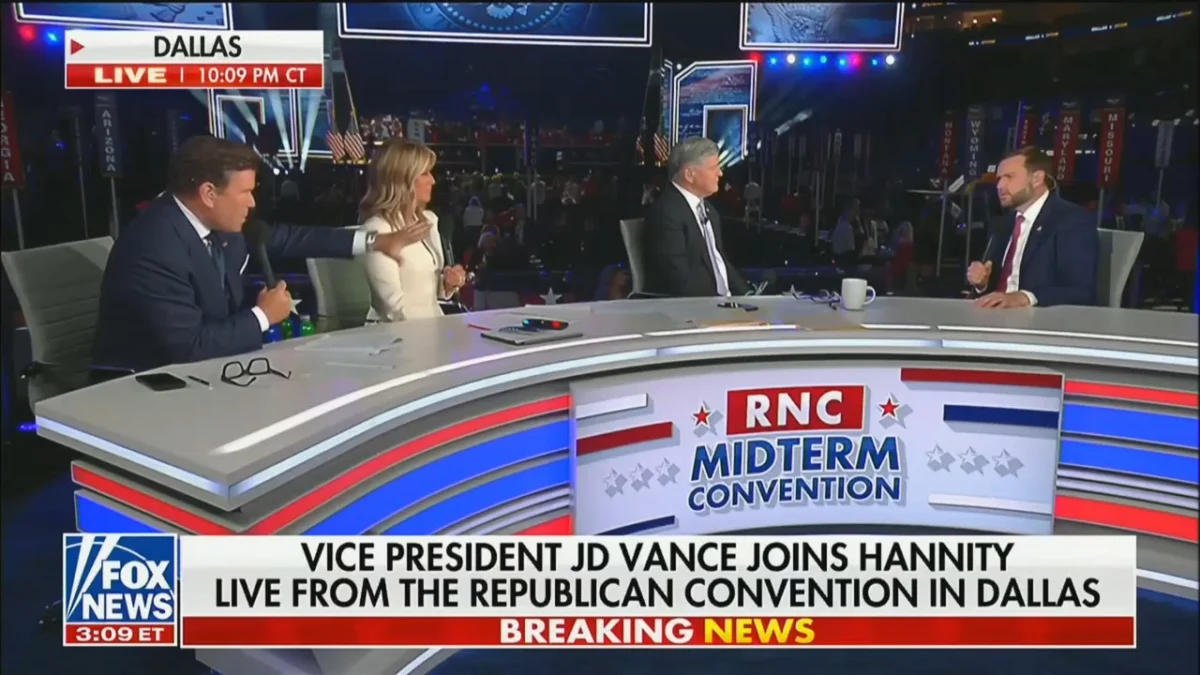
The political landscape of the upcoming midterm elections was fundamentally shifted on Wednesday evening when President Donald Trump, speaking at the GOP Midterm Convention in Texas, announced a sweeping proposal to issue a $5,000 "dividend" to American citizens contingent upon a Republican victory. The announcement, which immediately drew parallels to historical populist appeals and modern stimulus measures, became the central focus of a high-stakes exchange between Fox News chief political anchor Bret Baier and Vice President JD Vance. During the interview, Baier pressed the Vice President on the fiscal feasibility of the plan, its potential to reignite inflationary pressures, and the legal and ethical optics of promising direct cash payments in exchange for electoral success.
The proposal, unveiled before a raucous crowd of supporters, positions the $5,000 payout as a "national dividend" derived from what the administration describes as "unprecedented revenue" generated by aggressive trade tariffs and a revitalized domestic manufacturing sector. However, the timing of the promise—linked specifically to the outcome of the November elections—has invited intense scrutiny from legal experts, economists, and political rivals alike. Bret Baier’s questioning of Vice President Vance served as one of the first major media challenges to the administration’s new platform, highlighting a growing tension between the executive branch and segments of the news media over fiscal responsibility and the boundaries of campaign rhetoric.
The Proposal and the Immediate Political Fallout
President Trump’s speech in Texas was intended to galvanize the Republican base ahead of a midterm cycle that will determine the balance of power in both the House of Representatives and the Senate. By framing the $5,000 check as a "dividend," the President sought to distinguish the payout from traditional government "handouts," instead characterizing it as a share of the nation’s economic success under his leadership. "This is your money," the President told the audience. "We’ve taken it back from the foreign interests that have been looting our country for decades, and if you give us the mandate to keep going, we’re going to put that money right back into the pockets of the American worker."
The immediate reaction from the Democratic National Committee and various non-partisan watchdog groups was one of condemnation. Critics argue that the proposal borders on a violation of federal laws prohibiting the exchange of value for votes. While the administration argues that the dividend is a policy platform rather than a direct bribe, the explicit "if-then" nature of the promise—if Republicans win, then checks are sent—has created a firestorm of debate regarding the ethics of modern electioneering.
Bret Baier’s Interrogation of Vice President JD Vance
Following the President’s address, Vice President JD Vance appeared on Fox News to defend the administration’s vision. Bret Baier, known for his "Special Report" brand of rigorous questioning, did not shy away from the most pointed criticisms of the plan. Baier specifically addressed the cost of the program, which analysts estimate could exceed $1.3 trillion depending on the eligibility criteria.
"I can hear the critics’ heads exploding," Baier told Vance during the interview. "They’re saying out loud, I guarantee you, ‘the president is bribing voters to vote for Republicans to take over the House, and then he’s bankrupting the country because the deficit and debt is huge and inflation would come back if this comes into play.’ So how do you answer those criticisms?"
Vance, a key architect of the administration’s populist economic shift, rejected the characterization of the proposal as a bribe or a fiscal hazard. He argued that the funds would be sourced from the "extraordinary amount of revenue" being generated by the administration’s trade policies. "What the president’s talking about is fundamentally a dividend for American workers," Vance replied. He further asserted that the United States is finally standing up to foreign companies and countries that have historically "taken advantage of America’s workers."
The Vice President’s defense centered on the idea of economic sovereignty. He suggested that the $5,000 dividend is a mechanism to ensure that the benefits of protectionist trade policies are felt directly by the citizenry rather than being absorbed into the federal bureaucracy or used solely for debt service. "I don’t think it’s a controversial idea," Vance added, maintaining that sharing the nation’s wealth with its people is a logical extension of the "America First" agenda.
Economic Data and the $1.3 Trillion Question
The fiscal implications of a $5,000 per-person or per-household payout are staggering. If the dividend were applied to every American adult, the cost would far exceed the $1.3 trillion figure cited during the Baier-Vance exchange. For context, the total federal budget for the 2024 fiscal year is approximately $6.75 trillion, with a deficit already hovering near $1.6 trillion.
Economists have raised three primary concerns regarding the proposal:
- Revenue Reality vs. Projection: While the administration claims that tariffs are generating record revenue, historical data suggests that tariff income rarely covers the cost of large-scale social or economic programs. In the 2023 fiscal year, customs duties (tariffs) accounted for roughly $80 billion in federal revenue. To fund a $1.3 trillion program solely through tariffs, the administration would need to increase trade levies by more than 1,500%, a move that many experts warn would lead to a global trade war and significantly higher prices for American consumers.
- Inflationary Pressures: The U.S. economy has only recently begun to stabilize following the post-pandemic inflationary spike. Direct cash injections of this magnitude are traditionally seen as "demand-side" stimulants that can drive up the cost of goods and services if they are not matched by a corresponding increase in supply. Critics argue that a $1.3 trillion liquidity event would undo the Federal Reserve’s efforts to maintain price stability.
- National Debt Escalation: With the national debt currently exceeding $35 trillion, fiscal hawks within both parties have expressed alarm at any proposal that adds significantly to the deficit without a clear, verified funding source. The non-partisan Committee for a Responsible Federal Budget (CRFB) has noted that even with increased tariff revenue, the net cost of such a program would likely require massive new borrowing.
Legal Context and the Definition of Voter Bribery
The legal debate surrounding the "Midterm Dividend" centers on Title 18, Section 597 of the U.S. Code, which makes it a crime to make or offer to make an expenditure to any person, either to vote or withhold his vote, or to vote for or against any candidate. Legal scholars are divided on whether a broad policy proposal—even one involving direct cash—qualifies as a "bribe" in the same way a localized "cash-for-votes" scheme would.
Historically, political parties have promised "tax cuts" or "increased benefits" as part of their platforms. The Trump administration’s defenders argue that the $5,000 dividend is no different from a promised tax credit or a Social Security increase. However, the specificity of the amount and the direct link to the midterm election results create a unique legal gray area. Critics argue that by framing the payment as a "dividend" for a specific electoral outcome, the administration is pushing the boundaries of traditional policy-making into the realm of illicit inducement.
A Timeline of the Baier-Trump Relationship
The tension between Bret Baier and the executive branch is not an isolated incident. The interview with Vance comes just two weeks after a public spat between Baier and President Trump. The friction began when Fox News chief correspondent Jonathan Hunt reported on developments regarding Iran that were perceived as unfavorable by the White House.
President Trump subsequently attacked Hunt’s reporting and demanded that Baier "straighten out his flunkies" at the network. Baier, in a rare move of public pushback, defended his colleague and the integrity of the network’s reporting. This backdrop of professional friction added a layer of complexity to the interview with Vice President Vance, as Baier sought to maintain his reputation for objective journalism while navigating the highly polarized atmosphere of the midterm cycle.
Broader Implications for the GOP and the 2026 Midterms
The $5,000 dividend proposal represents a significant evolution in Republican economic strategy. For decades, the GOP was defined by "supply-side" economics, focusing on corporate tax cuts and deregulation to spur growth. Under the Trump-Vance ticket, the party has leaned more heavily into "nationalist-populism," prioritizing direct benefits to the working class and using government leverage to reshape trade.
This shift has created a rift within the party. Traditional fiscal conservatives, often referred to as "deficit hawks," find themselves in a difficult position: supporting a president who remains immensely popular with the base while opposing the massive spending his new policies require. Conversely, the populist wing of the party views the dividend as a necessary tool to combat the "cost of living crisis" and to demonstrate that the government can work for the average citizen rather than just the elite.
As the midterm elections approach, the "Midterm Dividend" is likely to remain the most controversial and discussed element of the Republican platform. Whether the proposal is a masterstroke of political branding or a fiscal and legal liability remains to be seen. What is certain is that the exchange between Bret Baier and JD Vance has set the stage for a national debate over the price of a vote and the future of the American economy.
The administration’s ability to sell this plan to a skeptical press and a weary electorate will be a defining factor in the months to come. If the proposal gains traction, it could redefine the relationship between the American taxpayer and the federal government. If it falters under the weight of fiscal reality and legal challenges, it may serve as a cautionary tale of the limits of populist rhetoric in a complex global economy. For now, the $5,000 promise remains a high-stakes gamble in one of the most consequential election cycles in recent history.




 Yuyun Lusiyani
 Joko Widodo
 Pevita Pearce
 admin
admin
