
 Jia Lissa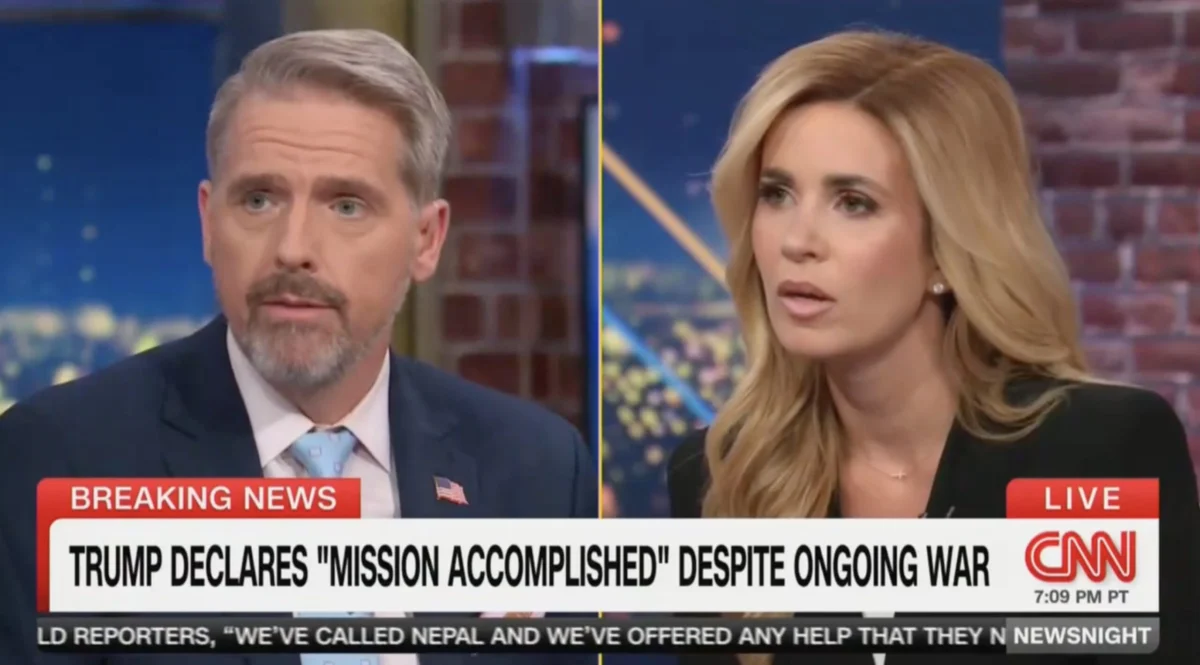
The ideological divide within the Republican Party regarding foreign policy and administrative appointments reached a public flashpoint on Thursday evening during a heated segment on CNN’s NewsNight. Caroline Sunshine, a prominent former campaign official for President Donald Trump, engaged in a sharp verbal altercation with conservative commentator Scott Jennings, explicitly stating her opposition to Jennings holding a position within the Trump administration. The confrontation, centered on the ongoing military and diplomatic conflict with Iran, highlighted a growing rift between the "America First" wing of the party and those associated with the neoconservative era of the early 2000s.
The exchange occurred during a panel discussion moderated by Abby Phillip, which focused on President Trump’s recent declaration of victory in the Iranian theater. Sunshine, who has become a vocal surrogate for the Trump movement, dismissed Jennings’ foreign policy perspectives as remnants of a failed era, citing his previous service under the administration of George W. Bush. The intensity of the debate underscored not only the friction over Middle Eastern strategy but also the high-stakes competition for key roles in the second Trump administration following the departure of White House Press Secretary Karoline Leavitt.
The Context of the "Mission Accomplished" Declaration
The catalyst for the televised spat was a Wednesday post on Truth Social by President Donald Trump, in which he declared "mission accomplished" regarding United States military objectives in Iran. The President’s assertion suggested a definitive conclusion to hostilities, a claim that has met with both praise from his base and skepticism from military analysts and political opponents.
Scott Jennings, appearing on CNN to defend the administration’s record, echoed sentiments he had previously expressed on his Salem Media program. Jennings argued that the United States had effectively "won the war against Iran," claiming that the Iranian military infrastructure had been decimated to the point of irrelevance. He suggested that the strategic objectives of the United States had been met with such precision that the conflict could be viewed as a closed chapter.
However, host Abby Phillip introduced a layer of factual scrutiny to the discussion, noting that Jennings’ claims regarding American control over the Strait of Hormuz—a critical chokepoint for global oil supplies—did not align with recent data. Citing reporting from the Wall Street Journal and independent oil-flow trackers, Phillip pointed out that the movement of energy resources through the waterway remained contested or obscured, contradicting the narrative of a total and orderly American victory.
The Ideological Clash: America First vs. Neoconservatism
When Phillip turned to Caroline Sunshine to ask if Trump should continue to tout a "complete finished war" as a political strategy, Sunshine pivoted the conversation toward a broader critique of Republican foreign policy history. Sunshine praised Trump’s "mission accomplished" rhetoric, framing it as a necessary precursor to a full military withdrawal.
"History doesn’t judge American presidents and their success in the Middle East by how long they stay. It judges them by how little they stay there," Sunshine remarked. This statement aligns with the isolationist and non-interventionist leanings of the current MAGA movement, which views long-term foreign entanglements as a drain on national resources and a deviation from domestic priorities.
The confrontation turned personal when Sunshine directly addressed Jennings’ professional history. Jennings served as a special assistant to President George W. Bush and was a key operative in both of Bush’s presidential campaigns. Sunshine used this background to disqualify Jennings’ current advice, drawing a sharp distinction between the elder George H.W. Bush—whom she characterized as more successful for his limited objectives in the Gulf War—and the younger George W. Bush, whose administration oversaw the prolonged and controversial Iraq War.
"I don’t want you going anywhere near Donald Trump’s presidency to go ruin it with more of your Iraq 2005 talking points," Sunshine told Jennings. The mention of 2005 was particularly pointed, as that year represented a period of significant insurgency and declining public support for the American occupation of Iraq.
The Battle for the White House Press Briefing Room
The timing of this public disagreement is significant due to the current vacancy in the White House communications office. Karoline Leavitt, who served as the White House Press Secretary, departed the administration earlier this week, leaving one of the most visible roles in the executive branch open.
Reports have circulated that Scott Jennings is actively seeking to succeed Leavitt. His frequent appearances on CNN as a pro-Trump voice have been interpreted by some as a public audition for the role. Sunshine’s aggressive dismissal of Jennings on national television suggests a concerted effort by some within the Trump inner circle to block his appointment. By framing Jennings as a "Bush-era" figure, Sunshine tapped into the deep-seated resentment many Trump supporters feel toward the pre-2016 Republican establishment.
The reaction from other panel members highlighted the awkwardness of the exchange. CNN commentator Bakari Sellers was heard laughing in the background as Sunshine delivered her critique, reflecting the unusual nature of seeing two prominent Republican figures engage in such a visceral public disagreement over the party’s direction.
Analyzing the Military and Economic Data
Beyond the political theater, the debate touches on significant geopolitical realities. The claim of a "won war" in Iran is complicated by the logistical realities of the region. The Strait of Hormuz remains a primary concern for global markets; approximately 20% of the world’s total oil consumption passes through this narrow passage daily.
While the Trump administration has asserted that its "maximum pressure" campaign and subsequent military actions have neutralized the Iranian threat, energy analysts remain cautious. If oil-flow data continues to show irregularities or if the Iranian Revolutionary Guard Corps (IRGC) maintains a covert presence capable of disrupting shipping, the "mission accomplished" narrative may face challenges from both domestic critics and international allies.
Jennings attempted to defend the necessity of a continued presence, suggesting that the U.S. would likely need to maintain "assets in the region for monitoring," specifically mentioning CIA surveillance of potential nuclear sites. Sunshine’s response was immediate and dismissive: "Why? The president said we won." She further criticized Jennings’ demeanor, accusing him of failing to "look her in the eye" during the exchange, a move that emphasized the personal nature of the disagreement.
Chronology of the Republican Foreign Policy Shift
To understand the weight of the Sunshine-Jennings spat, one must look at the timeline of the GOP’s evolving stance on Middle Eastern intervention:
- 1991 (The Gulf War): George H.W. Bush leads a coalition to expel Iraq from Kuwait but stops short of removing Saddam Hussein, a move Sunshine cited as a model of success.
- 2003–2011 (The Iraq War): George W. Bush initiates a "regime change" policy. Scott Jennings serves in the administration during the height of this conflict.
- 2016 (The Trump Realignment): Donald Trump wins the presidency after campaigning heavily against the Iraq War, famously calling it a "big, fat mistake" during the primary debates.
- 2024–2025 (The Iran Conflict): The Trump administration engages in direct military action against Iranian interests, culminating in the recent "mission accomplished" declaration.
- Present Day: The internal struggle manifests as a debate over whether "victory" means a total exit (Sunshine’s view) or a managed, long-term regional dominance (the view attributed to Jennings).
Broader Implications for the Trump Administration
The conflict between Sunshine and Jennings is emblematic of the broader struggle for the "soul" of the Republican Party’s second term under Trump. There is a clear tension between the "old guard," who believe in maintaining American global hegemony through traditional military and diplomatic structures, and the "new guard," who prioritize "America First" principles and are deeply skeptical of any individual associated with previous Republican administrations.
Sunshine’s rhetoric suggests that for the MAGA movement, the policy is as much about the personnel as it is about the principles. By labeling Jennings’ views as "Iraq 2005 talking points," she effectively weaponized one of the most unpopular periods of modern Republican history against a potential appointee.
Furthermore, the public nature of this dispute on a network like CNN indicates that these internal battles are no longer being confined to private meetings at Mar-a-Lago or the West Wing. They are being litigated in the media, with surrogates using televised segments to signal to the President who is "loyal" to his vision and who is a "remnant" of the past.
Conclusion and Future Outlook
As the Trump administration moves to fill the Press Secretary role and solidify its strategy in the Middle East, the fallout from this exchange is likely to persist. Scott Jennings remains a prominent voice in conservative media, but the public "veto" issued by a former campaign official like Caroline Sunshine may complicate his path to a formal White House role.
For the American public and international observers, the debate provides a window into the likely trajectory of U.S. foreign policy. If Sunshine’s perspective prevails, the administration will likely lean toward a rapid drawdown of forces in the Middle East, regardless of the complexities on the ground or the advice of veteran strategists. If the "monitoring" approach suggested by Jennings holds weight, the U.S. may find itself in a familiar position of long-term regional oversight, despite the "mission accomplished" declarations.
Ultimately, the Thursday night spat was more than just a moment of "must-see TV"; it was a substantive manifestation of a party in the midst of a profound transformation, struggling to reconcile its past actions with its current populist identity. Whether the "mission" in Iran is truly accomplished remains a matter of military and economic debate, but the war for control within the Republican Party is clearly far from over.


 Yuyun Lusiyani
 Joko Widodo
 Pevita Pearce
 admin
admin
