Pevita Pearce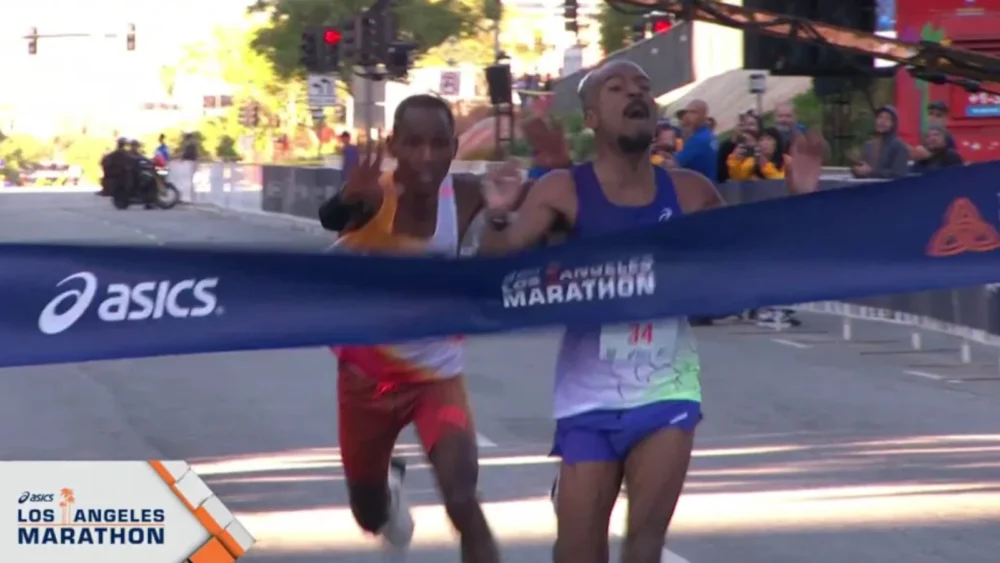
The Los Angeles Marathon, a cornerstone of the international distance running calendar, introduced a significant and controversial policy shift during its most recent iteration, allowing participants to receive finisher medals without completing the traditional 26.2-mile course. This decision, prompted by forecasted extreme temperatures, marks a departure from the rigid distance requirements that have defined the marathon since its standardization in the early 20th century. While the elite field saw a historic photo finish by American runner Nathan Martin, the broader narrative of the weekend was defined by organizational pivots toward runner safety and a series of remarkable performances across the global running community, ranging from world records in Lisbon to age-defying sprints in Albuquerque.
Adaptive Safety Protocols Amid Rising Temperatures
The organizers of the Los Angeles Marathon took the rare step of modifying the criteria for earning a finisher medal, citing a duty of care toward the thousands of amateur runners participating in the event. According to official communications released via the event’s digital rulebook and corroborated by Fox reporter Matthew Seedorff, runners were granted the option to exit the course at the 18-mile mark while still receiving their commemorative finisher and challenge medals. The official statement from the marathon’s website emphasized that this was a "one-off" decision necessitated by environmental conditions, stating that there is "no shame in making a smart decision for your body."
The decision was primarily driven by a rigorous weather forecast that predicted a sharp increase in temperatures throughout the race window. At the start of the event, temperatures were recorded in the mid-50s Fahrenheit, providing ideal conditions for the initial stages of the race. However, as the morning progressed, the mercury was projected to climb into the upper 70s and low 80s by the afternoon. For distance runners, such temperatures significantly increase the risk of heat-related illnesses, including hyperthermia, heat exhaustion, and exertional heatstroke. By offering a "short-course" finish at mile 18, organizers aimed to reduce the physical strain on less experienced participants who might otherwise push themselves beyond safe physiological limits to earn their medals.
Chronology of the 2026 Los Angeles Marathon Elite Race
While the amateur field navigated the heat with the new safety options, the elite race provided one of the most dramatic finishes in the history of the Los Angeles event. The men’s race was largely dominated by Michael Kamau, who maintained a commanding lead for the majority of the course. As the leaders approached the final two miles, Kamau appeared to have secured the victory, holding a lead of approximately 60 seconds over his nearest rival, American distance runner Nathan Martin, with only 1.4 miles remaining.
However, the final stretch saw a remarkable tactical shift. Martin, sensing a dip in Kamau’s pace, initiated a sustained "kick" to close the gap. With roughly 800 meters to go, Martin pulled within sight of the lead vehicle and Kamau. In a post-race interview, Martin reflected on his mindset during the closing moments, noting that he only began to believe a victory was possible in the final mile. He described the effort as a calculated risk, stating, "All right, I have to go for it, I have to at least try."
The resulting photo finish saw Martin overtake Kamau in the dying moments of the race, securing a victory that underscored the importance of endurance and psychological resilience in high-heat conditions. Martin’s win is being hailed as a significant achievement for American distance running, particularly given the caliber of the international field and the challenging environmental factors present throughout the day.
Supporting Data: The Impact of Heat on Marathon Performance
The organizational decision to offer medals at the 18-mile mark is supported by extensive sports science data regarding the impact of the Wet Bulb Globe Temperature (WBGT) on athletic performance. Research indicates that for every 10-degree Fahrenheit increase in temperature above 59 degrees, marathon finishing times for average runners can slow by as much as one to four minutes. More importantly, the incidence of medical emergencies rises exponentially when temperatures exceed 75 degrees Fahrenheit.
By mile 18, runners have typically depleted their glycogen stores and are entering a phase of the race often referred to as "the wall." In high-heat environments, the body’s ability to dissipate heat through sweat becomes less efficient as dehydration sets in, leading to an increased heart rate and decreased oxygen delivery to the muscles. The Los Angeles Marathon’s decision to provide a dignified "off-ramp" at this critical juncture likely averted a significant number of medical interventions, allowing the city’s emergency services to remain focused on the most critical cases.
Global Context: World Records and Senior Achievements
The weekend’s athletic narrative extended far beyond the streets of Southern California. In Portugal, the Lisbon Half Marathon witnessed a historic performance by Jacob Kiplimo. The Ugandan runner regained the world record for the 21.1-kilometer distance, clocking a staggering time of 57 minutes and 20 seconds. This performance required Kiplimo to maintain a pace of approximately 4 minutes and 22 seconds per mile, a feat that further cements his status as one of the greatest distance runners of the modern era.
Simultaneously, the USATF Masters community celebrated a feat of longevity in Albuquerque, New Mexico. Kenton Brown, aged 81, competed in the 200-meter sprint, finishing with a time of 29.70 seconds. While this time narrowly missed the world record for the men’s 80-plus category—currently held by Robert Lida at 29.15 seconds—it highlighted the extraordinary capabilities of senior athletes. Brown already holds the world record for the 100-meter sprint in his age bracket with a time of 14.21 seconds, illustrating a level of fast-twitch muscle retention that continues to intrigue sports physiologists.
Official Responses and Public Reaction
The Los Angeles Marathon’s decision to award medals for a partial finish has sparked a debate within the running community regarding the sanctity of the marathon distance. Traditionalists argue that the 26.2-mile requirement is the fundamental definition of the sport and that "finisher" medals should be reserved exclusively for those who complete the full course. Critics suggest that such moves could lead to the "participation trophy" stigmatization of endurance sports.
Conversely, public health officials and many participants have lauded the move as a progressive step in race management. Supporters argue that as global temperatures continue to rise, race organizers must prioritize participant safety over tradition. The social media response was largely positive, with many runners expressing relief that they could prioritize their health without the perceived "shame" of a Did Not Finish (DNF) result on their record.
Analysis of Implications for Future Race Management
The events of this weekend suggest a potential shift in how major marathons approach environmental challenges. The "Mile 18" policy may serve as a blueprint for other World Marathon Majors and large-scale city races facing similar heatwaves. Future implications include:
- Tiered Medal Systems: Organizers may consider formalizing tiered recognition, where different medals are awarded for different distances completed under extreme conditions.
- Enhanced Deferral Policies: Increased frequency of extreme weather may force marathons to offer more flexible deferral options or virtual race alternatives.
- Medical Resource Allocation: By encouraging at-risk runners to exit early, race directors can more effectively manage medical staff and supplies at the finish line and along the latter stages of the course.
The 2026 Los Angeles Marathon will likely be remembered as a turning point in the balance between athletic tradition and modern safety standards. While Nathan Martin’s victory provided the competitive highlight of the weekend, the organizational courage to redefine the "finisher" for a single day reflects a growing recognition of the physical limits of the human body in a changing climate. As distance running continues to grow in popularity, the integration of data-driven safety protocols and elite performance will remain the dual pillars of successful event hosting.




 Jia Lissa
 Yuyun Lusiyani
 Joko Widodo
 Eva Lovia