
 Jia Lissa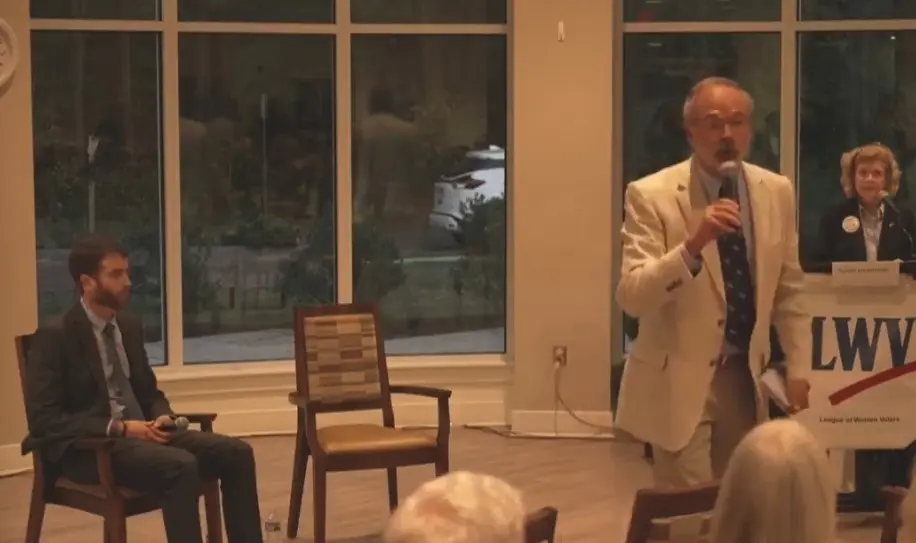
The political atmosphere in Maryland’s First Congressional District reached a boiling point on Tuesday night as incumbent Representative Andy Harris (R-MD) engaged in a sharp verbal confrontation with attendees during a scheduled debate. The event, which took place in Cambridge, Maryland, was intended to provide a platform for Harris and his Democratic challenger, Dan Schwartz, to discuss policy issues ahead of the 2026 midterm elections. However, the evening was overshadowed by a series of interruptions and a visible display of frustration from the long-serving congressman, who at one point labeled members of the audience as "rude" and accused them of violating the spirit of the First Amendment.
The debate was organized and hosted by the League of Women Voters, a nonpartisan organization known for its commitment to civil discourse and voter education. As the only Republican in Maryland’s eight-member congressional delegation, Harris has long been a lightning rod for political debate in the state, representing a district that encompasses the conservative-leaning Eastern Shore as well as portions of Harford and Carroll counties. The tension on Tuesday night reflected the broader national polarization, manifesting in a direct clash between a federal lawmaker and his constituents.
The Catalyst: Global Energy Policy and Diesel Prices
The primary flashpoint of the evening occurred during a discussion regarding energy costs and international relations. The moderator steered the conversation toward the current administration’s handling of global fuel markets, specifically addressing the controversial decision by President Donald Trump to purchase diesel from Russia. This policy shift comes amidst a period of heightened geopolitical instability, characterized by an ongoing conflict with Iran that has significantly disrupted global supply chains and sent fuel prices soaring across the United States.
Representative Harris attempted to frame the rising costs of diesel as a direct consequence of domestic policy choices made by his political opponents. "The facts are that diesel prices have gone up," Harris stated, addressing the crowd. "There’s no question about it. Why has it gone up? Because the Democrats and environmental regulations have not—"
Harris was unable to finish his sentence as a wave of laughter and jeers erupted from a section of the audience. The reaction appeared to be a response to his attribution of global price hikes to domestic environmental regulations, a point of contention for many critics who argue that international market forces and geopolitical conflicts are the primary drivers of the current energy crisis.
Escalation and the "Rude" Accusation
Visibly irritated by the interruption, Harris paused his response to address a specific audience member. "Ma’am, I gotta tell you," he began, though he was quickly drowned out by further shouting from the gallery. The congressman then doubled down on his critique of the audience’s behavior, framing the interruptions as a fundamental misunderstanding of free speech.
"This is the problem," Harris continued. "You all say you believe there’s a First Amendment, but only if you agree with you [sic]. You should let me finish the sentence, Ma’am. You are rude!"
The confrontation did not end there. As the moderator attempted to regain control of the room, a longer video of the exchange captured Harris pleading his case to the stage officials. "I’m sorry. I gotta do it. If you’re not gonna tell them I’m rude [sic], I’m gonna tell them you’re rude [sic]," he said, seemingly stumbling over his words in the heat of the moment. His remarks prompted a retort from a man in the crowd who shouted back, "You’re rude!"
The exchange spiraled as Harris attempted to return to his explanation of the global diesel shortage. When met with continued pushback, he pointed to another member of the audience, declaring, "You’re rude, too!" The constituent responded by claiming that the congressman had "started it." The moderator eventually intervened with a firm "Stop!" and requested that both candidates ask their respective supporters to maintain decorum and refrain from further interruptions.
Contextualizing the First District Race
The 2026 race for Maryland’s First Congressional District is being closely watched as a bellwether for Republican strength in a predominantly Democratic state. Andy Harris, an anesthesiologist by profession and a member of the House Freedom Caucus, has held the seat since 2011. He has consistently run on a platform of fiscal conservatism, limited government, and a staunch defense of the Second Amendment. His dominance in the district has rarely been challenged, but the changing demographic landscape and the volatility of the current political climate have emboldened Democratic efforts.

Dan Schwartz, the Democratic nominee, has centered his campaign on economic stability and infrastructure, often criticizing Harris for his alignment with the more populist wings of the Republican Party. During the debate, Schwartz sought to position himself as a pragmatic alternative, focusing on local issues such as the health of the Chesapeake Bay and the economic needs of rural farming communities on the Eastern Shore.
While the First District remains a Republican stronghold, recent polling suggests a competitive, though still uphill, battle for the Democrats. A survey conducted in July 2026 showed Harris maintaining a 13-point lead over Schwartz. However, political analysts note that such a margin is narrower than some of Harris’s previous victories, suggesting that his challenger has made inroads with moderate voters or that the incumbent’s recent controversies have had a cooling effect on his support base.
Energy Markets and the Geopolitical Backdrop
The specific policy issue that sparked the debate confrontation—diesel prices and Russian imports—is a complex one. The 2026 geopolitical landscape has been defined by the Trump administration’s aggressive stance toward Iran, which has led to a series of naval skirmishes and the disruption of oil tankers in the Strait of Hormuz. These events have created a "risk premium" on global oil prices.
To mitigate the impact on American consumers, the administration authorized the purchase of diesel from Russia, a move that drew sharp criticism from both sides of the aisle. Critics argue that relying on Russian energy undermines U.S. national security and contradicts previous sanctions regimes. Representative Harris, however, has consistently defended the administration’s "energy independence" goals, even when those goals involve controversial international trade deals.
The disagreement in the debate hall reflects a broader national divide over energy transition. While Harris blames "environmental regulations" for stifling domestic production and refining capacity, his opponents point to the record profits of oil companies and the inherent volatility of fossil fuel markets as the true culprits behind high prices at the pump.
The Role of Civility in Modern Political Debates
The incident in Cambridge highlights a growing trend of "town hall-style" friction where the boundaries between elected officials and the public are increasingly strained. The League of Women Voters, which prides itself on maintaining a "neutral zone" for political discourse, expressed disappointment following the event. In a post-debate statement, local representatives of the League emphasized that "the purpose of these forums is to allow voters to hear the candidates’ positions clearly, which is impossible when the environment becomes adversarial."
Constitutional scholars have also noted the irony of Harris’s invocation of the First Amendment. While the First Amendment protects citizens from government overreach regarding speech, it does not mandate that a private audience remain silent during a public forum. Conversely, the right of a speaker to be heard without disruption is often a matter of debate rules rather than constitutional law. Harris’s decision to engage directly and aggressively with hecklers is a tactic that has become more common in the era of viral social media clips, where "standing one’s ground" is often viewed favorably by a candidate’s base.
Implications for the Final Weeks of the Campaign
As the November election approaches, the fallout from the Cambridge debate remains to be seen. For Harris’s supporters, his willingness to call out what he perceived as "rudeness" and "liberal bias" in the audience may be seen as a sign of strength and conviction. For his critics, the outburst serves as evidence of a temperament ill-suited for public office and a disconnect from the concerns of his constituents.
The American Bridge 21st Century, a Democratic-aligned research and media organization, was quick to circulate a clip of the exchange, framing it as a "crash out" by the congressman. The video has since gained significant traction on social media, potentially serving as a fundraising tool for Schwartz in the final stretch of the campaign.
Historically, Maryland’s First District has prioritized candidates who focus on the agricultural and maritime economies of the Eastern Shore. Whether the controversy surrounding global energy policy and debate-stage decorum will shift the needle for undecided voters in counties like Wicomico, Dorchester, and Talbot is a question that will only be answered at the ballot box.
For now, the race continues with both candidates doubling down on their respective messages. Representative Harris remains the favorite to win a ninth term, but the events of Tuesday night serve as a stark reminder that even in "safe" seats, the political temperature remains at an all-time high. The League of Women Voters has indicated it will continue to host forums but may implement stricter audience guidelines to ensure that the remaining debates of the 2026 cycle proceed without similar interruptions.

 Yuyun Lusiyani
 Ana Megawati
 Joko Widodo
 Eva Lovia
 Pevita Pearce