
 Joko Widodo
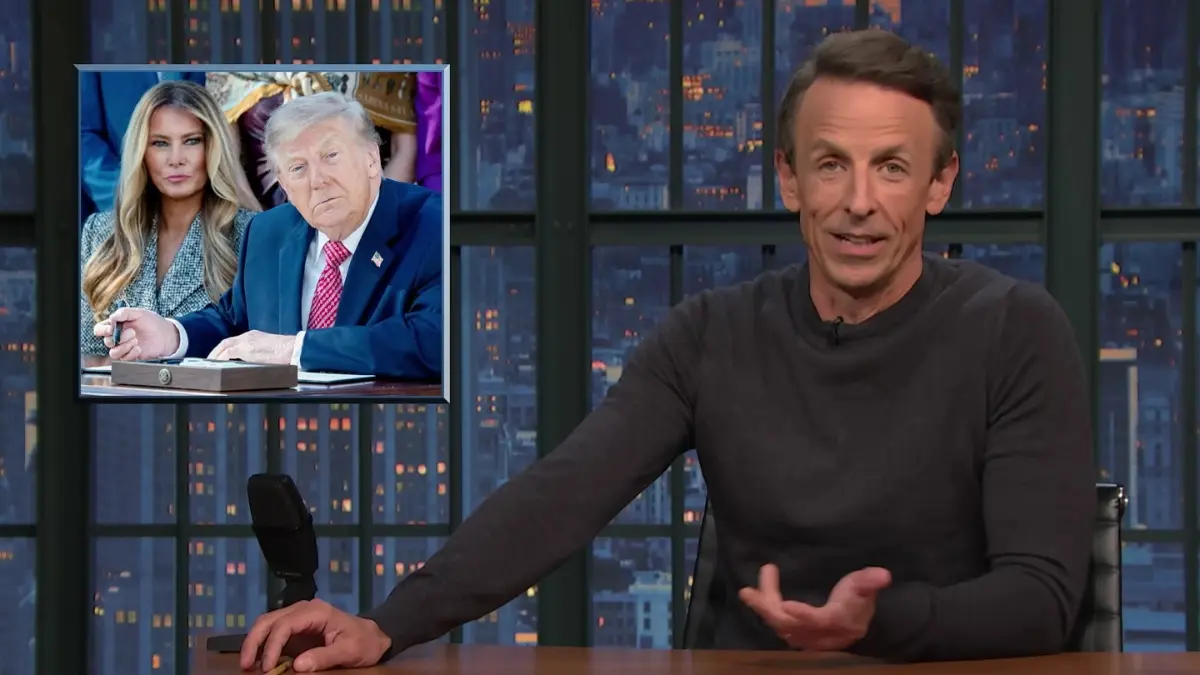
Late-night host Seth Meyers turned his comedic lens on President Donald Trump’s remarks at a recent Rose Garden ceremony, specifically dissecting a seemingly innocuous compliment directed at First Lady Melania Trump. The occasion was the signing of an executive order on October 19th, which aimed to establish a women’s health division within the National Institutes of Health (NIH) and a White House task force dedicated to the cause. While the executive order itself represented a significant policy announcement, it was the President’s linguistic choices in praising his wife that captured Meyers’ attention and became the subject of his televised critique.
During his Monday night monologue, Meyers zeroed in on a particular phrase used by President Trump when acknowledging Melania Trump’s role in conceptualizing the initiative. Trump described his wife as "a very skilled person, actually." This seemingly straightforward statement, according to Meyers, carried an undertone of surprise or reservation, transforming a potential accolade into what he characterized as a "backhanded compliment." Meyers humorously juxtaposed this with common phrases that can undermine sincerity, suggesting that adding "actually" to a compliment is akin to telling someone "You look tired" or "Calm down"—statements that often carry unintended or negative subtext.
The late-night host further amplified his point by playing a clip of President Trump elaborating on his wife’s involvement. Trump stated that Melania "worked so hard" on the initiative and added, "You wouldn’t believe it." Meyers’ response, delivered with comedic timing, suggested a subtle skepticism, implying that while he might believe her hard work, the phrasing itself hinted at a lower expectation. He then pivoted to a well-worn trope about President Trump’s leisure activities, quipping, "I don’t know, I might believe it. I’ve certainly never seen her on the golf course." This jab alluded to the President’s frequent and publicly documented golfing excursions, a recurring theme in discussions about his presidential activities.
The ceremony itself was not devoid of other moments that drew attention for their perceived awkwardness. Following the signing of the executive order, President Trump handed his Sharpie pen to Melania Trump, remarking, "I don’t know if her signature means anything." This comment elicited an uneasy reaction from the assembled guests, a mix of laughter and discomfort. Melania Trump, in turn, offered a composed response, smiling and stating, "Yours is the most important," before proceeding to sign the document. This exchange, captured on video, further fueled the narrative of a public dynamic that Meyers and others have frequently analyzed through a comedic lens.
Background and Context of the Executive Order
The executive order signed on October 19th, officially titled "Executive Order on Establishing a White House Task Force on Women’s Health" (though the provided text specifies a division within NIH and a task force), aimed to bolster the focus on women’s health within federal health agencies. The initiative sought to establish a dedicated women’s health division within the National Institutes of Health (NIH), a prominent biomedical research agency, and concurrently create a White House task force to coordinate efforts.
This policy move came at a time when women’s health issues were increasingly central to public discourse and political campaigns. The signing occurred just two weeks prior to the midterm elections, a period when political strategists often aim to mobilize key voter demographics. Public opinion polls, such as a Times/Siena Poll conducted around that time, indicated a significant gender divide in political support, with approximately one-third of American women reportedly supporting President Trump and the Republican Party. Against this backdrop, the administration’s emphasis on women’s health could be interpreted as an effort to engage or appeal to female voters.
Historical Precedents and the NIH Office of Research on Women’s Health
It is important to note that the concept of dedicated federal attention to women’s health is not entirely new. The NIH has housed an Office of Research on Women’s Health (ORWH) since 1990. This office was established with the mandate to ensure that women’s health is integrated into all aspects of biomedical and behavioral research. The new division, as described by officials, was intended to collaborate with the existing ORWH rather than supersede it, suggesting a strategy of augmenting existing structures rather than replacing them.
However, the administration’s commitment to women’s health funding had faced scrutiny in the past. In April of the same year, the administration had controversially cut funding for the long-running Women’s Health Initiative (WHI). The WHI, a major clinical research program, had been instrumental in understanding major chronic diseases in women and had generated significant scientific advancements. The funding cut sparked considerable public backlash, prompting a reversal of the decision. This prior action cast a shadow of doubt on the sincerity and sustainability of the administration’s renewed focus on women’s health, leading some observers to view the executive order as a potentially reactive measure.
Details of the Executive Order and Task Force
The executive order stipulated the creation of a White House task force, to be led by Susie Wiles and Health Secretary Robert F. Kennedy Jr. The precise composition and mandate of this task force were not detailed in the initial reports but were expected to involve representatives from various federal agencies. The executive order did not, at the time of its signing, allocate specific funds or set quantifiable funding goals for the new initiatives. This absence of dedicated financial commitment raised questions about the practical impact and long-term viability of the established division and task force.
The establishment of a women’s health division within the NIH, intended to complement the ORWH, was presented as a move to enhance research and understanding of diseases and conditions that disproportionately affect women or manifest differently in women. This included areas such as cardiovascular disease, osteoporosis, autoimmune diseases, and certain cancers. The task force was envisioned to provide a coordinated approach across government departments, addressing policy, research, and public health initiatives related to women’s well-being.
Analysis of the Compliment and its Implications
Seth Meyers’ comedic dissection of President Trump’s compliment to Melania Trump highlights a recurring pattern in the President’s public communication style. The use of qualifiers like "actually" or the inclusion of seemingly unnecessary details can, in some contexts, diminish the impact of praise. In the professional realm, such phrasing can be interpreted as implying that the positive attribute being highlighted is an exception rather than the norm, or that it was unexpected. This can lead to perceptions of insincerity or, at best, faint praise.
For First Lady Melania Trump, who has often maintained a more private public persona compared to her predecessors, such public acknowledgments, even if intended positively, can become subjects of intense scrutiny. Her role as a public figure, particularly in the context of a policy initiative bearing her name, naturally invites commentary on her involvement and the dynamics of the presidential couple. Meyers’ commentary, while framed as humor, taps into a broader public fascination with the presidential couple’s relationship and Trump’s distinctive communication style.
The inclusion of the phrase "You wouldn’t believe it" when describing Melania’s work further fuels this analysis. It can be read as an attempt to convey extraordinary effort, but it can also be perceived as implying that her level of engagement was surprising or unusual. This, coupled with the later remark about her signature’s significance, suggests a complex public portrayal where expressions of appreciation are sometimes intertwined with subtle caveats or observations that invite deeper interpretation.
Broader Political and Social Context
The timing of the executive order and its subsequent coverage cannot be entirely separated from the broader political landscape. As noted, the midterm elections were on the horizon, and women’s issues were a significant point of contention and mobilization for both major parties. President Trump’s administration had taken steps that were viewed by some as detrimental to women’s health rights, particularly concerning reproductive healthcare. Therefore, initiatives focused on women’s health, while ostensibly policy-driven, also carried significant political implications.
The perceived awkwardness of the President’s remarks, as highlighted by Meyers, can be seen as a microcosm of the broader communication challenges faced by the administration. In an era of heightened political polarization, every public statement, every gesture, and every word choice is subject to intense scrutiny and interpretation. For a policy aimed at addressing a critical aspect of public health, the surrounding narrative, including the personal interactions and linguistic nuances, can significantly influence public perception and the ultimate impact of the initiative.
The engagement of figures like Seth Meyers in dissecting these moments reflects a cultural trend where late-night comedy often serves as a platform for political commentary and social critique. By isolating specific phrases and re-contextualizing them, comedians can draw attention to perceived inconsistencies, ironies, or peculiarities in public discourse, prompting audiences to think critically about the messages being conveyed. In this instance, the focus on President Trump’s compliment to his wife served as a vehicle for commentary on his communication style, his public persona, and the political undertones of an event that aimed to address a significant public health issue. The ensuing discussion, amplified by media coverage and comedic analysis, underscored the intricate interplay between policy, personality, and public perception in the modern political arena.



 Nila Kartika Wati

 Eva Lovia

 Lina Irawan

 Yuyun Lusiyani

 Ana Megawati
