
 Jia Lissa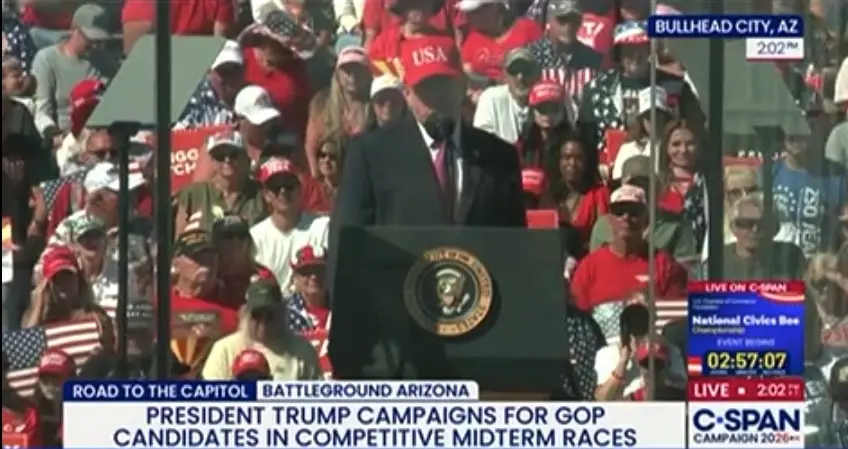
Speaking at a campaign-style rally in Arizona on Wednesday afternoon, President Donald Trump addressed the escalating economic and geopolitical consequences of the ongoing military conflict with Iran. During his remarks, the President offered a candid assessment of the current energy market, suggesting that while high oil prices have placed a burden on American consumers, the resulting profits for the domestic energy sector represent a significant economic boon for the United States. The President’s comments come at a time of heightened volatility in global energy markets, with Brent crude and West Texas Intermediate (WTI) reaching levels not seen in several years, and the national average for a gallon of gasoline climbing to $4.33.
The President’s rhetoric in Arizona highlighted a complex tension between the administration’s foreign policy objectives and the domestic economic reality of high energy costs. Trump acknowledged the potential for criticism regarding his stance, noting that his political opponents and the media might characterize his comments as indifferent to the struggles of average citizens. However, he maintained that the windfall being experienced by energy-producing states such as Texas, Oklahoma, and North Dakota is an overlooked benefit of the current price environment. While asserting his desire to eventually see prices return to pre-war levels, the President emphasized that the "fortune" being made by the U.S. energy industry is a factual reality of the current geopolitical landscape.
The Economic Landscape of the 2026 Energy Crisis
The current spike in energy prices is inextricably linked to the outbreak of hostilities with Iran, which began in February 2026. Since the commencement of military operations, global oil markets have reacted to the threat of supply disruptions in the Middle East, particularly concerning the Strait of Hormuz, a critical chokepoint for global oil transit. As of mid-October 2026, Brent crude is trading at approximately $106 per barrel, while West Texas Intermediate, the American benchmark, sits at $95 per barrel. These figures represent a sharp departure from the relative stability seen in 2025 and have directly contributed to the $4.33 national average for gasoline reported by AAA.
For the American consumer, these prices represent a significant inflationary pressure. High fuel costs impact not only personal transportation but also the logistics and shipping industries, leading to higher prices for consumer goods across the board. Despite these challenges, the President’s focus remained on the "top-line" revenue generated by the extraction and refining sectors. Data from the second and third quarters of 2026 support the President’s assertion that the industry is experiencing unprecedented financial success. Major oil firms reported record-breaking earnings in Q2, and the trend continued into Q3.
Particularly notable is the performance of the refining sector. According to market data, oil refiners averaged a 52% return over the previous quarter, outperforming even the upstream extraction companies. This disparity has led to increased scrutiny from congressional investigators and consumer advocacy groups, who argue that the "crack spread"—the difference between the price of crude oil and the price of the refined products produced from it—has widened to an exploitative degree during the conflict.
Chronology of the Conflict and Market Reaction
The timeline of the current energy crisis began in early 2026, following a series of diplomatic breakdowns regarding Iran’s nuclear program.
- February 2026: Formal military engagement begins. Oil markets immediately respond with a 15% overnight jump in futures.
- March – May 2026: Sanctions on Iranian exports are tightened, and regional instability leads to increased insurance premiums for tankers in the Persian Gulf. WTI crosses the $85 threshold.
- July 2026: Major oil corporations release Q2 earnings reports, showing record profits. The administration faces its first wave of significant domestic pressure over gas prices, which hit $4.00 nationally.
- September 2026: Refiners report a 52% increase in returns. The "fortune" mentioned by the President begins to manifest in state tax revenues for the "Oil Patch" states.
- October 2026: President Trump defends the economic trade-offs of the war during the Arizona rally, citing the need to prevent Iranian nuclear proliferation as the primary justification.
The President’s justification for the war—that Iran was on the precipice of acquiring a nuclear weapon—remains a point of intense domestic debate. While the administration has maintained that the threat was imminent, reports from various U.S. intelligence agencies have surfaced suggesting a more nuanced reality. During recent Senate hearings, lawmakers questioned officials regarding discrepancies between executive branch rhetoric and intelligence briefings. This internal friction has provided ammunition for critics who argue that the economic pain of the war is being justified by potentially flawed or exaggerated national security claims.
Impact on Energy-Producing States vs. the American Consumer
The "fortune" described by President Trump is most visible in the budgetary health of states like Texas, North Dakota, and Oklahoma. These regions have seen a surge in employment within the energy sector and a massive influx of severance tax revenue. For these states, the high price of oil acts as a powerful economic engine, funding infrastructure projects and public services. In his Arizona speech, Trump pointed to these states as evidence of national prosperity, framing the energy sector’s success as a win for "the country."
However, this regional prosperity stands in stark contrast to the experience of the "little person" the President mentioned in his remarks. For residents in non-oil-producing states, or for those in lower-income brackets, the $4.33 per gallon price tag at the pump represents a direct reduction in disposable income. Economists note that high energy prices act as a "regressive tax," disproportionately affecting those who spend a larger percentage of their income on basic necessities like commuting and heating.
The President’s assertion that he "cares about the little person like crazy" while simultaneously touting the record profits of oil companies creates a political paradox that his administration has struggled to resolve. While the administration claims to be working toward lowering prices, the continued military engagement in the Middle East provides a structural floor for oil prices that is unlikely to drop significantly in the near term.
Official Responses and Political Implications
The reaction to the President’s comments has been swift and divided along partisan lines. Supporters of the administration argue that a strong domestic energy sector is vital for national security and that the profits being made are a sign of American industrial strength. They contend that the war in Iran is a necessary preemptive measure and that the economic costs, while regrettable, are a price worth paying for global safety.
Conversely, Congressional Democrats and some moderate Republicans have expressed concern over the "windfall" profits of energy companies. Critics have called for a windfall profit tax or more aggressive investigations into price gouging at the refinery level. Senate Democrats have been particularly vocal, citing the 52% return for refiners as evidence that the industry is capitalizing on a national crisis. The contradiction between the President’s nuclear claims and intelligence reports has also led to calls for greater transparency regarding the original casus belli for the February invasion.
The broader implications of this policy are significant. Internationally, the high price of oil has shifted the balance of power among energy-exporting nations. While the U.S. has benefited domestically, other oil-rich nations—some of which are adversarial to U.S. interests—are also seeing their coffers filled by the high global price of crude. Domestically, the 2026 midterm cycle and the lead-up to the 2028 election are being shaped by the "gas pump politics" that have defined this year.
Analysis of Long-Term Consequences
As the conflict with Iran continues, the long-term outlook for the American economy remains tied to the volatility of the energy market. If oil remains above $100 per barrel for an extended period, the Federal Reserve may face challenges in managing inflation without triggering a broader economic slowdown. The "fortune" being made in Texas and North Dakota may not be enough to offset a potential decline in consumer spending across the rest of the nation.
Furthermore, the administration’s focus on traditional fossil fuel profits may impact the long-term trajectory of the energy transition. High prices for oil and gas traditionally accelerate interest in electric vehicles and renewable energy; however, if the administration continues to prioritize and celebrate the record profits of the oil industry, the policy environment for alternative energy may remain stagnant.
President Trump’s comments in Arizona serve as a definitive statement of his administration’s economic philosophy: that the strength of the industrial sector is a primary indicator of national health, even when that strength is derived from circumstances that cause individual financial strain for many citizens. As the nation moves toward the final months of 2026, the durability of this "fortune" and the true status of the Iranian nuclear threat will likely remain the central themes of the American political and economic discourse.




 Ana Megawati
 Joko Widodo
 Eva Lovia
 Lina Irawan