
 Amara Maple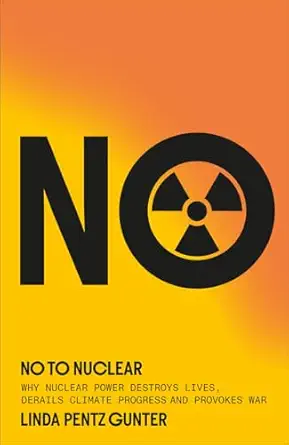
In an era where climate anxiety fuels a desperate search for carbon-free energy solutions, a growing chorus, particularly among younger activists, has begun to champion nuclear power as an indispensable tool in the fight against global warming. This perspective, increasingly prevalent in public discourse, posits that nuclear energy offers a reliable, large-scale alternative to fossil fuels, capable of delivering consistent baseload power without greenhouse gas emissions. However, this narrative is sharply challenged by Linda Pentz Gunter, the resolute founder of Beyond Nuclear, whose new book, No To Nuclear. Why Nuclear Power Destroys Lives, Derails Climate Progress And Provokes War (Pluto Press, April 2026), offers a rigorous, 200-page indictment of the nuclear power industry, aiming to dismantle what she describes as a pervasive and dangerous myth.
Pentz Gunter’s work arrives at a pivotal moment, as governments worldwide grapple with energy security and climate commitments. Her book is not merely an academic critique but a passionate appeal to a broad audience, especially those within the climate movement who, she argues, have been swayed by a sophisticated propaganda campaign. "I wanted to write a book that would appeal to a mass market audience, especially those in the climate movement who may have fallen prey to the saturation propaganda campaign being waged by the nuclear industry that paints itself as a solution to the climate crisis, when it is anything but," Pentz Gunter states. Her ambition extends beyond debunking myths; she endeavors to "put a human face on the story, to communicate what it feels like to be the victim of an industry that destroys the environment, harms health and leaves its lethal waste behind."
The Hidden Costs: Environmental Injustice and Human Suffering
A central theme in Pentz Gunter’s argument is the profound and often overlooked human cost of nuclear power. She asserts that both the nuclear power and nuclear weapons sectors have historically inflicted disproportionate harm on vulnerable populations. "Both the nuclear power and nuclear weapons sectors have disproportionately harmed Indigenous peoples and communities of color, as well as women and children, the most susceptible to harm from radiation exposure," she writes. This legacy of injustice spans the entire nuclear fuel cycle, from the initial stages of uranium mining to the devastating aftermath of atomic testing.
The extraction of uranium, a foundational component of nuclear fuel, has historically devastated Indigenous lands across the globe. In the United States, for instance, the Navajo Nation in the Southwest has grappled with the enduring health and environmental consequences of extensive uranium mining operations conducted from the 1940s to the 1980s. Thousands of abandoned mines dot the landscape, leaving behind radioactive waste that contaminates soil, water, and air, leading to elevated rates of cancer, kidney disease, and birth defects among residents. Similar stories of environmental racism and health crises can be found in other uranium-rich regions, including parts of Australia, Canada, and Africa, where indigenous communities bear the brunt of an industry eager to exploit their ancestral lands for resources. Pentz Gunter emphasizes, "No phase of this industry is benign," underscoring the pervasive nature of its destructive impact.
Nuclear Power and the Shadow of Proliferation
The blurred line between civilian nuclear energy programs and military aspirations is another critical area of concern highlighted in No To Nuclear. Pentz Gunter dedicates a topical section to Iran, particularly poignant given the geopolitical tensions preceding and during recent conflicts. "Iran is the poster child for the blurry line between a civil nuclear program and a military one," she observes. The narrative surrounding Iran’s nuclear facilities, often presented as a pretext for military action by the US and Israel, serves as a stark illustration of how civilian nuclear infrastructure can become a flashpoint for international conflict.
The very existence of civil nuclear programs inherently carries the risk of proliferation, as the technologies and materials involved can be diverted for weapons development. International treaties designed to prevent the spread of nuclear weapons, such as the Nuclear Non-Proliferation Treaty (NPT), struggle with this dual-use dilemma. While the NPT permits signatories to pursue peaceful nuclear energy, it simultaneously aims to prevent the acquisition of nuclear weapons. However, the knowledge and infrastructure developed for power generation can significantly shorten the path to weaponization. This inherent ambiguity ensures that "no one is sure of Iran’s true intentions while its civil nuclear program has made it a target," creating a perpetual state of suspicion and instability. This global dynamic raises profound questions about the long-term wisdom of promoting nuclear energy in an already fragile international security landscape.
The False Promise of Small Modular Reactors (SMRs)
A significant portion of the nuclear industry’s contemporary marketing strategy revolves around Small Modular Reactors (SMRs), touted as the next generation of nuclear power – safer, cheaper, and quicker to deploy. However, Pentz Gunter systematically debunks these claims. She argues that the myths surrounding SMRs, which are marketed as "more expensive, more dangerous and will produce greater volumes of nuclear waste than current reactors," are fundamentally flawed.
Despite claims of innovative design and inherent safety, SMRs are still in nascent stages of development, facing substantial technological and regulatory hurdles. Their modular nature is intended to reduce construction time and cost, yet early projects suggest otherwise. For instance, the NuScale Power project in Idaho, initially heralded as a breakthrough, faced significant cost escalations and delays, ultimately leading to its cancellation in 2023 due to prohibitive costs and insufficient subscriber interest. This incident underscores Pentz Gunter’s contention that SMRs are proving to be neither inexpensive nor swift to deploy. Furthermore, while individual SMRs are smaller, the deployment of numerous units across various sites could paradoxically lead to a greater overall volume of nuclear waste and a more dispersed risk profile, complicating waste management and security.
A System Built on Subsidies and Shadowy Dealings
Perhaps one of the most damning aspects of Pentz Gunter’s critique is her assertion that the nuclear power industry fundamentally relies on extensive public subsidies and is frequently entangled in criminal activities. "Across the United States to date, in Illinois, Ohio and South Carolina – there have been criminal cases that reveal the extent to which nuclear industry executives and politicians are willing to collude for mutual enrichment," she told Corporate Crime Reporter. These cases often involve bribery schemes, illegal lobbying, and dark money operations designed to secure legislative bailouts and favorable regulatory treatment for struggling nuclear plants. For example, the Ohio bribery scandal (House Bill 6) saw FirstEnergy executives indicted for funneling millions of dollars to politicians in exchange for a $1.3 billion bailout of two aging nuclear plants.
This pattern of financial dependency is not limited to criminal acts. M.V. Ramana, in his book Nuclear is Not the Solution: The Folly of Atomic Power in the Age of Climate Change, corroborates Pentz Gunter’s view, highlighting that "none of these new nuclear reactors will happen without subsidies. The industry does not want to pay for it." A particularly striking example is Bill Gates’s TerraPower project, aiming to develop a sodium-cooled fast reactor. Despite Gates being a multi-billionaire, his company secured a $2 billion subsidy from the Department of Energy for a projected $4 billion project. Pentz Gunter decries this as taxpayers funding a "vanity project," especially concerning given that fast reactors are "highly proliferation friendly" and potentially designed for export, raising further international security concerns.
The Uninsurable Risk: Taxpayers on the Hook
The financial precarity of the nuclear industry is further underscored by its inability to secure private insurance coverage for catastrophic accidents. This critical market failure led to the enactment of the Price-Anderson Act in the United States in 1957, which has been repeatedly renewed, most recently in April 2024 for another forty years. This act caps the liability for any single nuclear power plant accident at approximately $16 billion, with taxpayers shouldering any excess damages.
Pentz Gunter finds this arrangement deeply troubling: "What does that tell you? They are not willing to cover their own risk. They know it will cost a lot more if something goes wrong." The true costs of major nuclear disasters dwarf the capped liability. Estimates for the Chernobyl disaster in 1986 range as high as $700 billion, while the Fukushima disaster in 2011 is estimated to have cost at least $500 billion. The $16 billion cap, therefore, "isn’t going to go very far" in covering such immense economic and human devastation. The absurdity is compounded by SMR companies, who, despite claiming their new reactors are "meltdown proof, totally safe, and we don’t need an evacuation zone beyond the perimeter fence," still demand and receive the protection of the Price-Anderson Act. "Why do you need federal protection if they are totally safe and meltdown proof and we don’t need an evacuation zone beyond the perimeter fence and no sirens?" she rightly questions, exposing a fundamental contradiction.
Challenging the Narrative: Casualties and Propaganda
The debate over nuclear power’s safety is often clouded by industry-backed narratives that downplay the human cost of accidents. Pentz Gunter directly challenges claims, often echoed by "self-described environmentalists" like George Monbiot and Mark Lynas writing for The Guardian, that "Fukushima has killed no one." Lynas’s 2021 assertion that "we must never forget that Fukushima has killed no one" is, for Pentz Gunter, a dangerous simplification. "To say – the plant blew up, no one dropped dead and then it’s fine – that’s not the way it works," she explains.
The immediate death toll from radiation exposure at Fukushima might indeed be low, but the long-term health impacts, including increased cancer rates, are far more difficult to quantify and often manifest years later. Beyond direct radiation sickness, the disaster led to the evacuation of hundreds of thousands of people, causing immense psychological trauma, social disruption, and economic ruin for communities. The stress of displacement, loss of livelihood, and fear of invisible contamination significantly impact public health and well-being.
The Chernobyl disaster serves as an even more stark example. While the industry might admit to the deaths of "liquidators" – the firefighters and cleanup crews who sacrificed their lives – Pentz Gunter argues this is a severe understatement. "Figures range from tens of thousands to more than a million eventual deaths," she notes, referring to the long-term consequences. The "Chernobyl necklace" (scars from thyroidectomies due to radiation-induced cancer) and "Chernobyl heart" (birth defects) are grim reminders of the enduring genetic and somatic damage. Professor Kate Brown’s Manual for Survival: A Chernobyl Guide to the Future, which delves into declassified archives and personal testimonies, provides a powerful counter-narrative to official, minimized casualty counts, revealing a catastrophe of staggering proportions in terms of illness, displacement, and death. Even the partial meltdown at Three Mile Island, often cited by the industry as a success due to its containment, was followed by a "sudden bubbling up of all kinds of illnesses that were tied to exposure to radiation," though correlation was officially denied.
Nuclear Power: An Environmentalist’s Contradiction?
For Pentz Gunter, the continued advocacy for nuclear power by individuals who claim to be environmentalists represents a fundamental contradiction. "I would argue that if you support nuclear power, you are not an environmentalist anymore because it is so destructive to the environment," she states unequivocally. She views it as a "deeply extractive industry that discriminates against the people it exploits," often targeting Indigenous populations in "far flung places who nobody ever sees."
Beyond the social justice issues, Pentz Gunter argues that nuclear power is a strategic misstep in addressing the climate crisis due to its inherent slowness and expense. "It’s not so much about the carbon footprint, which is there. The issue is it takes so long and costs so much." While nuclear power plants do not emit greenhouse gases during operation, their construction, uranium mining, enrichment, and waste disposal processes are energy-intensive and have an environmental footprint. More critically, the protracted timelines for building new nuclear plants, often exceeding a decade even for SMRs, mean that significant decarbonization is delayed. "In that interim time, what we are doing is burning more fossil fuel. It’s just a diversion that is actually making the climate crisis worse."
Pentz Gunter champions renewables as the superior path: "The imperative right now is to reduce the most carbon for the least cost in the shortest time." Comparative analyses of Levelized Cost of Energy (LCOE) consistently show that solar and wind power, coupled with battery storage, are now significantly cheaper and faster to deploy than new nuclear builds. "If I gave you a dollar and you invest your dollar in nuclear and I invest mine in solar, I will reduce more carbon faster than you, for sure. You can bring renewables on very quickly. And they are here now. It’s not something we are uncertain about."
Moreover, the regulatory environment for new reactors, particularly SMRs, is concerning. Pentz Gunter points to the Trump administration’s efforts to "fast track them anyway and do away with the regulatory infrastructure and suppress the Nuclear Regulatory Commission so they can fast track these new reactors." This approach risks compromising safety standards for unproven designs. The small scale of some proposed SMRs (e.g., 10-megawatt reactors) means that "you would have to build hundreds if not thousands of them" to make a meaningful impact on the climate crisis, an undertaking she deems unrealistic, expensive, and slow. Ultimately, she concludes, nuclear power remains "the slowest, most expensive way of boiling water and also, of course, the most dangerous."
Cultural Narratives and Political Inertia
The public perception of nuclear power is heavily influenced by cultural narratives. While Oliver Stone’s pro-nuclear film Nuclear Now attempts to shift public opinion, its impact is arguably dwarfed by other cinematic portrayals. Christopher Nolan’s blockbuster Oppenheimer, though biographical, "did open up a window of opportunity for our community to make the argument against nuclear," by sparking conversations about the destructive potential of atomic technology. The television series Chernobyl on HBO, hailed as one of the most-watched series of all time, had an even more profound effect. "It had to explain all sorts of difficult technical concepts. But it was incredibly popular. People got a grip on what went wrong and the horrendous aftermath," Pentz Gunter recounts, noting Stone’s film as a "sad downward trajectory."
Despite the clear risks and economic arguments against nuclear power, political engagement on the issue in the United States remains remarkably low. Pentz Gunter notes the scarcity of nuclear skeptics in Congress, identifying only Senator Ed Markey (D-Massachusetts) and Senator Bernie Sanders (I-Vermont) among 535 members. This translates to a general lack of critical scrutiny. Conversely, she points to prominent pro-nuclear Democrats like Senators Cory Booker (D-New Jersey) and Sheldon Whitehouse (D-Rhode Island), who are "evangelically pro-nuclear." Pentz Gunter expresses frustration at the difficulty of engaging with such proponents, particularly Whitehouse, to understand their rationale. "I really want to understand how he can be so concerned about the emasculation of the Nuclear Regulatory Commission… and he is concerned about sea level rise and climate change. But he’s still this evangelical promoter of nuclear energy." This lack of dialogue and critical self-reflection within political circles underscores the entrenched nature of the pro-nuclear lobby and the formidable challenge faced by advocates like Linda Pentz Gunter.
In No To Nuclear, Pentz Gunter not only dissects the technical, economic, and ethical flaws of nuclear power but also calls for a fundamental re-evaluation of its role in humanity’s future. Her work serves as an urgent reminder that in the quest for climate solutions, the path forward must be chosen with a full understanding of historical injustices, economic realities, and the potential for devastating long-term consequences.



 Yuyun Lusiyani
 Joko Widodo
 Eva Lovia
 Pevita Pearce
 admin
admin
 Lina Irawan