
 Eva Lovia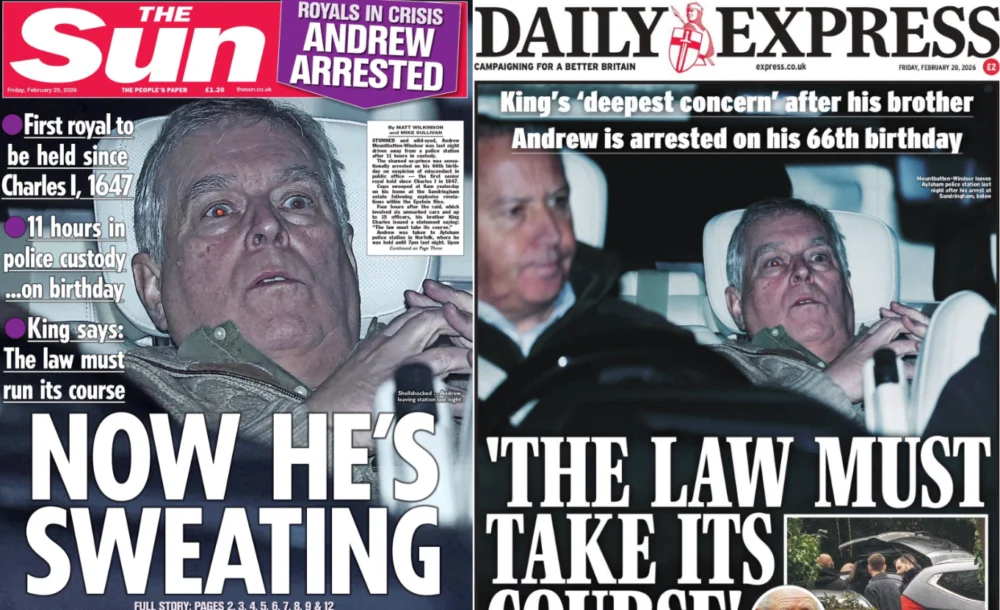
A photograph, taken through the rain-streaked glass of a vehicle’s windscreen, has emerged as an unlikely but potent symbol of the British monarchy’s evolving narrative in the 21st century. The image, focusing on a man whose eyes are starkly reddened by the intrusive flash of a camera, is far from a flattering portrait. Yet, this candid, almost accidental capture, taken on the evening of February 19, 2026, around 7 PM, is poised to become one of the most enduring and consequential visual records of the Royal Family, immortalizing a moment of profound personal and institutional crisis. It depicts Andrew Mountbatten-Windsor, the Duke of York, as he was transported back to his new residence on the Sandringham estate, eleven hours after becoming the most senior royal to be arrested in over 350 years.
The photograph, a stark testament to a dramatic day, rapidly traversed the globe. Within moments of its capture, it began circulating across digital platforms, soon dominating the front pages of newspapers from London to Tokyo and becoming a ubiquitous presence on television news bulletins and online news portals. Though less than a day old at the time of its widespread dissemination, the image had already achieved an unprecedented level of fame for royal photography, securing its place in the historical annals of the 21st century, albeit for reasons that cast a long shadow. This singular image encapsulates the precipitous fall from grace of a royal figure who, by some accounts, had long harboured a deep-seated conviction of his own inherent importance within the royal hierarchy. Andrew Mountbatten-Windsor, the eighth in line to the throne at the time of his arrest, had spent his birthday in police custody, apprehended on suspicion of misconduct in public office.
The wait for this image had been palpable. Following the confirmation of his detention, photographers and reporters had converged on locations where the former prince might be held or questioned. The police’s decision to release him under investigation marked the culmination of a day fraught with anticipation and intense media scrutiny. As the clock neared seven o’clock in the evening, news crews strategically positioned in Aylsham, Norfolk, were faced with the singular objective of securing the photograph that the world was clamouring to see.
The task of capturing this historic moment fell to Phil Noble of Reuters. His photograph, depicting Andrew appearing dazed and disoriented in the rear of the vehicle, has since been widely circulated. Noble himself later recounted the near miss, admitting that he had initially left the scene and returned to his hotel shortly before the prince’s arrival. A call from a colleague, informing him of the arrival of two cars, prompted his hurried return, placing him in the opportune position to take the now-iconic photograph.
A Global Spectacle: The Photo’s Immediate Impact
A survey of international newspapers unequivocally illustrates the profound significance of this single image in the narrative of royal history. Its placement on the front pages of publications across continents, from Spain to Singapore, underscored the seismic shockwave that the arrest of Queen Elizabeth II and Prince Philip’s second son sent through the Royal Family. The sensational headline in the New York Post, "Prince of Darkness," stood in stark contrast to the more factual, albeit equally damning, reports from other outlets, yet the photograph served as the unifying visual accompaniment to all. This image became the universal shorthand for a royal scandal of immense proportions.
The Duke’s Declining Fortunes: A Preceding Context
The Royal Family had, in the years leading up to this event, actively sought to distance itself from the Duke of York. King Charles III had previously stripped him of all his honorary military titles and royal patronages, a significant demotion for a senior royal. Consequently, Andrew Mountbatten-Windsor, now identified by his name rather than his ducal title, had also relinquished the lease on Royal Lodge, his thirty-room mansion on the Windsor estate, where he had resided for over two decades. This move signified a tangible reduction in his public standing and royal perquisites, foreshadowing the more drastic consequences of his legal entanglements.
A New Chapter Begins in Shadow: Sandringham and the Arrest
His relocation to the King’s private estate at Sandringham marked the beginning of a new phase in his life, a chapter that was immediately and dramatically overshadowed by his arrest and subsequent release under investigation. The implications of this event extended beyond his personal reputation, igniting a fierce debate about his continued place within the Line of Succession. Prominent political figures, including the Liberal Democrat leader Sir Ed Davey, publicly called for his removal from the line of succession, adding further political pressure to an already volatile situation. The controversy surrounding the Duke of York showed no signs of abating, with this arrest only serving to intensify the public discourse and scrutiny.
The Anatomy of the Image: A Technical and Symbolic Analysis
The photographic composition, while lacking artistic intent in the traditional sense, possesses a powerful symbolic weight. The composition, framed by the car’s interior, isolates the Duke of York, emphasizing his vulnerability and isolation. The red-eye effect, a common photographic artefact caused by light reflecting off the retina, here takes on a heightened significance. It imbues the subject with an almost spectral or demonic quality, inadvertently amplifying the negative connotations associated with the scandal. This unintended visual cue, coupled with the Duke’s apparent disorientation, creates an image that is both unflattering and deeply unsettling, a stark contrast to the carefully curated and regal portrayals typically associated with the Royal Family.
The choice of a candid, unposed shot further contributes to its historical impact. In an era where royal appearances are meticulously managed and often staged for maximum positive effect, this image represents an uncontrolled, raw glimpse into a moment of profound personal crisis. It bypasses the usual channels of official photography, offering a raw and unfiltered perspective that resonates with the public’s demand for transparency and accountability, especially in matters concerning individuals holding positions of significant public trust.
Historical Precedents and Royal Vulnerability
The arrest of a senior royal is a rare and historically significant event. While not unprecedented, the last instance of such a high-ranking royal being taken into custody dates back to the 17th century, highlighting the exceptional nature of Andrew Mountbatten-Windsor’s situation. This historical context underscores the magnitude of the scandal and its potential to destabilize public perception of the monarchy.
The Royal Family has historically presented an image of stoic resilience and unwavering moral rectitude. However, the 21st century has witnessed a series of challenges that have tested this carefully constructed facade. From the financial scandals involving other members of the extended royal family to the personal controversies that have plagued prominent figures, the monarchy has faced increasing pressure to adapt to a more transparent and accountable public sphere. Andrew’s arrest, amplified by the stark imagery, represents a particularly acute manifestation of this evolving dynamic. It brings into sharp relief the inherent vulnerability of even the most established institutions when faced with individual misconduct.
The Line of Succession: A Constitutional Quandary
The calls for Andrew Mountbatten-Windsor’s removal from the Line of Succession are not merely symbolic. The Line of Succession is a fundamental constitutional mechanism that dictates the order of inheritance to the throne. Any significant disruption or challenge to this order has the potential to raise constitutional questions and provoke public debate about the future of the monarchy itself. The fact that a senior royal, by virtue of his lineage, remains in the Line of Succession despite serious allegations of misconduct, fuels public discontent and prompts questions about the criteria for eligibility to the throne.
The legal process that followed the arrest, including the ongoing investigation, will be crucial in determining the full extent of the Duke’s culpability and the subsequent legal and public repercussions. However, the visual evidence captured on February 19, 2026, has already cemented his place in history, not as a celebrated royal figure, but as a symbol of a profound institutional challenge.
Broader Implications for the Monarchy’s Future
The enduring legacy of this photograph extends beyond the immediate scandal. It serves as a potent reminder of the evolving relationship between the monarchy and the public in the digital age. Images, particularly those that capture moments of vulnerability or controversy, can spread with unprecedented speed and impact, shaping public opinion and influencing institutional responses.
The Royal Family’s future will likely depend on its ability to navigate these complex dynamics, demonstrating both resilience and a willingness to adapt to the changing expectations of its subjects. The stark reality captured in that red-eyed photograph serves as a powerful, if unwelcome, catalyst for introspection and potential reform, ensuring that the story of the Royal Family in the 21st century will forever be marked by this moment of reckoning. The image, with its raw, unvarnished depiction of a prince in distress, will continue to tell its story for decades to come, a permanent testament to a period of profound challenge and transformation for the British Crown. The lessons learned, or perhaps not learned, from this episode will undoubtedly shape the narrative of royal succession and public accountability for generations.

 Yuyun Lusiyani
 Ana Megawati
 Joko Widodo
 Jia Lissa
 Pevita Pearce