
 Yuyun Lusiyani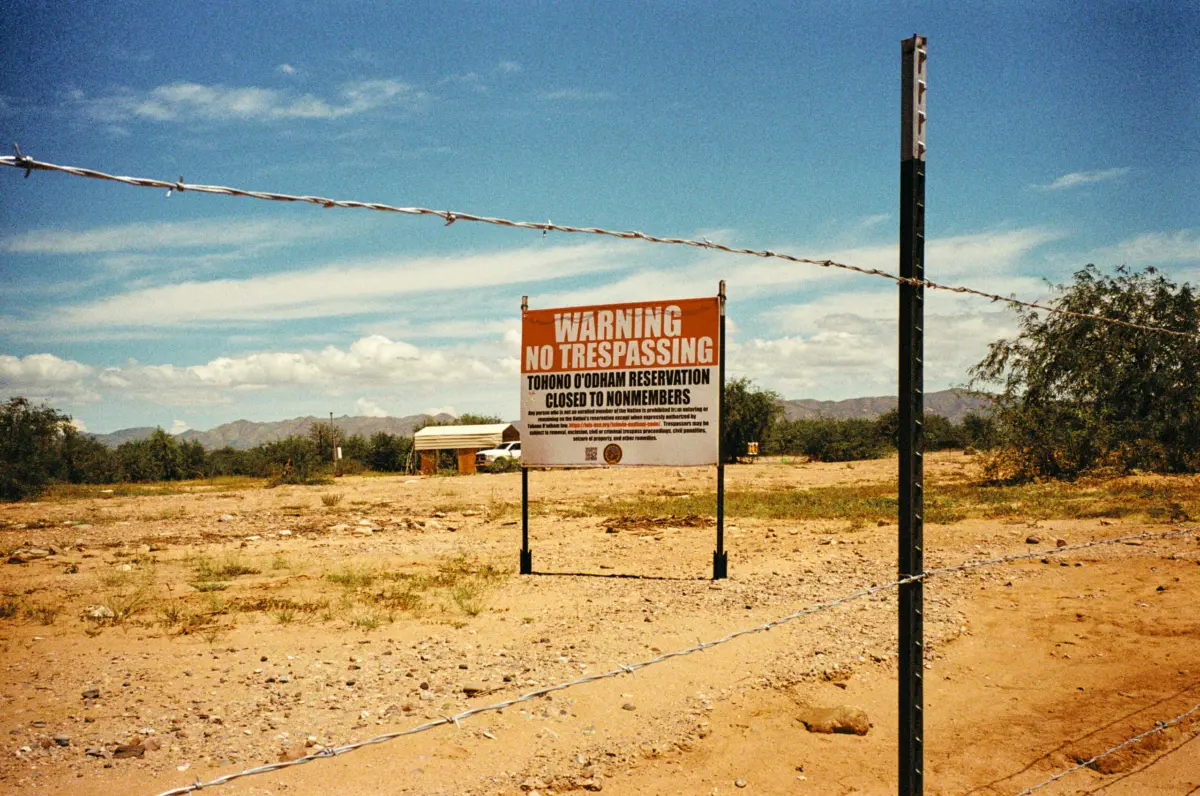
In the predawn hours of August 25, a critical flashpoint ignited in the ongoing dispute between the U.S. government and the Tohono O’odham Nation in Southern Arizona. At precisely 4:59 a.m., Verlon Jose, the 59-year-old chairman of the Nation, received an email from acting chief patrol agent Henry N. Laxdal of the U.S. Border Patrol’s Tucson Sector. The message, delivered with a mere 60-second notice, informed him that government contractors were already en route to conduct soil tests for the construction of a 62-mile border wall along the Nation’s southern boundary. While tribal cultural monitors were "welcome" to observe, they were explicitly warned against interfering with federal operations. This abrupt notification marked a dramatic escalation, transforming a simmering legal battle into a tangible, militarized incursion onto sovereign tribal lands.
A Pre-Dawn Incursion and Federal Mobilization
Chairman Jose was not caught entirely off guard. An hour prior to Laxdal’s email, tribal members had reported a caravan of vehicles, including work trucks, drilling rigs, and Border Patrol units, moving south through the reservation. Social media channels were already buzzing with similar sightings, confirming the federal government’s aggressive deployment. As daylight broke, the scale of the operation became chillingly clear: contractors were flanked by federal agents in masks and tactical gear, drawn from a special operations cadre previously deployed in controversial citywide sweeps in Minneapolis and Chicago, which had resulted in fatalities. The Nation’s chief of police, attempting to reach the worksite, was blocked by a federal roadblock, underscoring the government’s assertion of absolute authority.
Jose swiftly issued a public statement via the Nation’s website, condemning the incursion as illegal. He revealed that the Department of Homeland Security (DHS) had deployed a surveillance blimp and even enlisted Mexican security forces to protect the work crews, painting a picture of a coordinated, overwhelming federal presence.

Decades of Cooperation, Now Discarded
For a quarter-century, the Tohono O’odham Nation had successfully staved off the construction of a physical border wall through a strategy of cooperation with DHS. Their vast 2.8 million-acre reservation, the largest on the southern border, had become a testing ground for advanced homeland security measures. This included vehicle barriers, state-of-the-art surveillance towers (some provided by Israeli firm Elbit Systems), and extensive law enforcement partnerships with both Border Patrol and Immigration and Customs Enforcement (ICE), including the specialized "Shadow Wolves" unit comprised of Native American officers.
Despite these extensive collaborations and initial assurances from the Trump administration regarding consultation, ProPublica’s investigation revealed a stark shift in federal tactics. DHS turned its surveillance apparatus directly on tribal members, with 24-hour monitoring of an ongoing border prayer ceremony. Tribal members reported being questioned outside the reservation about their ceremonial activities, indicating a profound breach of trust and respect for religious freedom. The agency’s pivot signaled a clear abandonment of its "commitment to ongoing coordination," as claimed by Border Patrol acting chief Laxdal just moments before the incursion.
The Legal Battle and Unheeded Warnings
The Tohono O’odham Nation’s homeland straddles the U.S.-Mexico border, a geographical reality that defines their identity. Thousands of tribal members reside in Mexico, necessitating routine border crossings for ceremonies, family visits, and cultural continuity. A wall, tribal leaders and members argued, would shatter these ancestral ties and irrevocably destroy sacred landscapes integral to their cultural identity.

Their lawsuit, filed in federal court, asserted that the Trump administration’s unilateral efforts to build the wall constituted an unprecedented assault on tribal sovereignty. Administration attorneys, however, maintained that the government was engaging in good faith. This assurance seemingly swayed a judge in Washington, D.C., who, on August 14, denied the tribe’s request for a preliminary injunction to halt construction. The judge, Richard J. Leon, wrote that he "fully expect[ed] the government in the months ahead to follow through on its guarantees of consultation and cooperation with the Nation." Eleven days later, the "60-second heads up" email arrived, starkly contrasting with the court’s expectation.
The federal government’s posture was further illuminated by a celebratory post on X (formerly Twitter) by James Percival, general counsel of the Department of Homeland Security, hours after the injunction denial. Featuring a meme of the cybernetic Star Trek villains, "the Borg," with the caption "RESISTANCE IS FUTILE," Percival added, "We respect tribal sovereignty but not to the detriment of border security. This wall is getting built. Our authority is beyond dispute." This aggressive stance, effectively declaring federal supremacy over tribal rights, sent a clear and chilling message to the Tohono O’odham Nation.
Political Fault Lines and Legislative Efforts
The conflict over the border wall on the Tohono O’odham Nation has highlighted existing partisan divisions within Arizona. Republican legislative leaders have filed briefs in support of the project, echoing the Trump administration’s emphasis on border security. Conversely, Democratic Governor Katie Hobbs has supported the tribe, recognizing the profound cultural and sovereign impacts.
Adding another layer to the political landscape, progressive U.S. Rep. Adelita Grijalva, whose district encompasses the reservation, has announced plans to craft legislation aimed at reining in DHS’s sweeping powers. These powers allow the department to waive numerous federal laws – including environmental and cultural preservation statutes – to expedite border wall construction. The Trump administration has invoked these authorities on a staggering 60 occasions across its two terms, bypassing critical safeguards designed to protect sensitive ecological zones and Indigenous heritage. This legislative push underscores a growing recognition of the federal government’s unchecked power in border regions.

The Human Cost: Surveillance and Intimidation
For tribal members like Deshane Gregg, whose vehicle was forced off the road by a convoy of contractors and federal agents, the federal show of force feels less like cooperation and more like a siege. "You just feel helpless. You see these people, and they’re just so aggressive. They want you to react. They want you to show them that we could be ugly too," she recounted. "We’re just here doing prayer. We’re just here, not trying to bother them, but it gets to you when it’s constantly being like that. The drones flying over us all day, it’s a lot."
Indeed, ProPublica’s investigation, based on photographs, videos, court filings, interviews, firsthand observations, and over 1,000 contemporaneous written accounts by tribal members, paints a detailed picture of pervasive surveillance and intimidation. The Border Patrol and its tactical teams are not merely observing but actively monitoring and, at times, provoking.
When ProPublica sought answers to nearly 30 specific questions regarding the government’s surveillance and interactions, DHS, U.S. Customs and Border Protection (CBP), and the Border Patrol declined to respond directly. Instead, CBP Commissioner Rodney Scott issued a statement in August, characterizing the reservation’s southern boundary as "one of the most dangerous smuggling and trafficking corridors on the Southwest border" and a "remote desert that has facilitated decades of drug loads, migrant deaths, and cartel activity." Scott reiterated, "Congress funded this work, a Federal court has affirmed it, and CBP is carrying it out under the legal authorities that apply. Under President Trump’s leadership, we are securing the border and giving our agents the tools and support they need to protect the American people." This official response sidestepped specific allegations of surveillance and intimidation, instead framing the construction as a legally mandated imperative for national security.
The Historical Context of the Tohono O’odham Homeland

The O’odham people have inhabited the Sonoran Desert for thousands of years, their traditional lands stretching from what is now Southern Arizona deep into Mexico’s Sea of Cortez. This deep historical connection renders the concept of a border wall particularly devastating. The reservation itself, west of Tucson, is home to approximately 14,000 of the Nation’s 37,000 enrolled members, with an additional 3,000 residing in Mexico. The artificial division of their ancestral lands by a political boundary has long been a source of contention, but a physical wall represents an irreversible severing of cultural and familial ties.
During President Donald Trump’s first term, 226 miles of border wall were constructed across Arizona. However, the Tohono O’odham Nation remained the state’s longest unwalled section. The tide turned in February when CBP informed the tribe of its plans to completely seal off the reservation’s 62-mile border, earmarking nearly $52 billion from Trump’s "One Big Beautiful Bill Act."
Tribal leaders sought dialogue, including a meeting with DHS Secretary Markwayne Mullin, the first Native American to lead the department and an enrolled citizen of the Cherokee Nation. Hopes that Mullin might offer a more empathetic approach were quickly dashed. Jose recalled Mullin’s message: "We want to work with you, but we’re building the wall." Mullin allegedly stated that Justice Department attorneys were prepared to defend the project all the way to the Supreme Court, with council member Vivian Juan-Saunders recalling Mullin saying, "Don’t mess with me."
The pressure intensified the following month during a meeting with CBP Commissioner Scott. According to Jose, Scott explicitly threatened that if the Nation pursued a lawsuit, they could lose access to three critical border gates used by tribal members to travel to and from Mexico. These gates, essential for cultural and family continuity, are maintained at CBP’s discretion. Both Juan-Saunders and council member Jesse Navarro corroborated this alleged threat. CBP again declined to comment on the matter.
The "Tucson 5" Project and Contested Justifications

In June, a $1.3 billion contract for the wall, known as the "Tucson 5" project, was awarded to Sullivan Land Services Co. (SLSCO), a Texas firm with a history of Republican political donations and significant border wall contracts during the prior Trump administration.
The Tohono O’odham Nation filed its lawsuit on June 16, asserting that the project would illegally reduce the size of its reservation – an action permissible only by Congress – and constitute an enduring act of trespass, destroying sacred cultural sites. The tribe’s attorneys emphasized that the administration’s plans discarded decades of tribal cooperation with DHS, and came at a time of record-low border crossings. Trump administration claims of a safer border and 94% lower apprehensions, with Border Patrol "encounters" hitting their lowest levels in over 50 years, were presented as evidence of the wall’s fundamental redundancy. The tribe’s interim chief of police, James Cook, further attested to a 90% drop in illegal entry reports, stating that smuggling and border-related crimes had "almost disappeared."
However, senior Border Patrol official Benjamin S. Hollinder countered in a sworn declaration, arguing that the absence of a wall on the Nation created a "funneling effect," channeling smugglers onto the reservation. He contended this dynamic would intensify once other sections of Arizona were walled off, making the Nation a "vulnerable and a desirable area for [transnational criminal organizations] to operate."
The Roosevelt Reservation and the Limits of Federal Power
On the eve of a July 22 hearing for the preliminary injunction, DHS filed a notice affirming its decision to waive, in whole or in part, over 30 federal laws – including those mandating tribal consultation – to accelerate the project. In court, the government acknowledged its history of "cooperatively" working with the tribal government but asserted that the Nation "does not hold veto power over the United States’ sovereign duty to secure its borders."

The government insisted that construction would be limited to the "Roosevelt Reservation," a 60-foot-wide strip of land running along the U.S. side of the border in California, Arizona, and New Mexico, where CBP was authorized to construct barriers. Riyaz Kanji, the tribe’s lead attorney, argued that this historical strip did not extend onto tribal land, and even if it did, the rugged terrain would necessitate construction far beyond the 60-foot boundary. Kanji contended that DHS’s sweeping powers could not override a sovereign government, describing the administration’s plans as a "blatant and unprecedented disregard for the tribe’s rights." Justice Department attorney Adam R.F. Gustafson countered, stating the tribe had previously approved a barrier and the current dispute was merely over the type of barrier. He assured the court of DHS’s "commitment" to consultation and respect for the tribe’s views. The judge, appearing swayed by these assurances, denied the injunction, seemingly trusting the government’s pledge to remain within the 60-foot strip.
The Las Playas Intaglio and Broken Trust
The O’odham’s suspicions about the government’s mindfulness were tragically validated well before the August incursion. Just two days after the meeting with Secretary Mullin, a border wall contractor "inadvertently disturbed a cultural site" west of the reservation. A 70-foot swath was bulldozed through the Las Playas Intaglio, a 200-foot-long earthen etching of a fish, estimated to be at least 6,500 years old. This site was well-marked and known to archaeologists, and O’odham elder Wynona P. Larson Yazzie had visited it just the day before its destruction. This incident served as a stark precursor to the events on August 25, demonstrating the government’s capacity for cultural destruction despite assurances.
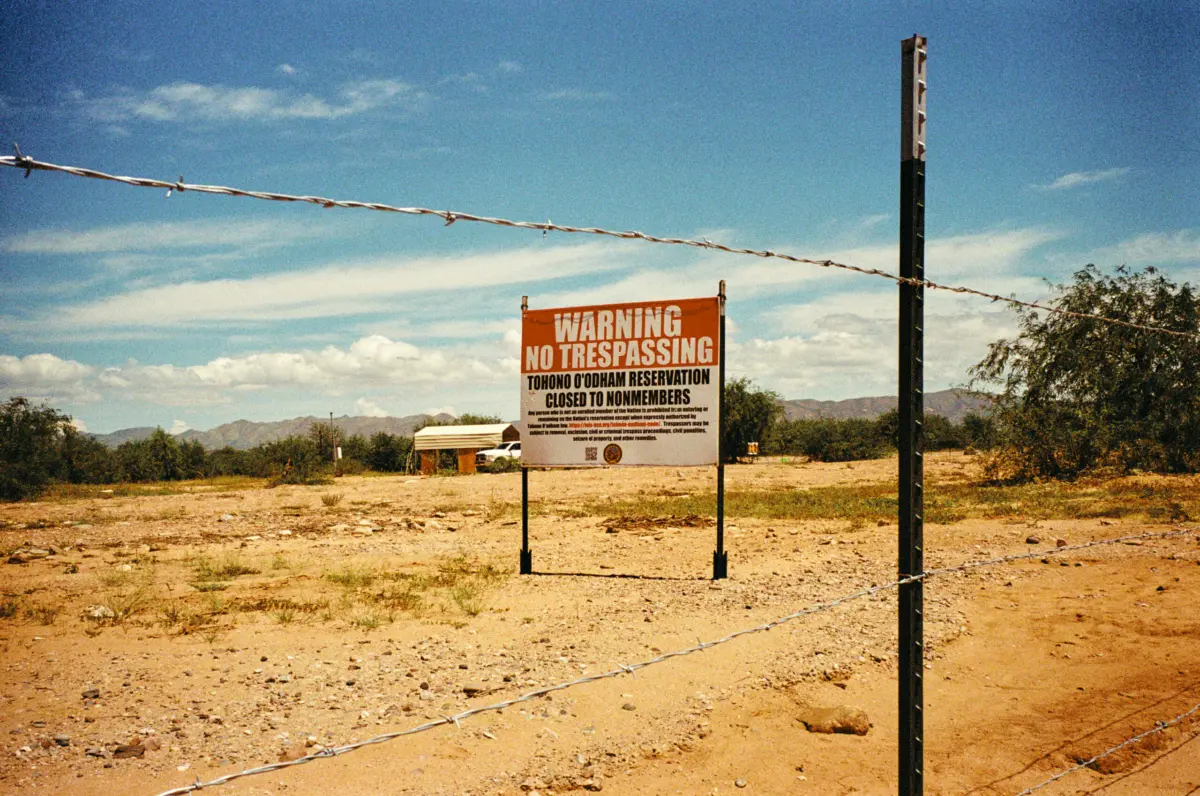
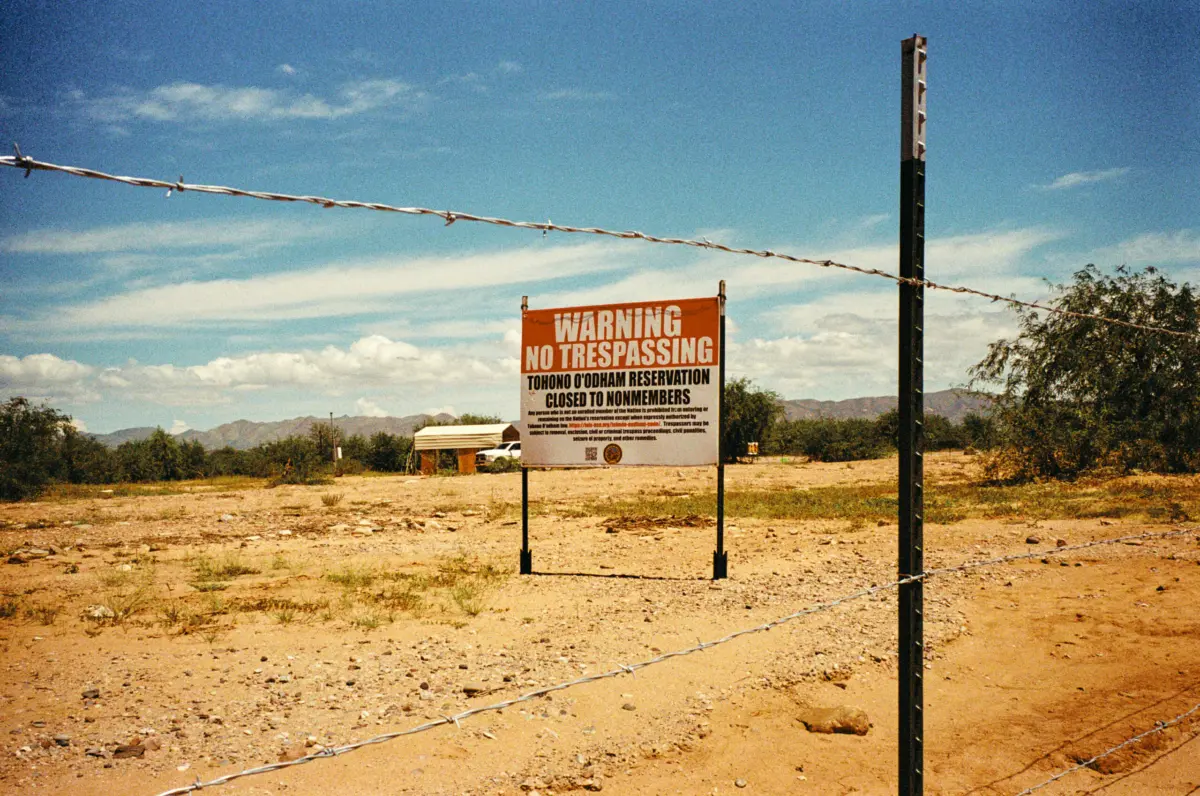
Larson Yazzie, a Marine Corps veteran and former tribal police officer, became a leading voice in the resistance. Upon learning of the imminent federal entry into the reservation for soil tests, tribal leaders erected dozens of 8-foot-wide "no trespassing" signs along the main access roads. Larson Yazzie, meanwhile, began making her own plans.
Tadai Me:i: The Prayer Camp and Its Surveillance

Joined by Amy Juan, a 40-year-old O’odham activist whose family history is deeply intertwined with the border, Larson Yazzie established a prayer camp. Juan recalled growing up crossing the traditional Ko:li Ki:jig crossing, only for a locking gate to be installed after 9/11, followed by a Border Patrol forward operating base near her grandparents’ home. This base expanded to include a helipad and detention space, with checkpoints becoming ubiquitous on roads leading north.
Human rights groups like Amnesty International have documented arrests and deportations of U.S.-born tribal members, along with verbal and physical abuse by Border Patrol agents, allegations CBP has not addressed. Juan noted the irony: the Nation’s cooperation with DHS, meant to ensure safety, had instead eroded civil liberties and brought intensified surveillance. While acknowledging the community’s struggle with border smuggling, Juan emphasized that the answer was not a wall but respect and safety "at what cost?"
The prayer camp, named Tadai Me:i ("roadrunner on fire"), was established at the symbolic Ko:li Ki:jig border gate. Prayer fires are a vital O’odham tradition, often convened during times of communal struggle. The camp, with its cots, chairs, and perpetually burning fire, became a focal point of resistance and ceremony. Lit on August 9, coinciding with the contractors’ preparations, the camp quickly became a target for federal surveillance.
The first drone sighting was recorded at 11:43 p.m. on August 10, marking the beginning of meticulous, minute-by-minute activity logs kept by camp participants. These handwritten logs, shared with ProPublica, span 13 days and chart a steady escalation of DHS presence: nearly 665 observations in the first seven days, mostly federal agents "buzzing around." Agents were seen photographing campers, and Mexican security forces (military and police) were observed conversing with Border Patrol agents across the international boundary, even sharing photos on their phones. "Surveillance has heightened," Juan confirmed, noting constant air activity from marked CBP choppers, suspected military Black Hawks, and handheld quadcopters hovering directly over prayer ceremonies.
Despite the intense scrutiny, the camp maintained a ceremonial atmosphere, focusing on morning prayers and nightly cleanses, not overt protest. Yet, fear was palpable. Some tribal council members worried about the camp attracting outsiders and escalating into a violent confrontation akin to the Standing Rock protests. Camp visitor Collin Quasule, 24, expressed his fear: "My fear is that they gonna start shooting us." He shared videos of federal agents trailing him, stopping him without cause, and refusing to accept his legal name and birthdate.

The logs also documented community efforts to intercept contractor caravans. On August 12, tribal police escorted off six trucks with Texas plates and an unmarked SUV with government plates, confirmed to be a Border Patrol agent. This was one of nearly a dozen such interceptions by tribal police in a three-day period.
A gathering of over 100 people at the camp on the fourth night was disrupted by news of an elder couple stopped by Border Patrol at a checkpoint outside the reservation, questioned about their "ceremony" and asked for tribal IDs – an unusual occurrence. The incident prompted many to leave, fearing late-night encounters.
The Post-Injunction Reality
Following Judge Leon’s denial of the injunction on August 14, the federal government moved swiftly. On August 25, the Border Patrol’s one-minute notice preceded the contractors’ arrival. Larson Yazzie raced to the border, filming from a distance after an agent warned her about a spike strip. The tribal police chief, blocked by a Border Patrol roadblock manned by SWAT-style BORTAC agents in desert camo, was only allowed to record after promising not to interfere. He observed drilling rigs and agents guarding them, noting that the heavy vehicles were operating beyond the 60-foot "Roosevelt Reservation" zone that government attorneys had assured the judge they would not leave. Bureau of Indian Affairs agents were also present, claiming to be there to "preserve the peace and monitor activities."
In response, the prayer camp’s flame, extinguished after its initial seven-day ceremony, was relit. Davy Cross, a 57-year-old tribal member, recounted hearing weapons being chambered and seeing at least five drones, initially visible with red lights, then going dark and flying low over the campers. These were followed by planes and helicopters. On August 27, Cross documented in the logbook being "surround[ed] by over 30 vehicles," including Border Patrol and Mexican state police, a moment captured in a video that quickly spread across social media.

The tribe’s attorneys filed an appeal, pleading for a halt to federal activities and arguing that the Trump administration was making "a mockery" of the court’s expectation of "consultation and cooperation."
The Big Bend Anomaly: A Tale of Two Borders
A stark contrast emerged with events unfolding simultaneously in Texas. The Trump administration’s plans for a wall through Big Bend National Park sparked an unusual coalition of environmental nonprofits, river guides, hunters, ranchers, and local sheriffs in opposition. One week before the armed convoy rolled onto the Tohono O’odham reservation, Republican Governor Greg Abbott announced a pause on the controversial Big Bend project after discussions with the DHS secretary. Abbott stated, "There are technology tools that don’t include barriers. Think of drones, think of fiber optics." Last week, a judge granted a preliminary injunction halting construction in the Big Bend area.
For Amy Juan, this presented a "darkly ironic" situation. The Tohono O’odham Nation had been a "laboratory" for decades for the very technologies Abbott now championed as alternatives to a physical wall. Yet, when tribal leaders made this case, they were told the wall was inevitable. "What makes Texas the exception to us is very clear," Juan asserted. "It’s good old boy conversations that are happening between the politicians and the CBP commissioners and Markwayne Mullin." This perceived double standard underscored a painful reality of unequal leverage and political influence.
Ongoing Struggle and Dystopian Realities

The early morning fire watch on September 26 fell to Nate Sosa, a young Pascua Yaqui member. At 3:28 a.m., he heard a weapon being chambered as a Border Patrol agent approached, shining a light into Mexico and walking within feet of sleeping campers. A drone and helicopter followed, then a convoy of dozens of vehicles. During morning prayers, a helicopter and drone again flew overhead.
Liz Quiroga, a 28-year-old tribal member, meticulously documented 379 observations over five days: nearly two-thirds involved Border Patrol units near the fire, six references to Mexican authorities, and 39 entries for unmarked vehicles and suspected "undercovers." A dozen aircraft sightings, including four helicopters, three planes, and five drones, further filled the logbook. "Nobody has any idea what’s actually happening out here," Quiroga stated. "This is true dystopia."
While its legal challenge continues, the Tohono O’odham Nation has ceased attempts to physically remove border wall contractors from its lands, recognizing the overwhelming federal force arrayed against them. The Tadai Me:i prayer camp persists, a symbol of spiritual resistance and cultural defiance, constantly watched by the federal government’s ubiquitous surveillance apparatus. The struggle for sovereignty, cultural preservation, and basic human dignity against the relentless march of federal border policy remains tragically unresolved on the lands of the Tohono O’odham Nation.

 Ana Megawati
 Joko Widodo
 Eva Lovia
 Jia Lissa
 Pevita Pearce