
 Eva Lovia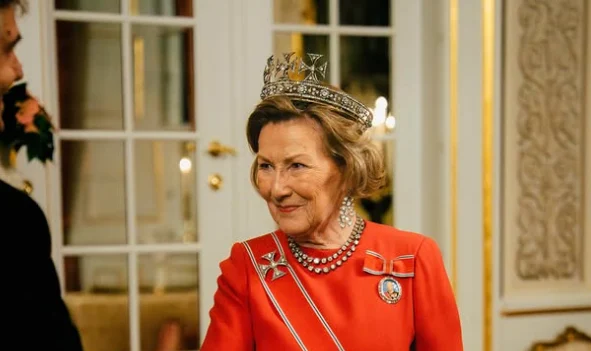
Queen Sonja of Norway recently captivated observers with a stunning rewear of a particularly distinctive tiara, the Maltese Cross Circlet, during a traditional celebration at Oslo’s Royal Palace in December. This choice, far from being a mere sartorial decision, brought to the forefront a piece steeped in royal history and connected to some of Europe’s most influential queens. The diadem, characterized by its unique design featuring diamond Maltese Crosses, not only highlighted Queen Sonja’s enduring style but also drew parallels with other significant royal jewellery moments of the year.
A Tiara of Unparalleled Distinction
The Maltese Cross Circlet is not a tiara that graces public appearances frequently, making its recent outing particularly noteworthy. Comprising a diamond bandeau base from which three striking Maltese Crosses can be attached, the tiara offers a versatile yet undeniably regal statement. Queen Sonja’s choice for the annual dinner for Norway’s bishops, an event attended by her husband, King Harald, and their son, Crown Prince Haakon, underscored the importance and formality of the occasion. This gathering, a staple in the Norwegian royal calendar, typically sees members of the Royal Family engage with senior clergy, reinforcing the close ties between the monarchy and the established church. The presence of such a rare and historically charged piece of jewellery at this event signals a deeper engagement with tradition and heritage.
The relative infrequency of the Maltese Cross Circlet’s public appearances over the past three decades adds to its allure. This rarity mirrors the situation surrounding another significant royal tiara, the Oriental Circlet, which the Princess of Wales showcased at a State Banquet at Windsor Castle in the same month. Both tiaras, despite their different origins and stylistic expressions, share a common thread: a connection to Queen Alexandra, a consort renowned for her impeccable fashion sense and considerable influence on royal jewellery collections.
The Historical Lineage of the Maltese Cross Circlet
The story of the Maltese Cross Circlet is intricately woven into the fabric of British and Scandinavian royal history, tracing its origins back to Queen Alexandra of Denmark and Wales. While the article focuses on Queen Sonja’s recent wearing of the tiara, its journey from its creation to its current home in the Norwegian Royal Collection is a fascinating narrative of inheritance and adaptation.
The Maltese Cross Circlet, in its current iteration, is intrinsically linked to Queen Alexandra’s personal style and her role as a trendsetter within European royalty. She was not only a consort to King Edward VII of the United Kingdom but also a significant figure in shaping the royal jewellery landscape of her era. Her influence extended to the modification and popularization of several key pieces, including those that would eventually find their way into the Norwegian Royal Collection.
A Legacy Rooted in Queen Alexandra’s Influence
Queen Alexandra’s impact on royal jewellery is undeniable. Considered one of the most stylish royals of her generation, her choices in fashion and adornment were closely watched and emulated by many. The Maltese Cross Circlet, however, represents a more profound legacy, as it was originally part of Alexandra’s Coronation jewels. This fact elevates the tiara from a mere accessory to a symbol of her own royal investiture.
The diadem began its life as part of the magnificent collection of jewels commissioned by Alexandra for the spectacular ceremony when she was crowned Queen alongside her husband, King Edward VII, in 1902. This detail places the tiara at a pivotal moment in British royal history, connecting it directly to the grandeur and ceremony of the Edwardian era. The commissioning of such elaborate pieces for a coronation underscores the wealth and prestige associated with the British monarchy at the turn of the 20th century.
The Journey to the Norwegian Crown
The lineage of the Maltese Cross Circlet then moves across the North Sea, finding its way into the Norwegian Royal Collection through a direct line of descent. Alexandra’s youngest daughter, Maud, married Prince Carl of Denmark and subsequently became Queen of Norway in 1905, following the dissolution of the union between Norway and Sweden. Queen Maud and King Haakon VII became the first reigning monarchs of modern Norway.
Queen Maud inherited many of her mother’s jewels, a testament to the close familial bonds and the continuation of royal traditions. Her son, King Olav V of Norway, who reigned from 1955 to 1991, then inherited a significant portion of these precious heirlooms from his mother. It was through this direct inheritance that the Maltese Cross Circlet ultimately became part of the Norwegian royal jewellery box, awaiting its moment to shine once more. King Olav V’s reign was a period of significant development for Norway, and the jewels he inherited, including this tiara, served as tangible links to the nation’s past and its evolving monarchy.
Queen Sonja: A Modern Icon with a Respect for Tradition
Queen Sonja, the wife of King Harald V (son of King Olav V), has consistently demonstrated a keen eye for style and a deep appreciation for the historical significance of the jewels she wears. Her background as a fashion student before marrying into royalty undoubtedly informs her sartorial choices, allowing her to blend contemporary elegance with a profound understanding of the weight and meaning of royal adornments.
Her pairing of the all-diamond Maltese Cross Circlet with a vibrant red evening gown during the December event was a deliberate and striking choice. The bold red hue of her gown served not only as a fashionable statement but also as a subtle yet powerful evocation of the colours of the Norwegian flag, a common practice among royals to show national pride. This thoughtful coordination of attire and symbolism further amplifies the impact of her appearance.
A Mirror to Other Royal Fashion Moments
The resonance of Queen Sonja’s tiara choice is amplified when considered alongside other recent notable royal jewellery moments. The aforementioned appearance of the Princess of Wales with the Oriental Circlet at the Windsor State Banquet provides a compelling parallel. The Princess of Wales wore the diamond and ruby Oriental Circlet with a blue dress, another calculated nod to the colours of the United Kingdom’s flag. This deliberate alignment of jewellery, attire, and national symbolism by both Queen Sonja and the Princess of Wales underscores a growing trend among modern royals to imbue their public appearances with layers of meaning and heritage.
The Oriental Circlet itself has a fascinating history, originally designed by Prince Albert for Queen Victoria. Inspired by Indian architecture, its design featured large diamond arches adorned with opals. However, Queen Victoria bequeathed the tiara to the Crown, and it was her daughter-in-law, Queen Alexandra, who famously requested the opals be removed due to her superstition that they were unlucky. She had them replaced with rubies, creating the version of the tiara that exists today. This modification by Alexandra highlights her personal taste and her willingness to adapt royal heirlooms to her own preferences, a practice that has shaped the evolution of many significant royal jewels.
The Broader Significance of Rare Tiara Appearances
The recent spotlight on these less frequently seen tiaras, such as the Maltese Cross Circlet and the Oriental Circlet, serves a dual purpose. Firstly, it allows the public to appreciate the breadth and depth of royal jewellery collections, which are often far more extensive and historically rich than commonly perceived. These collections are not merely displays of wealth but are repositories of national and familial history, passed down through generations and bearing witness to pivotal moments in a nation’s story.
Secondly, these rare appearances highlight the practical considerations behind royal fashion choices. While royals possess an array of magnificent jewels, they often rely on a curated selection of “go-to” tiaras that are readily available and fitted, simplifying preparations for high-profile events. The decision to wear a less common piece, therefore, often signifies a specific intention, whether it be to honour a particular occasion, acknowledge a historical anniversary, or as in Queen Sonja’s case, to pay tribute to a significant family connection.
Analysis of Implications
Queen Sonja’s choice of the Maltese Cross Circlet at the bishops’ dinner is more than just a fashion statement; it is an act of deliberate historical engagement. By selecting a tiara with such a direct link to her predecessors – Queen Alexandra, Queen Maud, and King Olav V – she reinforces the continuity of the Norwegian monarchy. In an era where monarchies are increasingly scrutinised for their relevance, such gestures serve to connect the present to the past, grounding the institution in tradition and heritage.
The parallel with the Princess of Wales’s choice of the Oriental Circlet further suggests a subtle, yet deliberate, coordination of messaging within the broader European royal sphere. Both women, at the apex of their respective royal families’ female representation, are showcasing heirlooms that speak to the enduring power of royal lineage and the significance of historical adornment. This can be interpreted as a strategic move to reinforce the image of established, stable, and historically grounded monarchies in a rapidly changing world.
The fact that these tiaras are rarely seen also adds an element of exclusivity and intrigue. When they do appear, they command attention and spark discussion, as evidenced by the media coverage. This renewed interest in historical royal jewellery can foster a greater public appreciation for the cultural and historical value of these pieces, moving beyond their purely monetary worth. It encourages a deeper understanding of the stories they hold and the roles they have played in shaping royal identities and national narratives.
Furthermore, the detailed accounts of the origins and journeys of these tiaras, as provided by royal commentators and historians, contribute to a richer public understanding of royal history. The Maltese Cross Circlet’s passage from British royalty to its Norwegian home through Queen Maud’s inheritance is a compelling illustration of the intricate web of relationships and traditions that define European royal families. This genealogical narrative, intertwined with the history of the jewels themselves, provides a tangible link to past eras and significant historical figures.
In conclusion, Queen Sonja’s rewear of the Maltese Cross Circlet was a moment of significant sartorial and historical resonance. It not only showcased her personal style and appreciation for heritage but also served as a potent reminder of the enduring power of royal tradition and the rich tapestry of history woven into the jewels worn by queens. The tiara’s journey from Queen Alexandra’s coronation to its current place in the Norwegian Royal Collection is a testament to the enduring legacy of royal families and the captivating stories that lie within their most treasured adornments.



 Yuyun Lusiyani
 Joko Widodo
 Pevita Pearce
 admin
admin
 Lina Irawan