
 Eva Lovia
The union of Crown Prince Haakon of Norway and Mette-Marit Tjessme Hoiby, once heralded as a modern royal love story that triumphed over adversity, now finds itself at a crossroads as the couple marks their silver wedding anniversary. What began as a widely scrutinized romance, culminating in a fairytale wedding attended by European royalty, has, over twenty-five years, been shadowed by a series of controversies that have tested the public’s perception of the beloved Norwegian couple. As they reach this significant milestone, the lustre of their once-celebrated union appears somewhat dulled, prompting a closer examination of the journey that has led them to this point.
A Love Story That Defied Convention
The path to the altar for Crown Prince Haakon and Mette-Marit was anything but conventional, a fact that was acknowledged not only by the public but also within the solemnity of their wedding ceremony. Mette-Marit, born in Kristiansand in August 1973, hailed from a background far removed from the gilded cages of royal life. Her upbringing was characterized by a love for outdoor pursuits, particularly sailing, a stark contrast to the more formal upbringing typically associated with royal consorts.
Her relationship with the heir to the Norwegian throne, Crown Prince Haakon, became public knowledge in 1999, immediately drawing intense scrutiny. The principal points of contention were twofold: Mette-Marit’s status as a single mother to her son, Marius Borg Hoiby, born from a previous relationship, and her past association with Oslo’s vibrant and sometimes tumultuous "party scene." These aspects of her life were perceived by some as incompatible with the staid image expected of a future queen.
The pressure surrounding her past culminated in a poignant television interview in January 2001, shortly after the announcement of their engagement. In a tearful confession, Mette-Marit openly addressed her history with drugs, expressing remorse and seeking understanding. This moment of vulnerability, rather than alienating the public, paradoxically galvanized widespread support for the couple, transforming apprehension into a wave of empathy and anticipation for their wedding. The interview is widely seen as a pivotal moment in shaping public opinion, demonstrating a willingness to confront her past head-on.
The Wedding: A Symbol of Modern Royalty
The wedding ceremony, held on August 25th, 2001, at Oslo Cathedral, was a deliberate reflection of the couple’s modern sensibilities and the challenges they had overcome. The pronouncements of Bishop Gunnar Stalsett during his sermon, "You have not chosen the easiest path, but love has triumphed," encapsulated the narrative that had unfolded. The ceremony itself broke with some traditional protocols, signifying a new era for the Norwegian monarchy.
One of the most striking departures from tradition was the manner in which Crown Prince Haakon greeted his bride. Instead of waiting at the altar, he met Mette-Marit at the entrance of the cathedral, and together, they walked down the aisle. This act symbolized their partnership and their shared journey. Mette-Marit’s four-year-old son, Marius, played a significant role as the pageboy, further emphasizing the blending of their families and the inclusive nature of their union. The musical selection for the ceremony also mirrored this blend, incorporating both contemporary and traditional pieces.
The Bridal Ensemble: Elegance and Personal Touch
Mette-Marit’s wedding gown, designed by Norwegian designer Ove Harder Finseth, was a masterclass in understated elegance. Crafted from crepe and tulle, the dress featured a simple yet sophisticated silhouette. The square-cut neckline and fitted sleeves transitioned into a bodice that flowed seamlessly into a gently flared skirt. A dramatic, full-length train extended from the skirt, complemented by a breathtakingly long tulle veil, estimated to be around twenty feet, which cascaded past the train.
Adding a personal and modern touch, Mette-Marit herself contributed to the design of her striking bouquet. It was not a traditional arrangement but rather a flowing, sculptural piece shaped from petals, reflecting her artistic sensibilities and desire for a unique bridal statement.
The bride’s choice of a tiara was also significant. She wore a delicate diamond tiara, featuring daisy motifs arranged in a subtle bandeau style. This piece was a wedding gift from her new in-laws, King Harald V and Queen Sonja of Norway, serving as a clear and public endorsement of their support for their new daughter-in-law and her unconventional path to becoming Crown Princess.
A Milestone Wedding in a New Millennium
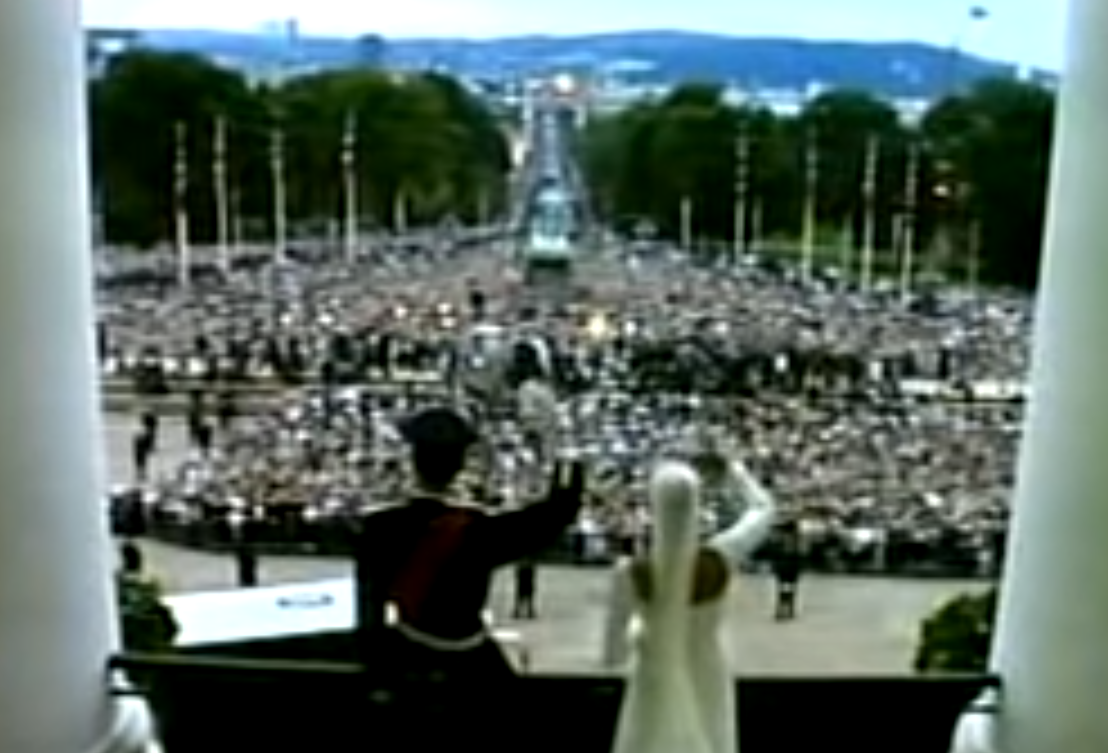
The wedding of Crown Prince Haakon and Mette-Marit held a unique place in royal history. Occurring in August 2001, it marked the first royal wedding of the 21st century, a symbolic event that resonated as a new millennium dawned. This distinction underscored the modern trajectory of the Norwegian monarchy and its embrace of contemporary values. The event drew a distinguished guest list, comprising many of Europe’s reigning monarchs and their consorts, further cementing its international significance.
Among the esteemed attendees were two other prominent figures on the royal marriage circuit at the time. Máxima Zorreguieta, who was engaged to Willem-Alexander of the Netherlands, was present, accompanied by her fiancé and his mother, then Queen Beatrix. Her attendance hinted at an impending royal wedding in another European nation.
Another notable guest, Eva Sannum, a Norwegian model, was widely speculated to be on the cusp of a royal engagement to Prince Felipe of Spain. Her presence at the wedding, initially attending alone but later photographed with Prince Felipe at the reception, fueled rumors of an imminent announcement. However, their relationship ultimately dissolved, and Prince Felipe later married Letizia Ortiz Rocasolano in 2004, who is now the Queen of Spain.
A Growing Family and Evolving Legacy
Following their wedding, Crown Prince Haakon and Crown Princess Mette-Marit’s family grew, welcoming two children: Princess Ingrid Alexandra and Prince Sverre Magnus. Princess Ingrid Alexandra, by virtue of Norway’s succession laws, is the heir apparent to the throne, setting another modern precedent as the first woman to be born with the right to inherit the crown ahead of any younger brothers. Her future reign signifies a continued evolution of the Norwegian monarchy.
The Fading Fairytale: Emerging Controversies
Despite the initial optimism and the establishment of a loving family, the latter years have seen the "fairytale" narrative surrounding Crown Princess Mette-Marit face considerable challenges. Her public image has been significantly impacted by a series of revelations that have cast a shadow over her standing.
In early 2023, details emerged regarding her past association with convicted sex offender Jeffrey Epstein. Papers related to the financier’s affairs brought to light the extent of their acquaintance. The Crown Princess’s response to these revelations, during interviews on Norwegian national television, was met with criticism. Many felt her explanations lacked a sufficient understanding of the gravity of Epstein’s crimes and her proximity to him. This incident reignited public discourse about her past and judgment.
Further compounding these issues, her elder son, Marius Borg Hoiby, was convicted of several offenses, including two counts of rape, and subsequently sentenced to four years in prison. While Marius is not a direct royal heir, his actions and conviction inevitably cast a difficult light on the royal family, given his close relationship with the Crown Princess and his status as the stepson of the Crown Prince.
Silver Anniversary Amidst Royal Health Concerns
As Crown Prince Haakon and Crown Princess Mette-Marit approach their silver wedding anniversary, the Norwegian Royal House has opted for a subdued celebration. While Mette-Marit’s wedding gown has been put on display, and a new official photograph of the couple has been released, the scale of the commemoration is notably restrained. The primary reason cited for this subdued approach is the Crown Princess’s ongoing recovery from a lung transplant, which she underwent earlier in the year. Her pulmonary fibrosis had progressed to a critical stage, with doctors estimating she had only a year to live without the procedure.
Adding to the familial concerns, King Harald V was admitted to hospital recently. He is currently in a stable condition after commencing antibiotics for a bloodstream infection. The 89-year-old monarch is expected to be incapacitated for several weeks, a development that has understandably caused concern across Norway. The Prime Minister has publicly addressed the King’s health, highlighting the impact of his temporary absence.
A Regent’s Duty and a Public Image in Recovery
Twenty-five years after their wedding, Crown Prince Haakon finds himself acting as regent for his father, King Harald V, while Crown Princess Mette-Marit focuses on her recovery. The challenges faced by the royal family, both personal and public, underscore the complexities of navigating royal life under constant public scrutiny. While the Crown Princess’s physical recuperation is underway, the restoration of her public image, tarnished by recent controversies, may prove to be a more protracted process. As they mark their silver anniversary, the once-unblemished sheen of their royal fairytale appears to have been irrevocably altered, reflecting the realities of a modern monarchy facing contemporary challenges.




 Yuyun Lusiyani
 Joko Widodo
 Jia Lissa
 Pevita Pearce
 admin
admin
