
 Jia Lissa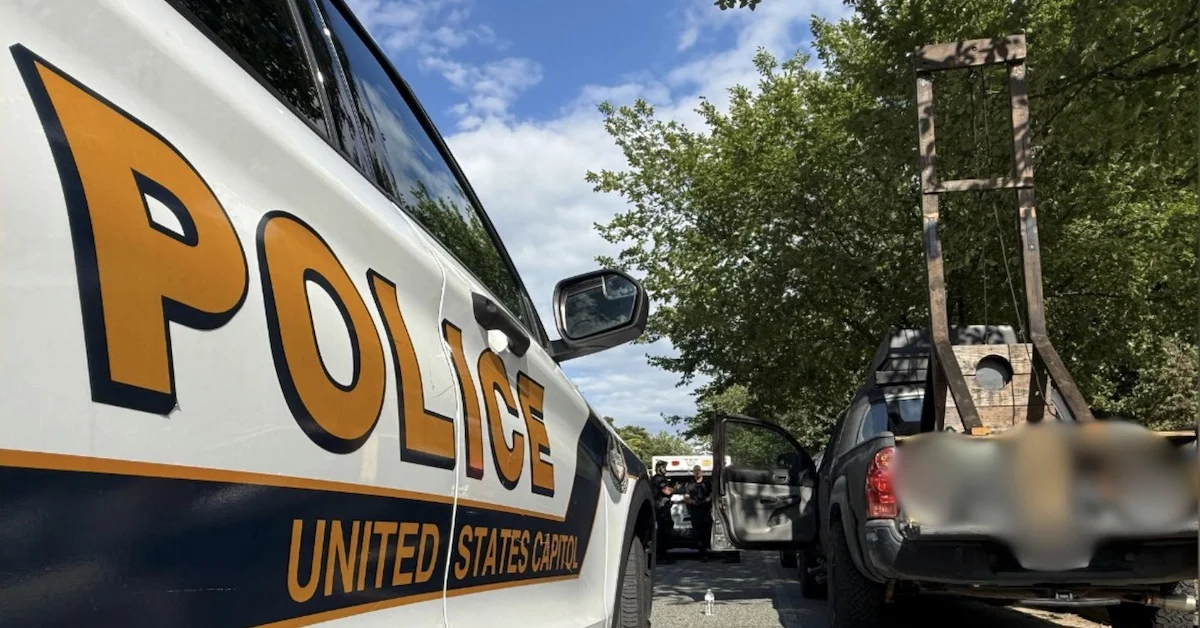
In a significant breach of the high-security perimeter surrounding the United States’ judicial heart, the U.S. Capitol Police (USCP) announced on Tuesday the arrest of a California man found in possession of a full-sized guillotine. The suspect, identified as 35-year-old Philan-Tam-Duy Le, was apprehended after his vehicle was discovered illegally parked near the 100 block of East Capitol Street, placing the individual and the macabre device within immediate proximity of the Supreme Court building. The incident occurred at approximately 3:00 p.m. EST, drawing immediate attention from federal law enforcement and sparking a comprehensive investigation into the suspect’s motives and the logistical journey that brought him from the West Coast to the steps of the nation’s highest court.
The arrest comes at a time of heightened sensitivity regarding the security of federal officials and judicial institutions. According to a formal statement released by the USCP, officers initially approached the vehicle—a pickup truck—due to a parking violation. However, the routine encounter quickly escalated when officers observed a large, wooden-framed guillotine standing upright in the bed of the truck. Photographs released by investigators show the contraption, complete with a large blade and a traditional tall frame, clearly visible to passersby and law enforcement. The presence of such a device, historically associated with political execution and revolutionary violence, prompted an immediate tactical response and the closure of the surrounding area to pedestrian traffic.
Details of the Arrest and Suspect Profile
The suspect, Philan-Tam-Duy Le, hails from Julian, California, a small mountain community located in the Cuyamaca Mountains, roughly 60 miles northeast of San Diego. The geographic distance between the suspect’s residence and the nation’s capital—a journey of approximately 2,600 miles—suggests a calculated and long-distance transit. USCP investigators have confirmed that Le drove the vehicle across the country with the guillotine in tow, though the specific route taken and whether the device was shrouded or visible during the cross-country trip remains a subject of the ongoing probe.
Le was taken into custody without significant resistance and has been charged with "Carrying a Dangerous Weapon." Under District of Columbia law, the classification of a "dangerous weapon" can encompass a wide variety of objects not traditionally defined as firearms, provided they are capable of inflicting serious bodily harm and are possessed under circumstances that suggest intent to use them as such or in violation of public safety regulations. The USCP’s statement emphasized that the possession of the guillotine in a high-security zone constituted a direct threat to the order and safety of the Capitol complex.
Security Context and the Supreme Court Summer Recess
At the time of the arrest, the Supreme Court of the United States was in its traditional summer recess. During this period, the justices are typically away from the bench, and the building’s internal activity is significantly reduced compared to the high-pressure months of the spring term. However, the exterior of the building remains a focal point for tourists, protesters, and political activists. The 100 block of East Capitol Street, where Le’s truck was found, is a critical artery that separates the Supreme Court from the Library of Congress and the U.S. Capitol building itself.
The USCP has maintained a heightened security posture in this area following several years of increased threats against members of the judiciary. In 2022, following the leak of the Dobbs v. Jackson decision, Congress passed the Supreme Court Police Parity Act to provide 24-hour protection to the families of Supreme Court justices. While the justices were not present in the building on Tuesday, the symbolic nature of the Supreme Court as a target for political expression—and potential violence—remains a primary concern for federal intelligence agencies.
Chronology of the Incident
The timeline of the event, as reconstructed from USCP reports and witness observations, begins in the early afternoon of Tuesday:

- 2:30 p.m. – 2:45 p.m. EST: A white pickup truck with California license plates is observed maneuvering through the streets of the Capitol Hill neighborhood. Witnesses later reported seeing a tall, wooden structure in the back, though many initially mistook it for construction materials or a theatrical prop.
- 2:50 p.m. EST: The vehicle is parked illegally in the 100 block of East Capitol Street, an area strictly regulated for government and emergency vehicles.
- 3:00 p.m. EST: USCP officers on routine patrol notice the vehicle. Upon closer inspection of the truck bed, they identify the object as a functioning or semi-functioning guillotine.
- 3:05 p.m. – 3:30 p.m. EST: A security perimeter is established. Philan-Tam-Duy Le is identified as the driver and owner of the vehicle. He is detained on-site for questioning while the K-9 unit and bomb disposal technicians are called to ensure the vehicle does not contain explosives.
- 4:00 p.m. EST: The USCP officially announces the arrest and the seizure of the "dangerous weapon." The truck is towed to a secure facility for further forensic analysis.
Investigating Motivation and Political Climate
As of Tuesday evening, federal investigators are meticulously reviewing Le’s background, social media presence, and any manifestos or communications that might shed light on his decision to transport a guillotine to Washington, D.C. The use of a guillotine as a political symbol has seen a resurgence in various protest movements over the last decade, often used as a metaphor for "cutting off" the power of the ruling class or as a direct threat against specific political figures.
The political climate surrounding the Supreme Court has been particularly volatile in recent months. While former President Donald Trump has occasionally criticized the court when rulings did not go his way, his administration and allies recently celebrated a significant legal victory regarding mail-in ballots. The ruling in question allows the Department of Homeland Security (DHS) to compile lists of individuals in various states deemed eligible to vote, a move that aligns with a previous executive order aimed at tightening voter rolls. This ruling has polarized the electorate, with proponents arguing it ensures election integrity and critics claiming it represents federal overreach into state-led election processes.
Whether Le’s actions were motivated by these specific judicial developments or a broader anti-government sentiment is currently unknown. The USCP statement noted, "USCP investigators are going through the suspect’s background to learn more about why he came to Washington, D.C."
Legal Implications and the "Dangerous Weapon" Statute
The charge of "Carrying a Dangerous Weapon" (CDW) in the District of Columbia is a serious offense that can carry significant prison time, especially when the offense occurs on or near federal grounds. D.C. Code § 22–4504 prohibits the carrying of a "deadly or dangerous weapon" in any place other than one’s own home or place of business. While the law is most frequently applied to firearms and knives, the courts have historically interpreted "dangerous weapon" to include any object that can be used to cause death or great bodily harm when the possessor intends to use it as a weapon.
Legal analysts suggest that the sheer size and historical context of the guillotine will be central to the prosecution’s case. A guillotine is not a tool with a common utilitarian purpose in a modern urban environment; its primary design is for decapitation. The prosecution will likely argue that transporting such a device to the doorstep of a co-equal branch of government constitutes an implicit threat of violence.
Broader Impact on Capitol Hill Security
This incident is likely to prompt a review of vehicle access and parking enforcement in the immediate vicinity of the Supreme Court and the Capitol. Despite the installation of bollards, fencing, and increased patrols over the last several years, the ability of a vehicle carrying a large-scale execution device to park so close to the court highlights potential vulnerabilities in perimeter management.
In the coming days, the USCP is expected to coordinate with the FBI and the Joint Terrorism Task Force to determine if Le acted alone or if he is affiliated with any extremist groups. The Cuyamaca Mountains region of California, while known for its scenic beauty, has also been home to various fringe political enclaves, and investigators will be looking for any domestic terrorism links.
The arrest of Philan-Tam-Duy Le serves as a stark reminder of the persistent security challenges facing Washington, D.C. As the investigation continues, the focus remains on the intersection of political symbolism, mental health, and the physical safety of those who serve in the nation’s highest institutions. For now, the guillotine remains in federal custody—a grim artifact of a cross-country journey that ended in handcuffs just feet away from the halls of justice.

 Yuyun Lusiyani
 Joko Widodo
 Pevita Pearce
 admin
admin
