
 Jia Lissa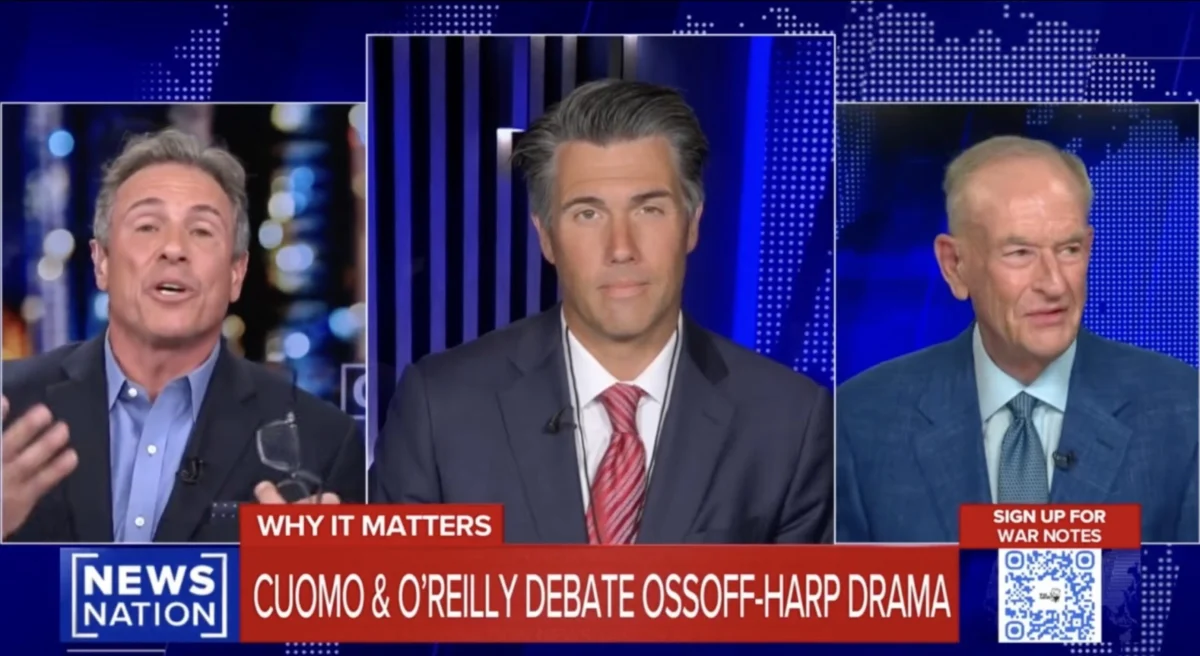
The landscape of cable news commentary witnessed a significant confrontation on Monday night as two of the industry’s most recognizable figures, Chris Cuomo and Bill O’Reilly, engaged in a protracted and highly personal debate. The exchange occurred during the NewsNation program On Balance with Leland Vittert, serving as a stark reminder of the deep ideological and professional divisions that continue to define American political media. What began as a discussion regarding Senator Jon Ossoff’s (D-GA) recent comments about a top aide to former President Donald Trump quickly spiraled into a fifteen-minute interrogation of journalistic integrity, partisan bias, and the historical records of both commentators.
The primary catalyst for the dispute was the "Natalie Harp saga," a controversy stemming from remarks made by Senator Ossoff during a political rally earlier this month. Ossoff had drawn attention to the close proximity and professional relationship between Donald Trump and Natalie Harp, a former One America News (OAN) personality who now serves as a key communications aide to the former president. O’Reilly, the former host of The O’Reilly Factor on Fox News, accused Cuomo, a former CNN anchor, of failing to apply the same level of scrutiny to Democratic rhetoric as he does to Republican statements.
The Genesis of the Dispute: The Natalie Harp Controversy
To understand the intensity of the Monday night clash, it is necessary to examine the underlying event involving Senator Jon Ossoff and Natalie Harp. During a rally in Georgia, Ossoff made comments that O’Reilly and other conservative commentators characterized as a "smear" against Harp. Harp has gained notoriety in political circles for her constant presence by Trump’s side, often carrying a portable printer to provide the former president with immediate access to news clips and social media posts.
O’Reilly asserted that Cuomo had previously refused to condemn Ossoff’s remarks when prompted. "When I asked Chris last week to criticize Ossoff for what he did, he did not do it," O’Reilly stated during the segment. "Instead, he turned it on me and said, ‘OK, you say nothing about Trump’s insults.’ That’s not true, and we provided NewsNation with a montage."
This accusation set the stage for a broader debate about the consistency of media criticism. O’Reilly’s central argument was that the mainstream media, and Cuomo specifically, operate with a double standard, ignoring vitriol from the left while obsessing over the rhetoric of the right. Cuomo, conversely, argued that O’Reilly’s attempts to frame himself as an objective critic of Donald Trump were fundamentally disingenuous.
A Chronology of the 15-Minute Confrontation
The debate on On Balance did not follow a traditional interview format; rather, it functioned as a high-stakes rhetorical sparring match that Leland Vittert struggled to moderate. The chronology of the exchange highlights a rapid escalation from professional disagreement to personal animosity.
- The Opening Salvo: O’Reilly initiated the conflict by revisiting a previous conversation where he felt Cuomo had evaded a direct question about Senator Ossoff. He presented his argument as a matter of factual record, claiming that he had fulfilled his end of a "challenge" by providing clips of himself criticizing Donald Trump.
- The "Puppy" Analogy: Cuomo immediately rejected O’Reilly’s premise. He characterized O’Reilly’s relationship with Trump as subservient, using the metaphor of a "little puppy." Cuomo argued that while O’Reilly might offer mild critiques of Trump, he remains fundamentally aligned with the MAGA (Make America Great Again) movement.
- The Montage Interlude: Leland Vittert attempted to ground the discussion by introducing a montage of clips curated by O’Reilly’s team. These clips were intended to show O’Reilly criticizing the former president. Cuomo preemptively dismissed the video as "cherry-picked."
- The Escalation: Following the montage, Cuomo’s tone became increasingly sharp. He accused O’Reilly of "playing in the pigpen with the MAGA people" and suggested that O’Reilly’s professional conduct was motivated by content creation rather than a pursuit of the truth. He also referenced O’Reilly’s radio appearances and interactions with other conservative hosts, labeling them as dishonest.
- The Counter-Attack: O’Reilly responded by accusing Cuomo of indifference toward the truth. "You don’t care whether what you’re saying is true or not," O’Reilly fired back. He defended his record by claiming he possessed "50 clips" of himself challenging Trump, though he noted the segment was not a "telethon" and could not show them all.
- The Final Minutes: As the clock neared the fifteen-minute mark, the argument became a meta-commentary on the state of the media. Vittert admitted to the audience that after ten minutes of listening, the core of the argument had become obscured by the vitriol. Cuomo snapped back, suggesting the audience understood the stakes even if the moderator did not.
The Montage Debate: Authenticity vs. Curation
A central point of contention was the video montage provided by O’Reilly. In the world of cable news, "receipts"—or archived footage—are often used to prove consistency or expose hypocrisy. However, the use of such montages is frequently criticized as a form of "confirmation bias" in which only favorable moments are selected.
Cuomo’s dismissal of the montage centered on the "tone" of the criticism. He argued that O’Reilly’s critiques of Trump were superficial and lacked the visceral anger O’Reilly frequently directs toward Democrats like Ossoff. "You call Ossoff a gutter snipe, and you get all angry. And you’re never like that with Trump," Cuomo observed.
Cuomo further pointed out specific instances where he felt O’Reilly had remained silent, such as Trump’s historical attacks on female journalists including Megyn Kelly, Kristen Holmes, and Kaitlan Collins. By citing these specific names, Cuomo sought to illustrate a pattern of selective outrage. O’Reilly’s defense—that he has an extensive library of critical content—did little to satisfy Cuomo, who maintained that the frequency of content does not equate to the integrity of the message.
Historical Context: The Media Career Paths of Cuomo and O’Reilly
The friction between Cuomo and O’Reilly is rooted in their respective histories as pillars of opposing media giants. Bill O’Reilly was the face of Fox News for two decades, pioneering a "no-spin" style of populist, conservative-leaning commentary that transformed the network into a ratings powerhouse. His departure in 2017 following allegations of sexual misconduct (which he denied) marked the end of an era in traditional cable news.
Chris Cuomo, meanwhile, was a central figure at CNN, known for his "Cuomo Prime Time" segments and his more confrontational, liberal-leaning approach. His tenure ended in 2021 amid controversies surrounding his involvement in advising his brother, then-New York Governor Andrew Cuomo, during a political crisis.
Both men have sought professional reinvention on NewsNation, a network that markets itself as a neutral alternative to the perceived partisanship of CNN, MSNBC, and Fox News. Their presence on the same platform creates a unique laboratory for political discourse, but as the Monday night segment demonstrated, their deep-seated stylistic and ideological differences often overshadow the network’s mission of neutrality.
Supporting Data: The Evolution of NewsNation and Cable Ratings
The confrontation between Cuomo and O’Reilly occurs at a time when NewsNation is aggressively expanding its footprint. According to recent Nielsen data, while NewsNation still trails the "Big Three" (Fox, CNN, MSNBC) in total viewership, it has seen year-over-year growth in key demographics. The network’s strategy involves hiring established "stars" from other networks to draw in existing fanbases.
However, segments like the Cuomo-O’Reilly clash highlight a potential risk for the network. While "shouting matches" often drive short-term social media engagement and YouTube views—as evidenced by the rapid sharing of this specific clip—they can also alienate viewers seeking the "unbiased" reporting the network promises. The tension between providing "objective" news and hosting "opinionated" personalities remains a primary challenge for NewsNation’s leadership.
Analyzing the Rhetoric: Personal Insults and Professional Credibility
The rhetoric used during the exchange was notably personal, moving beyond policy disagreements into the realm of character assassination. Cuomo’s use of terms like "little puppy," "pigpen," and "gutter snipe" (referencing O’Reilly’s own words) reflects a rhetorical strategy designed to diminish O’Reilly’s perceived authority.
O’Reilly, for his part, utilized a strategy of "whataboutism," a common tactic in political debate where an accusation is met with a counter-accusation. By focusing on Senator Ossoff, O’Reilly attempted to shift the focus from Trump’s behavior to the behavior of Democratic officials. His claim that Cuomo was "making content" rather than practicing journalism was an attempt to undermine Cuomo’s professional identity as a "fair broker."
This type of exchange is indicative of a broader trend in American political discourse where the "messenger" is often the primary subject of the debate, rather than the "message." The fifteen-minute duration of the argument, without a clear resolution or a shift back to policy, suggests that the conflict itself was the intended product of the segment.
Broader Implications for Media Objectivity and Public Perception
The clash on On Balance serves as a microcosm of the current state of American media. The inability of two veteran broadcasters to agree on basic standards of criticism reflects a fractured reality where "truth" is often viewed through a partisan lens.
For the audience, such exchanges can lead to increased cynicism. When prominent journalists and commentators accuse one another of lying, being "puppies" for politicians, or operating in "pigpens," the credibility of the entire industry is called into question. The "Natalie Harp saga," which was the original topic, was largely lost in the shuffle of personal grievances, leaving viewers with little more than a spectacle of professional animosity.
Furthermore, the incident underscores the difficulty of moderating high-profile personalities in a live television environment. Leland Vittert’s admission that he was unsure what the two men were even arguing about highlights the limitations of the traditional moderator role when faced with two individuals who have decades of experience in controlling the narrative.
As the 2024 election cycle intensifies, confrontations of this nature are likely to become more frequent. The Cuomo-O’Reilly exchange on NewsNation is not merely a "battle of the network stars," but a reflection of a media environment that is increasingly characterized by conflict over consensus. Whether NewsNation can maintain its "middle-of-the-road" identity while hosting such volatile segments remains to be seen, but for now, the network has successfully positioned itself as a primary stage for the ongoing war of words between the old guards of cable news.


 Yuyun Lusiyani
 Joko Widodo
 Pevita Pearce
 admin
admin
