
 Eva Lovia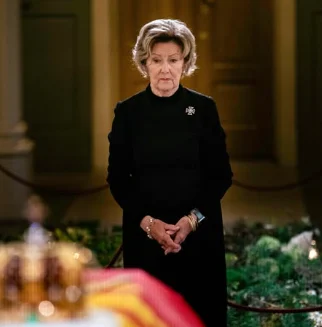
On the eve of the state funeral for His Majesty King Harald V of Norway, his devoted widow, Queen Sonja, maintained a poignant and solitary vigil by his coffin. As the nation prepared for its final, solemn farewell to a monarch who reigned for over three decades, Queen Sonja stood as a solitary figure beside her late husband’s coffin, which lay in state within the hallowed confines of the Royal Palace chapel in Oslo. The profound grief etched on her face was a testament to a shared life that spanned nearly seventy years, a union that began as a controversial romance and blossomed into one of Norway’s most enduring royal partnerships.
The simple yet deeply moving inscription on the wreath of white flowers placed beside the King’s coffin articulated the profound sentiment of a nation and, most intimately, of his wife: “Thank you for a wonderful life.” This succinct message encapsulated a lifetime of shared experiences, devotion, and service to the Norwegian people. Queen Sonja, aged 89, has demonstrated remarkable strength and grace in the wake of her husband’s passing on August 28th. Her tributes have been numerous and deeply personal, reflecting the profound bond they shared. In the immediate hours following the King’s death, she was instrumental in accompanying his coffin on its somber journey back to the Royal Palace, a visible symbol of her unwavering support and love. Two days later, she attended a heartfelt memorial service at Asker, a place of deep personal significance for the royal couple.
The Queen’s active participation in the proceedings underscores her enduring role within the Norwegian monarchy. She walked with quiet dignity behind her husband’s coffin as it was carefully carried through the regal chambers of the Royal Palace, a procession that culminated in its placement in the chapel for public mourning. This act of accompanying her husband on his final journey through their shared home served as a powerful visual representation of their lifelong partnership.
Beyond the immediate funeral arrangements, it has been officially announced that Queen Sonja, along with other members of the Royal Family, will make a public appearance on the Royal Palace balcony following the funeral service. This tradition, deeply ingrained in Norwegian royal custom, offers a moment for the grieving family to acknowledge and receive the condolences of the nation. In the days since King Harald’s death, tens of thousands of Norwegians have converged before the palace, leaving an ocean of flowers and candles as poignant tributes to their beloved monarch. The balcony appearance will serve as a collective moment of shared remembrance and a symbol of continuity for the Norwegian Crown.
The procession of the Royal Family on the balcony will be led by King Haakon VIII, the only son of King Harald and Queen Sonja, and his wife, Queen Mette-Marit. They will be joined by their children, Crown Princess Ingrid Alexandra and Prince Sverre Magnus, signifying the future of the Norwegian monarchy. Queen Sonja will also be present, a unifying figure amidst the younger generation of royals. Completing the immediate family representation will be Princess Märtha Louise, the King and Queen’s daughter, accompanied by her three daughters, Maud Angelica, Leah Isadora, and Emma Tallulah. This gathering on the balcony will underscore the strength and unity of the Royal Family as they navigate this period of profound national grief.
The state funeral of King Harald V is expected to draw a significant congregation of international royalty, a testament to the King’s standing and the deep ties of friendship and kinship that bind European monarchies. Among the distinguished guests confirmed to attend are representatives from the United Kingdom: The Prince of Wales will be present, representing His Majesty King Charles III, and The Princess Royal will attend in a personal capacity as the godmother of the new King, Haakon VIII. This dual representation highlights the close historical and familial connections between the Norwegian and British Royal Families.
From Sweden, King Carl XVI Gustaf and Queen Silvia will be in attendance, accompanied by a substantial delegation including Crown Princess Victoria and Prince Daniel, Prince Carl Philip and Princess Sofia, Princess Madeleine and her husband Chris O’Neill, and Princess Christina. This extensive representation from the Swedish monarchy underscores the close fraternal relationship between the two neighboring kingdoms.
Their Royal Highnesses King Frederik X and Queen Mary of Denmark will also pay their respects, accompanied by their eldest child, Crown Prince Christian. Regrettably, Queen Margrethe II of Denmark will be unable to attend, having been taken to hospital after feeling unwell over the weekend. Her absence is a notable one, given her long-standing relationship with King Harald.
The Netherlands will be represented by Their Majesties King Willem-Alexander and Queen Máxima, accompanied by the heir to the throne, Princess Catharina-Amalia, and former monarch, Princess Beatrix. The King and Queen of the Belgians, Philippe and Mathilde, have also confirmed their attendance, further solidifying the European royal solidarity.
Further representation will come from the Grand Duchy of Luxembourg, with Their Royal Highnesses Grand Duke Guillaume and Grand Duchess Stéphanie attending, alongside former ruler Grand Duke Henri. From the Principality of Monaco, Their Serene Highnesses Prince Albert II and Princess Charlene will also be present. Finally, Their Majesties King Felipe VI and Queen Letizia of Spain, along with Queen Sofía, will join the international mourners. The presence of such a distinguished assembly of monarchs and royals from across Europe serves not only as a tribute to King Harald V but also as a powerful demonstration of the enduring relevance and interconnectedness of European monarchies in the 21st century.
The funeral procession is scheduled to commence from the Royal Palace at 12:00 noon on September 9th, with the state service to be held at Oslo Cathedral at 1:00 PM local time. Following the service, King Harald’s coffin will be conveyed to Akershus Fortress, a historic site deeply intertwined with Norway’s past, where he will be laid to rest in a private ceremony within the Royal Mausoleum. This final resting place, steeped in national history, provides a fitting and dignified end for a monarch who dedicated his life to his country. The subsequent return of the Royal Family to the palace for the balcony appearance and a reception for guests signifies the commencement of a new chapter for the Norwegian monarchy, one that will be shaped by the legacy of King Harald V and the continuity provided by his successor.
Background and Context of King Harald V’s Reign
King Harald V ascended to the throne on January 17, 1991, following the death of his father, King Olav V. His reign was marked by a steadfast commitment to constitutional monarchy, a dedication to serving the Norwegian people, and a deep personal connection with his subjects. Born in 1937, Harald’s early life was shaped by the tumultuous events of World War II. As Crown Prince, he lived in exile in Sweden and later the United States, returning to Norway in 1945. His upbringing instilled in him a profound understanding of the sacrifices made by his nation and a deep appreciation for its democratic values.
His marriage to Sonja Haraldsen in 1968 was a landmark event in Norwegian royal history. Their union, between a Crown Prince and a commoner, was initially met with public apprehension but ultimately came to symbolize a modernizing monarchy, more in touch with the lives of ordinary Norwegians. This blend of tradition and a forward-looking approach characterized much of Harald’s reign.
King Harald was known for his approachable demeanor, his passion for sailing, and his unwavering dedication to environmental causes. He navigated Norway through periods of significant economic prosperity, technological advancement, and evolving social landscapes. His reign coincided with Norway’s rise as a major player on the global energy stage and its continued commitment to international peace and humanitarian efforts. He was a vocal advocate for human rights and a bridge-builder in diplomatic relations. His public addresses often carried a tone of warmth, humility, and a deep sense of duty, resonating with a broad spectrum of the Norwegian population.
Chronology of Recent Events
- August 28, 2024: His Majesty King Harald V of Norway passes away at the age of 87. The news is met with widespread national mourning.
- August 28, 2024 (Evening): The coffin of King Harald V is transported from the National Hospital to the Royal Palace in Oslo. Queen Sonja accompanies the coffin.
- August 30, 2024: A memorial service is held in memory of King Harald V at Asker Church, attended by Queen Sonja and other members of the Royal Family.
- September 1, 2024: The lying in state of King Harald V begins at the Royal Palace chapel, allowing the public to pay their respects. Queen Sonja maintains a solitary vigil by the coffin.
- September 9, 2024 (12:00 PM): The funeral procession begins from the Royal Palace.
- September 9, 2024 (1:00 PM): The state funeral service takes place at Oslo Cathedral.
- Post-Funeral: The coffin is conveyed to Akershus Fortress for a private burial in the Royal Mausoleum.
- Post-Funeral (Following Day): The Royal Family, including Queen Sonja, King Haakon VIII, Queen Mette-Marit, their children, and Princess Märtha Louise and her daughters, will appear on the Royal Palace balcony to acknowledge the public.
Supporting Data and Analysis
King Harald V’s reign, spanning over 33 years, positions him as one of Norway’s longest-reigning monarchs. This longevity allowed him to become a consistent and unifying figure in a rapidly changing world. His passing marks the end of an era for Norway, a period characterized by stability and a strong sense of national identity, often fostered by his steady presence.
The significant international attendance at his funeral underscores Norway’s respected position on the global stage and the enduring influence of its royal family. The presence of heirs to numerous thrones, such as Crown Princess Ingrid Alexandra of Norway, Crown Princess Victoria of Sweden, and Crown Prince Christian of Denmark, highlights the continuity and intergenerational relationships within European monarchies. This diplomatic gathering, even in the context of grief, serves to reinforce alliances and shared values among these nations.
The economic impact of a state funeral of this magnitude, while secondary to the solemnity of the occasion, involves significant logistical planning and security measures. The closure of public spaces, traffic diversions, and the deployment of security personnel are all part of managing such a high-profile national event. However, the primary focus remains on honoring the late monarch and providing a dignified farewell.
The appearance of the Royal Family on the palace balcony is a crucial moment for public engagement and reinforces the symbolic connection between the monarchy and the people. It allows for a visible display of unity and resilience, assuring the public of the continued strength of the institution. This public interaction, especially following a period of mourning, is vital for maintaining public trust and affection for the Crown.
Official Responses and Reactions
While direct quotes from specific family members beyond the initial announcement of grief are not detailed in the provided text, the actions and presence of Queen Sonja, King Haakon VIII, and other family members speak volumes. Queen Sonja’s solitary vigil, her participation in processions, and her planned balcony appearance are powerful non-verbal expressions of her love, respect, and unwavering commitment to her late husband and her role as Queen.
The official statements from the Norwegian Royal House following King Harald’s passing expressed profound sorrow and highlighted his lifelong dedication to Norway. They emphasized his role as a national father figure and a source of unity and strength. The planned balcony appearance, as announced, is framed as an opportunity for the family to receive the nation’s condolences and to express their gratitude for the outpouring of support.
The international dignitaries attending the funeral are expected to convey their personal condolences and official messages of sympathy from their respective governments and royal houses. These expressions of solidarity are a crucial part of diplomatic protocol during times of national mourning for heads of state and their families.
Broader Impact and Implications
The death of King Harald V and the subsequent funeral mark a significant transition for Norway. His successor, King Haakon VIII, now assumes the mantle of leadership at a time when monarchies across Europe are continually adapting to contemporary societal expectations. King Haakon, having been groomed for this role throughout his life, faces the challenge of building upon his father’s legacy while navigating the evolving landscape of public perception and the demands of a modern constitutional monarchy.
The enduring popularity of the Norwegian monarchy, as evidenced by the public’s outpouring of grief and respect, suggests a strong foundation for King Haakon VIII. However, the institution’s continued relevance will depend on its ability to connect with younger generations and to adapt to societal changes. Queen Sonja’s continued presence and influence will likely provide a vital source of continuity and experience for the new King and Queen.
The strong turnout of international royalty at the funeral also signals the continued importance of inter-royal relationships as a form of soft diplomacy. These connections, built over generations, foster understanding and cooperation between nations, even in the absence of formal political ties. The Norwegian Royal Family, through their relationships with other European royal houses, plays a role in maintaining these valuable networks.
In conclusion, the passing of King Harald V and the preparations for his state funeral are a profound moment for Norway. Queen Sonja’s quiet strength and dignified tributes, alongside the collective grief and respect shown by the nation and the international community, underscore the significant impact of his reign. As Norway bids a final farewell to its beloved monarch, the nation looks to the future, confident in the continuity of its royal family and the enduring values that King Harald V so steadfastly represented.




 Yuyun Lusiyani
 Joko Widodo
 Jia Lissa
 Pevita Pearce
 admin
admin
