
 Jia Lissa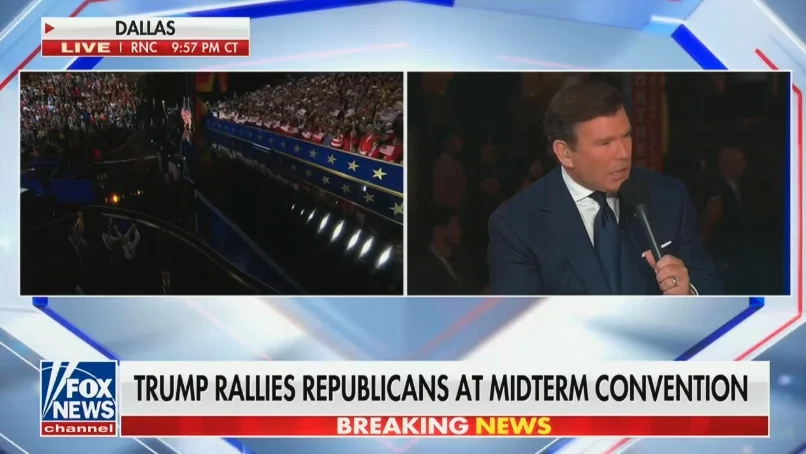
The Republican National Committee (RNC) recently concluded a high-stakes, two-day midterm convention in Dallas, Texas, an event characterized by both intense party loyalty and notable absences from the party’s moderate wing. At the center of the gathering was a marathon keynote address delivered by former President Donald Trump, which drew significant attention not only for its length and rhetorical style but also for the effusive praise it received from Fox News’ chief political anchor, Bret Baier. Baier, who leads the network’s flagship "straight news" program, Special Report, departed from his typical neutral posture to laud the former president’s performance during a post-speech analysis with colleague Sean Hannity.
The convention, organized at the explicit urging of the former president, served as a strategic rallying point for the Republican Party as it prepares for a pivotal midterm election cycle. However, the event was not without internal controversy. Reports indicated that the RNC had requested Republican candidates attending the event to contribute $25,000 to the party, a move that drew criticism from some GOP figures. Former governors and party strategists expressed concern that such a high financial barrier might divert much-needed resources away from individual campaigns and toward the central party apparatus, potentially straining the budgets of candidates in tight races.
A Marathon Address in the Heart of Texas
President Trump’s speech on Wednesday night lasted one hour and 45 minutes, a duration that tested the stamina of both the speaker and the audience. Throughout the address, the former president touched on a wide array of topics, ranging from the existential state of the nation to specific endorsements of local Texas officials. In one of the more striking moments of the evening, Trump suggested that the United States might not "even exist" currently had the outcome of the 2024 election—or his ongoing political movement—been different. This rhetoric of existential crisis has become a hallmark of his recent public appearances, aimed at galvanizing his base by framing the political landscape as a struggle for national survival.
The speech also delved into the intricacies of Texas politics. Trump urged the crowd to support Ken Paxton for the U.S. Senate, despite offering a backhanded compliment regarding Paxton’s appearance, noting he might not be "the best-looking guy" but remained a staunch political ally. Furthermore, the former president found himself in the position of mediator when the Dallas crowd began to boo Senate Majority Leader John Thune (R-SD). Trump intervened, scolding the audience and attempting to maintain a semblance of party unity, even as he has frequently clashed with Thune and other members of the traditional GOP leadership in the past.
Media Reaction and the Baier-Hannity Exchange
Following the conclusion of the address, Bret Baier joined Sean Hannity to offer an immediate assessment of the performance. Baier’s commentary was notably positive, focusing on the former president’s physical and mental energy. Addressing Hannity, who has maintained a well-documented personal and professional relationship with Trump, Baier remarked on the "barn-buster" nature of the speech.
"Listen, Sean, you know this president better than most," Baier stated. "But this is him energized. This is him feeding off this crowd. This is, you know, he just loves this element. And let’s remind everybody, this guy is 80 years old. He just gives this barn-buster speech. He went all over the place. We got this speech written out. There were a lot of fill-in-the-blanks."
Hannity concurred with Baier’s assessment of the speech’s improvisational nature, noting that had the former president stuck strictly to the teleprompter, the address likely would have lasted only 40 minutes. Baier highlighted what he considered the most resonant line of the night: "On election night we’re going to prove that America does not belong to those who hate it. America belongs to those who love it." Baier identified this as the moment that elicited the strongest reaction from the Dallas audience, framing it as a central pillar of the former president’s current messaging strategy.
Political Context and Polling Data
The Dallas convention took place against a backdrop of complex polling data and a divided Republican electorate. While the former president remains the most influential figure within the party, his approval ratings in several major national polls remain "underwater," with a majority of respondents expressing unfavorable views. Despite these figures, Trump has insisted on positioning the upcoming midterm elections as a referendum on his record and his vision for the country’s future.
This strategy has created a rift among Republican incumbents. While the Dallas convention saw strong attendance from the party’s "MAGA" wing, many high-profile Republicans—particularly those representing swing states or competitive districts—opted to skip the event. These candidates are often wary of being too closely tied to the former president’s more polarizing rhetoric, fearing it could alienate moderate and independent voters necessary for victory in November. The decision to stay away highlights the ongoing tension within the GOP between the populist base and the more traditional or moderate elements of the party.
Chronology of the Dallas Convention
To understand the significance of the event, it is essential to look at the timeline of its development:
- Event Announcement: The RNC announced the two-day Dallas convention earlier this year, citing the need for a unified strategy ahead of the midterms.
- Financial Controversy: Weeks before the event, reports surfaced regarding the $25,000 "attendance fee" for candidates, leading to public questioning of the party’s fundraising priorities.
- The Keynote Address: On Wednesday night, Donald Trump took the stage for a nearly two-hour speech, covering national security, local endorsements, and critiques of the current administration.
- Immediate Media Analysis: Minutes after the speech concluded, Bret Baier and Sean Hannity provided their analysis on Fox News, emphasizing the former president’s vigor and the crowd’s enthusiasm.
- Post-Convention Fallout: In the days following the event, political analysts began measuring the impact of the "referendum" strategy on polling in key battleground states like Pennsylvania, Arizona, and Georgia.
Implications for the Republican Party
The enthusiasm displayed by Bret Baier and the Dallas crowd underscores a significant reality of modern American politics: the former president’s ability to command the spotlight and energize his core supporters remains unparalleled. For the RNC, the Dallas convention was a successful display of base mobilization. However, the broader implications for the general election are more nuanced.
By making the midterms a referendum on himself, Trump is betting that his base’s enthusiasm will outweigh any potential backlash from moderate voters. This strategy places a heavy burden on Republican candidates who must navigate the space between Trump’s loyalists and the broader electorate. The "love it or hate it" rhetoric highlighted by Baier serves as a potent tool for internal mobilization, but it also reinforces the deep partisan divisions that have come to define the American political landscape.
Furthermore, the praise from a "straight news" figure like Bret Baier is significant. It suggests that even within the more traditional news-gathering arms of conservative media, there is a recognition of Trump’s enduring vitality as a political force. This alignment between the news and opinion sides of the network may signal a more unified media front heading into the final months of the campaign.
Official Responses and Divergent Perspectives
While the RNC and Trump’s allies have hailed the Dallas convention as a triumph of unity and energy, other voices within the party have been more cautious. Some GOP strategists have pointed out that while energy in a Dallas ballroom is important, it does not necessarily translate to votes in suburban districts in the Midwest.
"The challenge for the party is not the base; the base is already there," noted one anonymous Republican consultant. "The challenge is the suburban voter who is concerned about inflation and the economy but is also weary of the constant political drama. A two-hour speech about the 2024 election doesn’t always address those kitchen-table issues."
In contrast, RNC officials defended the event and the fundraising requirements, stating that the funds are essential for building the infrastructure needed to compete with the Democratic Party’s own fundraising machine. They argue that the former president’s involvement is the single greatest asset the party has for generating the resources and turnout necessary for a "Red Wave" in November.
Conclusion: A Party at a Crossroads
As the Republican Party moves forward from the Dallas convention, the path to the midterms remains fraught with both opportunity and risk. The energy and stamina displayed by Donald Trump, as noted by Bret Baier, suggest that the former president is fully committed to his role as the party’s primary architect and spokesperson. Whether this high-energy, personality-driven approach will resonate with a national electorate remains the central question of the 2024 cycle.
The Dallas convention served as a microcosm of the current GOP: a party deeply devoted to its leader, willing to pay high premiums for access and influence, yet still grappling with internal divisions and a challenging national polling environment. As candidates return to their home districts, the echoes of Trump’s "barn-buster" speech and Baier’s enthusiastic endorsement will likely continue to shape the narrative of the campaign, for better or for worse, in the eyes of the American voter.




 Yuyun Lusiyani
 Joko Widodo
 Pevita Pearce
 admin
admin
