
 Jia Lissa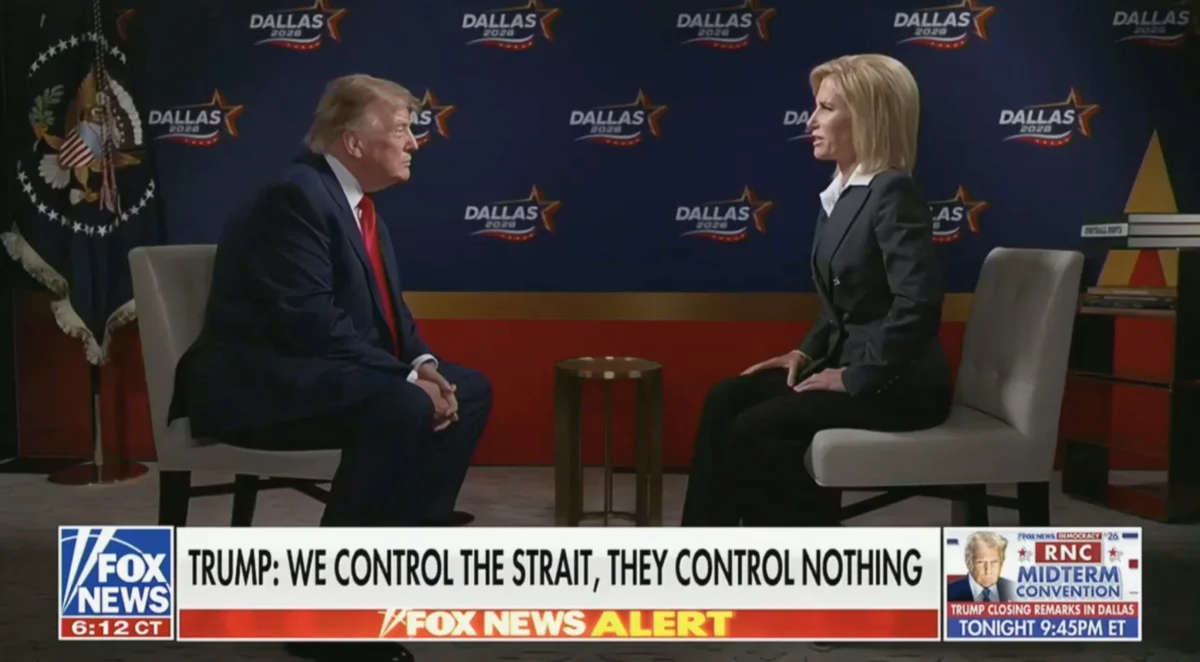
During a high-profile interview on Thursday’s edition of Fox News’s The Ingraham Angle, President Donald Trump and host Laura Ingraham engaged in a pointed exchange regarding the ongoing military conflict with Iran. Speaking from the sidelines of a Republican midterm convention in Dallas, Texas, the two figures sparred over the administration’s strategic objectives, the resilience of Iranian military capabilities, and the potential domestic political fallout as the United States approaches a critical election cycle. The conversation highlighted a growing tension between the administration’s claims of military dominance and the reality of persistent Iranian strikes against U.S. assets in the region.
The exchange began with Ingraham questioning the efficacy of the current military campaign. Despite the administration’s previous assertions that Iranian forces had been significantly degraded, Ingraham noted that Tehran remains capable of launching sophisticated attacks. "I thought we decimated them," Ingraham remarked, pointing to recent reports of Iranian forces firing on U.S. Navy vessels. President Trump countered this narrative, asserting that the U.S. military had successfully "knocked out nine of their tankers" and insisting that the Islamic Republic is currently "limping along." However, the President stopped short of providing a specific end date for the hostilities, reiterating his belief that the conflict would conclude "right after the election."
The Strategic Discord and the 2029 Horizon
A central point of contention during the interview involved the projected duration of the conflict. Ingraham cited a recent report from The Wall Street Journal suggesting a rift within the administration’s inner circle. According to the report, Secretary of State Marco Rubio and Vice President JD Vance have privately expressed concerns that the military engagement with Iran could persist well beyond the current term, potentially lasting until January 2029.
This long-term projection stands in stark contrast to the President’s public-facing optimism. When pressed on the discrepancy, Trump maintained that the Iranian government is in "deep trouble" and that their ability to sustain a prolonged war is overstated. Nevertheless, the admission that top advisors are bracing for a multi-year engagement suggests a more complex military reality than the "decimated" narrative implies. The President’s insistence that the war’s conclusion is tied to the election cycle also raised questions among analysts regarding whether military strategy is being influenced by domestic political considerations.
Military Resilience vs. Administrative Claims
The technical capability of Iran to continue missile strikes remained a focal point of the discussion. Ingraham asked, "How are they getting off missiles?" referring to recent strikes on U.S. military installations and aircraft, including a notable strike on a base in Jordan. Trump’s response—that "they can always get off missiles" but are "largely wiped out"—reflects the difficulty of achieving total neutralization of mobile missile batteries and asymmetric warfare capabilities.
Military data from independent think tanks suggests that while Iran’s conventional naval and air forces have faced significant pressure, their ballistic missile program and drone technology remain robust. This technical persistence allows Tehran to project power and conduct "nuisance" strikes that, while perhaps not strategically decisive, serve to undermine the narrative of total U.S. military control. The President’s acknowledgment that he has avoided a "full" military incursion partly due to the upcoming election further underscores the cautious balancing act between military objectives and voter sentiment.
The Economic and Political Stakes of the Midterm Convention
The interview took place against the backdrop of a Republican convention in Dallas that has seen a mix of high-energy rallies and logistical challenges. For the GOP, the "Iran war"—a term the administration occasionally swaps for "military conflict" to soften public perception—is a double-edged sword. Ingraham argued that the conflict has had a tangible negative impact on the President’s midterm prospects, specifically citing the rise in energy costs.
"If we hadn’t done Iran, you’d be cruising to midterm victory," Ingraham predicted, noting that gas prices could have been as low as $2.25 per gallon without the regional instability. Trump rejected the notion of regret, stating, "I don’t believe in the word regret. You can always question yourself a little bit." He maintained that his "Maximum Pressure" campaign was the only way to prevent Iran from obtaining a nuclear weapon, which he claimed the Democratic party would essentially allow.
Chronology of the Conflict and Escalation
The current state of hostilities is the result of a multi-year escalation that began with the U.S. withdrawal from the Joint Comprehensive Plan of Action (JCPOA) in 2018. The timeline of the conflict highlights several key flashpoints:
- May 2018: The U.S. exits the Iran nuclear deal, reimposing heavy economic sanctions.
- January 2020: The targeted strike on General Qasem Soleimani leads to a direct missile exchange between the two nations.
- 2022-2023: Increased incidents in the Strait of Hormuz, with both sides reporting the seizure or destruction of naval vessels.
- Present Day: Continued drone and missile attacks on U.S. bases in Jordan and Iraq, alongside U.S. retaliatory strikes on Iranian-backed infrastructure.
This chronology illustrates a shift from economic warfare to direct kinetic engagement. The President’s assertion that the conflict will end "right after the election" suggests a pivot toward a diplomatic or final military resolution, though critics argue that such timelines are rarely dictated by the American election calendar alone.
Domestic Unrest and the China Comparison
In a notable turn in the interview, President Trump addressed the internal stability of the Iranian regime. He predicted that at some point, the Iranian military and law enforcement would refuse to continue the crackdown on domestic protesters. However, he drew a controversial parallel to historical events in China, noting that the Chinese government successfully suppressed the 1989 Tiananmen Square protests using "the army tank," while other countries failed to maintain order in similar fashion.
Ingraham countered by highlighting China’s recent history of avoiding foreign military entanglements. "China never seems to get in many military conflicts," she observed, suggesting that Beijing’s focus on industrialization and domestic economic strength has allowed it to grow without the drain of "forever wars." This comparison touched on a sensitive nerve within the "America First" movement, which often debates the merits of isolationism versus interventionism.
Broader Implications and Official Responses
The reaction to the interview has been swift across the political spectrum. Democratic leaders have characterized the President’s comments as proof that the administration lacks a clear "exit strategy" for the Middle East. A spokesperson for the Democratic National Committee suggested that the President’s admission of delaying full military action for the sake of the election was "a dangerous politicization of national security."
Conversely, supporters of the administration point to the "all-time high" stock market and the containment of Iranian nuclear ambitions as proof of success. They argue that the "decimation" of Iranian proxies and the destruction of tankers mentioned by the President have successfully deterred a larger regional conflagration.
From a geopolitical perspective, the implications are profound:
- Nuclear Proliferation: The administration’s primary justification remains the prevention of a nuclear-armed Iran. Any perceived weakness in the U.S. position could embolden Tehran to accelerate enrichment.
- Regional Alliances: Partners like Israel and Saudi Arabia are watching the U.S. election closely, as a change in administration or a shift in the "Maximum Pressure" policy would require a total recalibration of their own security strategies.
- Global Energy Markets: As Ingraham noted, the conflict remains a primary driver of volatility in oil prices. Until a resolution is reached, global markets will likely remain on edge, sensitive to any disruption in the Persian Gulf.
Conclusion
The dialogue between President Trump and Laura Ingraham serves as a microcosm of the broader debate currently taking place within the United States. It pits a "victory-oriented" executive narrative against a more skeptical, "realist" assessment of military and economic costs. As the midterms approach, the administration’s ability to reconcile its claims of military success with the reality of ongoing Iranian resistance will likely be a deciding factor for voters concerned with both national security and the domestic economy. For now, the "Iran war" remains an open-ended conflict, with the January 2029 date looming as a potential, albeit grim, milestone for a conflict that many hoped would have ended years ago.




 Yuyun Lusiyani
 Joko Widodo
 Eva Lovia
 Pevita Pearce
 admin
admin
 Lina Irawan