
 Jia Lissa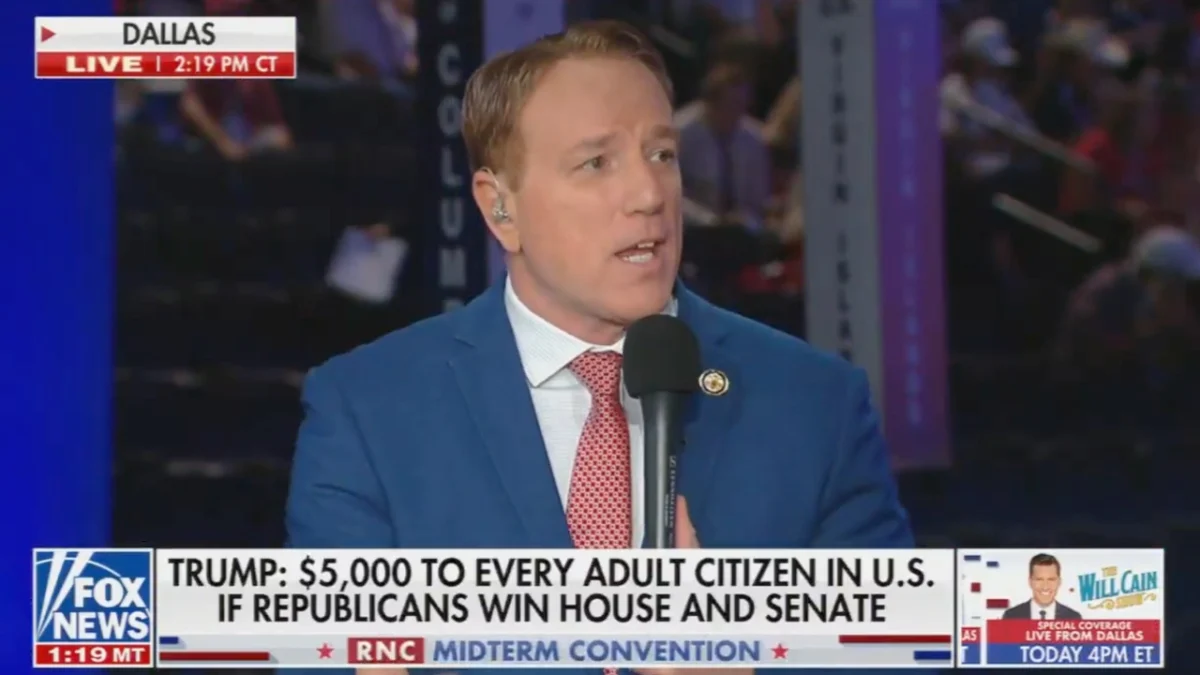
During a recent appearance on Fox News, Congressman Pat Fallon (R-TX) sought to clarify and contextualize a high-profile campaign promise made by former President Donald Trump regarding a proposed $5,000 payment to American citizens. The statement, which Trump delivered during a rally in Houston, suggested that a Republican victory in the upcoming midterm elections would result in a direct financial "dividend" for every adult citizen in the United States. Fallon’s intervention highlights an ongoing effort within the Republican Party to frame the former president’s populist economic rhetoric as a standard fiscal policy involving tax rebates rather than a new federal spending program.
The controversy began when Donald Trump told a crowd of supporters that the current state of the U.S. economy, which he described as robust under his previous administration’s foundational policies, would allow for a massive redistribution of wealth if his party regained control of Congress. "If the Republicans win," Trump stated, "I will issue a dividend to every adult citizen in the United States of America for $5,000." This claim immediately drew fire from fiscal conservatives, Democratic opponents, and media analysts, many of whom questioned the feasibility and the underlying motivation of such a massive cash infusion.
Representative Fallon’s "Rebate" Defense
In his interview with Fox News, Congressman Fallon worked to rebrand the "dividend" as a return of taxpayer funds rather than a government handout. "It’s our money. And it’s just, like you said, it’s a rebate," Fallon explained, responding to the growing skepticism surrounding the proposal. He argued that Trump’s language was perhaps less about a literal guarantee of immediate checks and more about the legislative potential that would exist under a Republican-controlled legislature.
"If President Trump isn’t saying that if we win, we’ll do this, he’s saying we’ll be in a position to do this because we’ll have the votes to do it," Fallon added. He emphasized a core tenet of conservative economic philosophy: that the government does not generate wealth, but merely collects it from the private sector. "The government creates nothing. The private sector does. And I think it’s unfortunate that so many folks on the other side of the aisle don’t appreciate that."
By framing the $5,000 as a "rebate" of "our money," Fallon attempted to align the proposal with traditional GOP goals of tax reduction. However, the distinction between a tax cut—which reduces the amount of money the government takes in—and a universal dividend—which involves the government sending out checks regardless of an individual’s tax liability—remains a point of significant contention.
Calculating the Fiscal Impact of a Universal Dividend
To understand the magnitude of the former president’s proposal, it is necessary to examine the demographic and fiscal data of the United States. According to the U.S. Census Bureau’s recent estimates, there are approximately 258 million adults (aged 18 and older) currently residing in the country. A $5,000 payment to every adult citizen would require a total federal expenditure of approximately $1.29 trillion.
To put this figure into perspective, a $1.29 trillion payout would represent nearly 20% of the total federal budget for the 2023 fiscal year. It would also significantly exceed the cost of the 2017 Tax Cuts and Jobs Act over its first several years of implementation. Critics have pointed out that such an expenditure would likely necessitate a massive increase in the national debt, which currently exceeds $31 trillion, or a drastic reduction in existing federal programs, including Social Security and Medicare—options that are generally unpopular with the electorate.
Furthermore, the proposal comes at a time when the United States is grappling with persistent inflation. Economic theory generally suggests that injecting over $1 trillion in liquidity directly into the hands of consumers would increase demand for goods and services, potentially driving prices higher and exacerbating inflationary pressures. This potential consequence has led some economists to label the plan counterproductive to the goal of stabilizing the cost of living.
A History of "Big Check" Rhetoric
The $5,000 promise is not an isolated incident in Donald Trump’s political history. During his presidency, particularly in the wake of the COVID-19 pandemic, Trump frequently advocated for direct payments to Americans. In 2020, he famously pushed for $2,000 stimulus checks, a move that put him at odds with then-Senate Majority Leader Mitch McConnell and other fiscal hawks within the Republican Party.
CNN’s Manu Raju noted on "Inside Politics" that the former president has established a pattern of promising large financial returns to voters. Raju presented a compilation of instances where Trump promised "big checks" for various reasons, ranging from trade deal surpluses to healthcare savings. "The president’s been making these promises over and over again about giving a rebate check for this and that and the other," Raju observed.
Journalist Leigh Ann Caldwell highlighted the irony in Trump’s justification for the payment. According to Caldwell, Trump’s rhetoric suggested that the U.S. fiscal situation was so prosperous that the government could afford to distribute trillions of dollars. "The funniest part of that entire thing was his lead up talking about the way that… the fiscal situation is so great in the United States that he’s able to pay Americans if Republicans win," Caldwell remarked, pointing to the disconnect between that narrative and the actual federal deficit.
Bipartisan Criticism and the "Bribery" Allegation
The reaction to the $5,000 dividend proposal has been sharply critical, spanning the political spectrum. While Democrats have dismissed it as a desperate attempt to sway voters, some of the most pointed critiques have come from within the conservative movement.
Charles C.W. Cooke, a prominent columnist for the National Review, published a scathing op-ed titled "Trump’s $5,000 Giveaway Scheme Is Morally, Practically, and Politically Catastrophic." Cooke argued that the proposal was a departure from conservative principles and an embrace of the very "socialism" that Republicans often decry. "Painfully aware that, once the midterms are over, he risks being gradually consigned to irrelevance, President Trump has hit once again upon a Hail Mary plan for political success. That plan is bribery," Cooke wrote.
Cooke’s analysis emphasized the ideological inconsistency of the move. He noted that Trump made the $5,000 pledge shortly after delivering a speech condemning the rise of socialism in America. By promising a government-issued "dividend," Cooke argued, Trump was essentially proposing a form of Universal Basic Income (UBI), a policy more commonly associated with the progressive wing of the Democratic Party.
Legislative and Constitutional Hurdles
Beyond the political and economic criticism, the implementation of a $5,000 universal dividend faces immense legislative hurdles. Under the U.S. Constitution, the "power of the purse" resides with Congress. Article I, Section 9, Clause 7 stipulates that "No Money shall be drawn from the Treasury, but in Consequence of Appropriations made by Law." This means that even if a Republican president were in office, he could not unilaterally issue checks; a bill would have to pass both the House of Representatives and the Senate.
Given the current political climate, such a bill would likely face a filibuster in the Senate, requiring 60 votes to proceed. Even with a Republican majority, it is highly improbable that every GOP senator—many of whom are staunch fiscal conservatives—would support a $1.3 trillion spending increase. This reality lends weight to Representative Fallon’s attempt to characterize the statement as a goal of being "in a position to do this" rather than a concrete, immediate promise.
The Midterm Context and Voter Sentiment
The timing of Trump’s proposal is significant. As the midterm elections approach, both parties are focusing heavily on the economy, which polls consistently show as the top concern for voters. Republicans have centered their campaign on high gas prices and inflation, blaming the Biden administration’s spending for the economic downturn.
The $5,000 dividend appears to be a counter-strategy designed to offer a tangible financial incentive to the Republican base and undecided voters. However, the move carries political risk. By promising a massive government payout, the former president may undermine the GOP’s broader message of fiscal responsibility and smaller government.
For many voters, the memory of the COVID-19 stimulus checks remains fresh. Those payments were widely popular at the time but have since been criticized by many Republicans as a primary driver of the current inflationary cycle. Trump’s new proposal forces Republican candidates like Pat Fallon to navigate a difficult path: supporting the leader of their party while simultaneously reassuring fiscally conservative donors and voters that the party has not abandoned its commitment to reducing the deficit.
Conclusion and Future Implications
As the debate over the $5,000 "dividend" continues, it serves as a microcosm of the current state of the Republican Party—a tension between traditional conservative fiscal policy and the populist, transaction-based politics of Donald Trump. While Representative Pat Fallon’s attempt to frame the proposal as a "rebate" of "taxpayer money" provides a degree of political cover, the sheer scale of the proposed expenditure remains a significant hurdle for policy analysts and lawmakers alike.
The coming months will determine whether this proposal remains a staple of the campaign trail or if the bipartisan backlash forces a pivot in strategy. Regardless of the outcome, the discussion has once again highlighted the central role of direct financial appeals in modern American politics and the complex relationship between political rhetoric and fiscal reality. For now, the "big check" remains a powerful, if controversial, tool in the former president’s political arsenal, challenging his allies to find a way to reconcile his populist promises with the party’s long-standing economic identity.




 Yuyun Lusiyani
 Joko Widodo
 Eva Lovia
 Pevita Pearce
 admin
admin
 Lina Irawan