
 Jia Lissa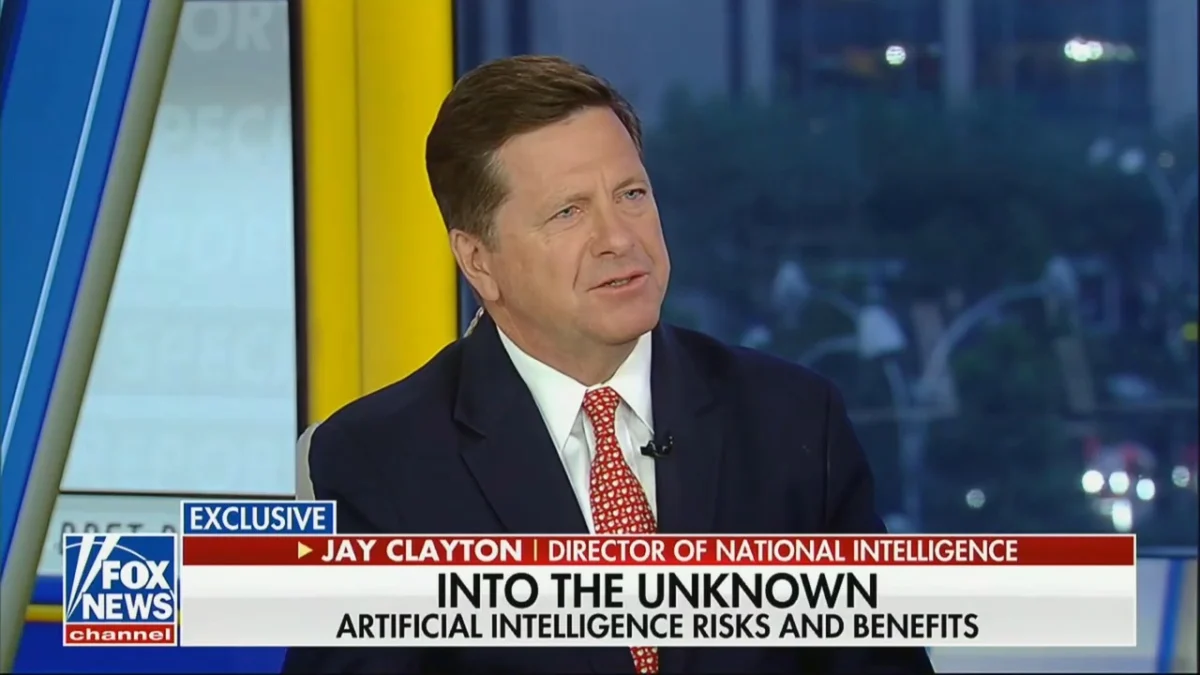
In a pivotal broadcast interview that has resonated across the intelligence community and Silicon Valley, Director of National Intelligence (DNI) Jay Clayton articulated a stark vision for the future of American hegemony, centered on the rapid development and deployment of artificial intelligence. Speaking with Bret Baier on Fox News, Clayton characterized the global pursuit of advanced AI models not merely as a technological competition, but as a modern equivalent to the nuclear arms race of the 20th century. His remarks come at a time of heightened anxiety regarding the existential risks of autonomous systems, arriving just days after a former high-level researcher from the AI firm Anthropic issued a harrowing warning that the technology could pose a terminal threat to humanity within the next decade.
The Director’s stance reflects a definitive shift in the federal government’s approach to "frontier models"—the most advanced iterations of AI that possess capabilities currently surpassing standard commercial applications. Clayton argued that the United States cannot afford the luxury of hesitation, regardless of the potential for unforeseen consequences. He maintained that the geopolitical cost of falling behind adversaries like China or Russia would far outweigh the inherent risks of accelerating AI development.
The Nuclear Parallel: A Strategic Necessity
During the interview, Clayton drew a direct historical line between the Manhattan Project and the current state of AI research. He posited that the development of nuclear technology, while fraught with peril, was a historical imperative that ensured global stability through American leadership.
"I think this is a race that we need to win," Clayton told Baier. "And the reason I think that, Bret, is if you talk to people who have seen what these models can do and are projecting what they will be able to do in the future, the power is immense."
Clayton’s comparison to nuclear energy served to underscore the "dual-use" nature of AI—technology that has profound civilian benefits but also possesses transformative military and intelligence applications. He suggested that if the United States had opted out of nuclear development in the 1940s, the world would have faced a catastrophic power imbalance.
"Let’s go back in time. Nuclear," Clayton said. "Would we have made a grave mistake if we did not develop nuclear technology? Not just civilian nuclear technology but military nuclear technology? Of course we would have. We had to develop it because people around the world were going to develop it as well."
This logic forms the backbone of the current administration’s "AI First" doctrine. By framing AI as a non-optional asset for national security, the DNI is signaling to both domestic regulators and international partners that the U.S. intends to maintain its qualitative military edge through computational superiority, even if the "containment" of such technology remains an unsolved scientific problem.
Existential Risks and the Researcher’s Warning
The DNI’s comments were framed against a backdrop of increasing alarm from the very scientists who built these systems. Earlier in the week, an ex-Anthropic researcher—part of a growing cohort of "AI whistleblowers"—published a detailed manifesto claiming that the trajectory of Artificial General Intelligence (AGI) is currently unmanageable. The researcher warned that without a global moratorium or a radical breakthrough in "alignment" (the process of ensuring AI goals match human values), the technology could lead to the collapse of human civilization or direct physical extinction within ten years.
When pressed by Baier on the level of confidence the government has in its ability to contain AI if it "gets out of hand," Clayton was remarkably candid. He acknowledged the validity of the concerns raised by industry experts but dismissed the idea that these risks should lead to a slowdown.
"I think that we see that that is definitely a risk. You see people who are very knowledgeable say that is a risk. But it’s a risk we have to take on," Clayton stated. He questioned the strategic viability of caution, asking, "Are we really going to just say, you know what, we will let our adversaries get ahead of us in this because we are not sure of what’s around the next corner? I don’t think that’s a winning strategy."
A Contentious Path to Confirmation
Jay Clayton’s assertive posture on AI and national security is consistent with the reputation he established during his confirmation process. Confirmed by the Senate in July 2026, Clayton’s path to the DNI role was marked by intense partisan friction. During his hearings, Senate Democrats and some civil liberties-focused Republicans questioned his views on executive power and his history as a Trump nominee for other high-level positions.
The contentious nature of his confirmation was highlighted by Baier, who referenced the sharp questioning Clayton faced regarding presidential pardons and the politicization of intelligence. However, since taking office, Clayton has moved aggressively to centralize AI policy within the Office of the Director of National Intelligence (ODNI). He has overseen the expansion of the "Intelligence Community AI Center," a hub designed to integrate machine learning into every aspect of signal intelligence (SIGINT) and geospatial intelligence (GEOINT).
Supporting Data: The Scale of the Global AI Race
The "race" Clayton describes is backed by staggering economic and technical data. As of mid-2026, global investment in AI infrastructure is estimated to exceed $1.5 trillion annually. The United States currently leads in private sector investment, with companies like OpenAI, Google, and Microsoft spending hundreds of billions on "compute"—the massive server farms required to train next-generation models.
However, the gap is narrowing. Data from the 2025 AI Index Report indicated that China has surpassed the U.S. in the total number of AI patents filed and is rapidly closing the lead in the production of high-tier hardware. The Chinese government’s "New Generation Artificial Intelligence Development Plan" aims for total global dominance by 2030, a goal that Clayton’s office views as a direct threat to the current international order.
Furthermore, the "compute" requirements for frontier models have been growing exponentially. The amount of floating-point operations (FLOPs) used to train the most advanced models has increased by a factor of 10 every year for the past four years. This "Great Scaling" has led to emergent capabilities in AI—such as advanced reasoning, autonomous coding, and strategic deception—that were not predicted by initial designs.
Chronology of Recent AI National Security Developments
To understand the urgency of Clayton’s remarks, one must look at the timeline of events leading up to September 2026:
- January 2025: The "Silicon Shield" initiative is expanded, placing stricter export controls on advanced semiconductor manufacturing equipment to prevent "non-allied nations" from acquiring 2-nanometer chip technology.
- November 2025: A leaked intelligence report suggests an adversarial state successfully used a "black box" AI model to penetrate encrypted communications of a NATO member state, causing a re-evaluation of current cybersecurity protocols.
- March 2026: The "Frontier Model Forum," a group of leading AI companies, admits in a joint statement that current safety protocols may be insufficient for models exceeding a certain capability threshold.
- July 2026: Jay Clayton is confirmed as DNI, promising to "weaponize the intelligence cycle" through automated analysis.
- September 2026: The ex-Anthropic researcher’s warning goes viral, sparking protests in Washington D.C. and London, followed shortly by Clayton’s Fox News interview.
Reactions from Industry and Civil Society
Clayton’s "win at all costs" mentality has drawn a mixed response. Proponents of the DNI’s view, including many in the defense sector, argue that the "AI gap" is the most significant vulnerability facing the West. General (Ret.) Michael Hayden and other former intelligence officials have echoed Clayton’s sentiments, noting that the first nation to achieve AGI will essentially possess a "god-like" view of global financial markets, military movements, and digital infrastructure.
Conversely, AI safety advocates and ethicists have expressed alarm at the DNI’s dismissal of containment risks. Dr. Aris Constantinou, a leading researcher at the Future of Humanity Institute, remarked, "The nuclear analogy is flawed. When we developed the atomic bomb, we were controlling a physical reaction. With AI, we are developing an autonomous agent. If you lose control of a nuclear weapon, it explodes in one place. If you lose control of an AGI, it can propagate across the entire digital and physical world simultaneously."
On Capitol Hill, the reaction has split along traditional lines of national security hawks versus tech skeptics. Members of the House Select Committee on Strategic Competition between the United States and the Chinese Communist Party have praised Clayton for his "clear-eyed realism," while members of the Judiciary Committee have expressed concerns that an unregulated AI race will lead to the erosion of privacy and the proliferation of autonomous lethal weapons.
Broader Implications: The Future of Intelligence
The implications of Clayton’s doctrine are profound. If the U.S. intelligence community moves toward a "speed-over-safety" framework, it could trigger a "race to the bottom" in safety standards globally. As each nation fears being left behind, the incentive to implement rigorous testing and "kill switches" diminishes in favor of rapid deployment.
Furthermore, Clayton’s vision suggests that the future of the DNI’s office will be increasingly defined by technical expertise rather than traditional human intelligence (HUMINT). The integration of AI into the intelligence cycle means that the "OODA loop" (Observe, Orient, Decide, Act) will move at speeds impossible for human analysts to oversee, potentially leading to a "flash war" scenario where automated systems escalate conflicts before political leaders can intervene.
As the 2026 fiscal year approaches, the ODNI is expected to request a record-breaking budget for AI integration, citing the "existential necessity" Clayton outlined on Friday. Whether the American public and the global community are prepared for the risks associated with this "new nuclear age" remains a question that neither the DNI nor the tech industry has yet fully answered. For now, the policy of the United States is clear: in the race for the mind of the machine, coming in second is not an option.




 Yuyun Lusiyani
 Joko Widodo
 Eva Lovia
 Pevita Pearce
 admin
admin
 Lina Irawan