
 Amara Maple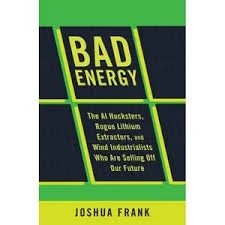
A recent interview featuring prominent environmentalist Bill McKibben on Ezra Klein’s podcast has ignited fresh discussion on the trajectory of global climate action, presenting a narrative of both accelerating climate change and burgeoning green energy solutions. However, this optimistic outlook is sharply contrasted by the release of Joshua Frank’s new book, Bad Energy: The AI Hucksters, Rogue Lithium Extractors, and Wind Industrialists Who Are Selling Off Our Future (Haymarket Books, 2026), which offers a profound critique of the current green transition, arguing it is driven more by profit than planetary salvation.
The Optimistic Horizon: Green Energy’s Rapid Ascent
Klein’s summary of his conversation with McKibben encapsulates a dual reality: the undeniable acceleration of climate change, a fact long established and increasingly evident through global warming trends, extreme weather events, and ecological disruptions. The Intergovernmental Panel on Climate Change (IPCC) reports consistently underscore the urgency, highlighting the need for drastic emissions reductions to avert catastrophic consequences. Yet, amidst this grim assessment, Klein and McKibben point to a silver lining: the remarkable advancements in renewable energy technologies.
“Green energy is getting better and cheaper, faster than we had ever dared hope,” Klein observed, citing data from the energy think tank Ember. A particularly striking finding from April 2025 indicated that all new global electricity demand was met by green power. This represents a pivotal shift, a testament to years of innovation, investment, and policy support that have dramatically reduced the cost of solar and wind power, making them competitive, and often cheaper, than fossil fuels in many markets. This exponential growth has fostered a sense of "clean energy abundance," a new form of energetic wealth that, just a few years ago, seemed like a distant dream. The narrative suggests that a future of "more and better" – not "less and worse" – is now within reach, tangible and actionable.
This positive framing is often championed by policymakers and industry leaders who envision a future powered entirely by renewables, with electric vehicles, smart grids, and advanced battery storage forming the backbone of a decarbonized economy. The rapid deployment of solar farms, wind turbines, and grid-scale batteries is frequently cited as proof that technological innovation, coupled with market forces, can address the climate crisis without necessitating fundamental changes to economic growth models. For many, the "green revolution" is synonymous with progress, jobs, and a cleaner future, aligning environmental goals with economic prosperity.
The Counter-Narrative: "Bad Energy" and the Perils of "Critical Mineral Capitalism"
However, not everyone shares this celebratory view. Joshua Frank, an editor at Counterpunch, challenges the prevailing optimism with a stark and unsparing critique in his book, Bad Energy. Frank argues that the current green energy transition, far from being a selfless endeavor to save the planet, is fundamentally driven by profit incentives and risks replicating the destructive patterns of fossil fuel capitalism.
Frank’s central thesis is that while the imperative to cease burning fossil fuels is undeniable, the "significant, haphazard expansion of green energy" has already caused — and continues to cause — profound environmental and social damage. He points to large-scale solar projects, vast wind farms, and the intense mining required for renewable technologies as examples of this destruction, impacting communities and ecosystems globally.
A critical aspect of Frank’s argument is the insatiable demand for energy, exacerbated by the rapid proliferation of data centers in wealthier nations. These digital infrastructure hubs, essential for everything from artificial intelligence to cloud computing, consume enormous amounts of electricity, creating an ever-expanding demand that, Frank contends, renewables simply cannot match without significant environmental cost. This endless pursuit of growth, even "green" growth, becomes the core problem.
Frank’s investigation takes readers on a journey from copper mines in Montana and Bolivia, where indigenous lands and pristine environments are often sacrificed, to sprawling wind farms in Wyoming that necessitate extensive transmission line infrastructure, scarring landscapes and disrupting wildlife. He also delves into the nascent but highly contentious geopolitical battle over deep-sea mining in the South Pacific, highlighting the unknown ecological consequences of extracting critical minerals from fragile ocean ecosystems. His work offers a "stark assessment of the costs of the rush for renewables and the demand for endless growth."
The Roots of Dissent: Local Impacts and Systemic Critique
Frank’s motivation for writing Bad Energy stems from his direct observations in southern California. He describes witnessing "industrial sized so-called renewable developments in the Mojave Desert" which, to someone intimately familiar with the region, are "alarming." These projects, often sprawling across vast tracts of biologically sensitive desert, disrupt delicate ecosystems, threaten endangered species, and undermine the desert’s natural ability to act as a carbon sink.
Simultaneously, Frank investigated changes to California’s residential solar program under Governor Gavin Newsom, discovering a systematic dismantling of initiatives that promoted decentralized energy production. He attributes this to the powerful influence of large utilities like PG&E, which, he argues, prioritize control and expansion of the centralized grid over genuine decentralization, all "under the guise of fighting climate change." This political maneuvering, fueled by corporate donations and a revolving door between industry and government, exemplifies how profit motives can hijack even well-intentioned environmental policies.
The "frothing at the mouth" of energy companies over critical minerals — lithium, copper, nickel, cobalt, and rare earth elements — represents another continuation of extractive industries. These minerals are indispensable for electric vehicles, batteries, solar panels, and wind turbines. Frank cautions that this rush necessitates "hundreds of new huge mines all over the globe," leading to a predictable cycle of environmental degradation, social displacement, and the exploitation of rural and indigenous communities, much like the fossil fuel era. The question Frank poses is profound: "Is Elon Musk and his Tesla really the answer to our troubles? Can we really consume our way out of climate chaos?" His research unequivocally suggests otherwise.
Challenging the "Big Green" Consensus and Embracing Degrowth
Frank’s critique extends to many mainstream environmental organizations, which he believes have "blindly accepted policies because they are labeled Green." He doesn’t oppose solar technology itself, but questions the scale and location of deployment. "Do we really need six square miles of solar panels in the Mojave? Do we really need huge wind farms in Wyoming with transmission lines crossing through valleys and over mountains all the way to California? Is that the best we can come up with?" he asks, advocating instead for scaling down and producing energy locally.
His vision is rooted in a philosophy of "degrowth" – a radical departure from the prevailing economic paradigm that demands continuous expansion. Frank argues that simply replacing fossil fuel capitalism with "critical mineral capitalism" will not solve the climate crisis. Instead, a fundamental critique and rejection of capitalist interests driving planetary collapse are necessary. This means a systemic rethinking of consumption, production, and economic organization.
When discussing transportation, Frank acknowledges the role of electric vehicles but asserts they are not a complete solution to pollution. He advocates for a radical transformation of urban landscapes, prioritizing expanded public transit, bikeability, and walkability over a car-centric culture, electric or otherwise. He cites European cities that restrict vehicles as positive examples of this shift.
He also scrutinizes the narrative around countries like China and Australia. While McKibben might point to China’s booming solar capacity as a step forward, Frank highlights that this growth often only keeps pace with China’s overall economic expansion, rather than significantly displacing fossil fuels. China remains the world’s largest emitter of greenhouse gases, and its continued construction of coal plants and increasing pollution negate much of the perceived "green" progress. Similarly, Australia, despite its renewable potential, remains the second-largest exporter of fossil fuels globally, after Russia. For Frank, true progress means replacing fossil fuels on a real scale, not just adding renewables on top of existing extractive systems. He firmly states, "I would embrace degrowth. That’s the only way we are going to navigate ourselves out of this."
Policy Alternatives and a Democratized Future
Frank’s vision for a truly sustainable future diverges significantly from mainstream policy proposals. While he supports residential solar, he emphasizes its deployment in already disturbed areas like parking lots and brownfields, rather than pristine wilderness. He champions "low hanging fruit" solutions, noting that two-thirds of homes in Los Angeles lack rooftop solar, as do countless commercial buildings.
Regarding critical mineral mining, Frank acknowledges its necessity but advocates for a "democratized mining" approach. This would involve small-scale operations with minimal environmental impact, prioritizing local needs over global supply chains for multinational corporations. He also points to alternatives like sodium-ion batteries, which may have a lower environmental footprint than lithium. Crucially, he stresses that mining, particularly for public lands and indigenous sacred sites, must benefit the public and local communities, not just private interests. He suggests models like public power authorities, akin to the Tennessee Valley Authority, as a step towards democratizing energy production and controlling extraction for public good.
Frank’s intellectual influences include contemporary thinkers like Kohei Saito (author of Slow Down: The Degrowth Manifesto) and Murray Bookchin (author of The Ecology of Freedom), grounding his journalistic observations in a rich tradition of ecological and anti-capitalist thought. He emphasizes his role as a journalist, observing how these technologies "are playing out in the real world, on the ground," offering a practical critique of the "abundance movement" and its real-world consequences.
The Fundamental Challenge: Capitalism and Climate Crisis
The core of Frank’s argument is that the climate crisis cannot be resolved without "radically changing the economic system that underpins it." He sees the loss of biodiversity, overfishing, deforestation, and industrial agriculture as symptoms of an underlying capitalist system that prioritizes endless growth and profit over ecological integrity. This is where he draws a critical distinction with Bill McKibben, whom he respects for his past contributions but believes has become less vocal about the systemic role of capitalism in the crisis.
Frank’s perspective is not widely reflected in mainstream political discourse or policy circles. He notes a contingent within the Democratic Socialists of America (DSA) that grapples with these issues, but generally, such conversations are absent at higher policy levels, a reflection, he contends, of the broader environmental movement’s reluctance to confront fundamental economic structures.
He addresses potential criticisms, such as being labeled a "shill for Big Oil," by emphasizing that his book offers a comprehensive critique, extending even to hydropower and nuclear energy – technologies often championed by different factions of the "abundance movement" or the left. His aim is to provide a tool for critical examination, ensuring that even seemingly "good" technologies like wind and solar are implemented in ways that truly minimize their impacts and serve ecological and social justice, rather than merely perpetuating a new form of extractive capitalism.
Conclusion: Navigating a Complex Green Future
The debate between the optimistic embrace of rapidly advancing green technologies and the critical warnings against a "critical mineral capitalism" underscores the profound complexities of the climate crisis. While the progress in renewable energy offers a glimmer of hope, Joshua Frank’s Bad Energy serves as a crucial reminder that the path to a sustainable future is not merely about swapping one energy source for another. It demands a deeper, more systemic reckoning with economic models, consumption patterns, and the very definition of progress. The question remains whether societies can truly transition to a regenerative economy that respects planetary boundaries and social equity, or if the pursuit of "green" growth will simply pave a new road to ecological and social peril. The choices made in the coming years will determine not just the fate of energy systems, but the fundamental character of human civilization on a finite planet.



 Yuyun Lusiyani
 Joko Widodo
 Eva Lovia
 Jia Lissa
 Pevita Pearce
 admin
admin