
 Jia Lissa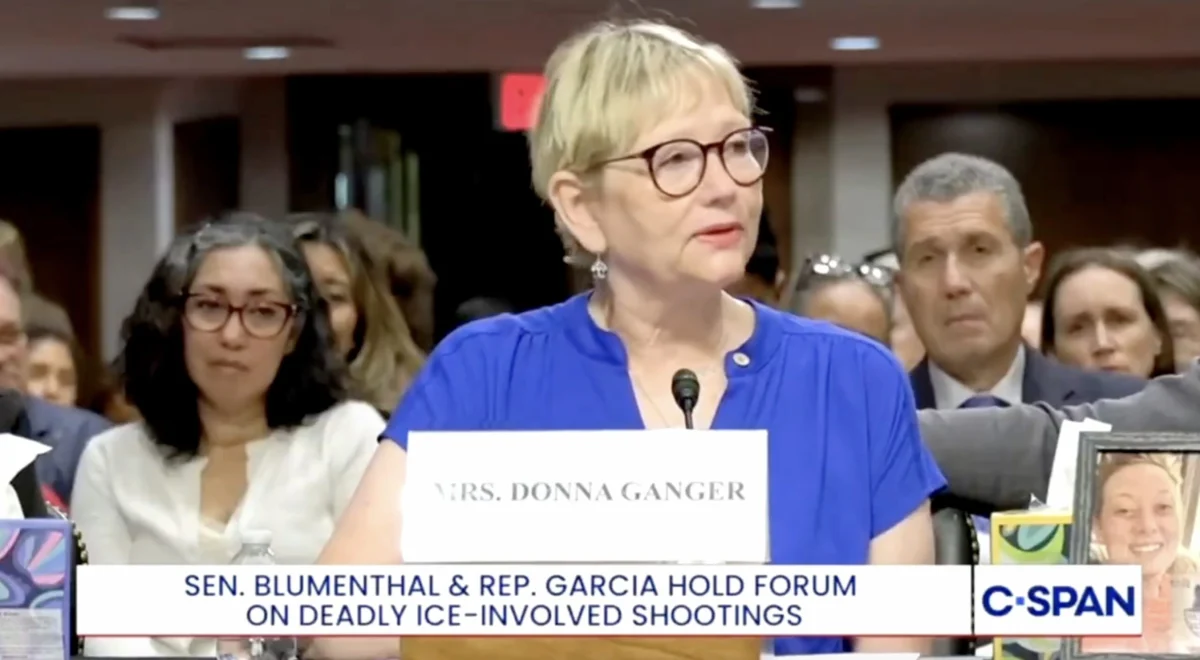
Donna Ganger, a self-described Republican and supporter of President Donald Trump, appeared before a joint congressional forum on Tuesday to deliver a searing indictment of the federal immigration enforcement apparatus following the death of her daughter, Renee Good. Speaking on Capitol Hill, Ganger detailed the harrowing circumstances surrounding the January shooting of the 37-year-old activist by an Immigration and Customs Enforcement (ICE) agent in Minneapolis. Her testimony, which categorized the current state of federal enforcement as "madness," highlighted a growing tension between the administration’s aggressive immigration policies and the constitutional protections afforded to American citizens.
The forum, hosted by Senator Richard Blumenthal (D-CT) and Representative Robert Garcia (D-CA), served as a platform for families of victims killed by federal agents to address lawmakers directly. Ganger’s appearance was particularly notable due to her political background, as she revealed she had voted for President Trump under the belief that his administration would prioritize the safety of American citizens. Her daughter, however, became a casualty of that same enforcement machine during a demonstration in Minnesota, an event that has since sparked intense scrutiny regarding the use of lethal force by federal agents in domestic settings.
The Shooting of Renee Good: A Detailed Chronology
The events leading to the death of Renee Good began in January in Minneapolis, where Good was participating in a demonstration. Unlike many individuals who encounter ICE agents, Good was not the subject of an immigration investigation or a target for deportation. Instead, she was an activist engaged in a protest that involved partially blocking a roadway—a common tactic in civil demonstrations.
According to investigative documents and forensic reports, Good was confronted by ICE Agent Jonathan Ross. During the encounter, Ross discharged his service weapon multiple times. Autopsy results later revealed that Good sustained four gunshot wounds, which proved fatal. Initial reports from the scene were conflicting, with federal sources initially suggesting a high-threat environment. However, subsequent investigations and eyewitness accounts painted a different picture: that of an unarmed civilian engaged in non-violent, albeit disruptive, civil disobedience.
In the immediate aftermath of the shooting, the administration’s response was characterized by a robust defense of Agent Ross. President Trump initially claimed that Good had "violently, willfully, and viciously ran over the ICE officer," a statement that suggested the use of lethal force was a direct response to an attempted murder. This narrative was later challenged by video evidence and internal reviews which failed to corroborate the claim that Ross had been struck or endangered in the manner described by the White House.
The situation took a turn when the President was informed of the family’s political leanings. Upon learning that Good’s father was a "tremendous Trump fan," the President’s rhetoric shifted. In a subsequent statement, Trump admitted he "felt terribly" about the shooting, though he qualified his sympathy by stating he "understood both sides of it." This pivot drew criticism from civil rights advocates who argued that the validity of a victim’s life should not be contingent upon their family’s political allegiances.
Patterns of Escalation: Statistical Analysis of Agency Shootings
The death of Renee Good is not an isolated incident but rather part of a broader trend of escalating violence involving federal immigration personnel. According to a recent data analysis conducted by CNN, at least 21 individuals have been shot by ICE and Customs and Border Protection (CBP) personnel during the current administration’s second term. This figure represents a significant uptick in lethal encounters compared to previous administrative cycles.
The data suggests several contributing factors to this increase:
- Aggressive Mandates: The administration’s "zero-tolerance" approach and the expansion of ICE’s operational remit into interior cities have increased the frequency of high-stakes encounters between agents and the public.
- Reduced Oversight: Critics argue that the rapid deployment of agents and the emphasis on "shock and awe" enforcement tactics have come at the expense of rigorous de-escalation training.
- Legal Immunity: The continued application of qualified immunity often shields federal agents from personal liability, which some legal experts suggest creates a culture of impunity within the agencies.
In the case of Renee Good, the lack of immediate administrative consequences for Agent Ross has become a focal point of public outrage. Following the shooting, Ross was not terminated or suspended indefinitely; instead, he was transferred to a different state where he resumed his active duties. This "lateral transfer" policy has been criticized by Senator Blumenthal, who described it as a failure of institutional accountability.
Congressional Testimony: "This is Madness"
During Tuesday’s forum, Donna Ganger’s testimony provided a human face to these statistics. Emotional and at times trembling, Ganger described the "torture" of being unable to protect her daughter from the very government she had supported at the ballot box.
"Our family is a very American blend," Ganger told the panel. "We vote differently, but we love each other deeply. I’m a registered Republican. I voted for President Trump under the impression that these agents were here to protect the citizens of the United States—innocents like our family and the others here—against terrorists, certainly not to accuse those here of being terrorists and take precious lives."
Ganger’s testimony touched on a fundamental shift in the perception of federal law enforcement among conservative voters. She argued that the disregard for constitutional rules and the "viciousness" of the encounter in Minneapolis represented a departure from the rule of law. Her concluding remark—"This is madness"—resonated through the hearing room, framing the current enforcement climate as one that has spiraled out of control.
The forum also heard from other families whose lives have been upended by federal shootings. Rachel Reyes, the mother of Ruben Ray Martinez, and the sons of Lorenzo Salgado Araujo, Ronaldo and Lorenzo Salgado, shared similar stories of sudden, violent loss. Stella Carlson, a witness who recorded the fatal shooting of Alex Pretti, also provided evidence, highlighting the role of civilian oversight in documenting these encounters when official body camera footage is withheld or non-existent.
Official Responses and Institutional Accountability
The Department of Homeland Security (DHS) and ICE have maintained that their agents operate under strict use-of-force guidelines designed to protect both the officers and the public. In official statements regarding the Minneapolis incident, the agency has emphasized the "volatile nature" of protests and the "split-second decisions" agents must make when they perceive a threat.
However, the lack of transparency regarding internal investigations remains a point of contention. Representative Robert Garcia noted during the forum that the public is often left in the dark about the findings of Office of Professional Responsibility (OPR) reviews. "When an agent shoots an American citizen four times and is then simply moved to a different office in a different state, the message being sent is that there are no consequences for lethal errors," Garcia stated.
The legislative response to these incidents is currently bifurcated along party lines. Democratic lawmakers are pushing for the "Enforcement Oversight and Accountability Act," which would mandate body cameras for all interior ICE operations and establish an independent commission to investigate every discharge of a firearm by a federal agent. Conversely, many Republican lawmakers continue to emphasize the need for "unfettered enforcement" to maintain border security and interior order, often framing these shootings as unavoidable consequences of a chaotic environment.
Broader Implications for Constitutional Protections
The death of Renee Good and the subsequent testimony of her mother raise critical questions about the intersection of national security, immigration enforcement, and the First Amendment right to protest. As federal agencies increasingly operate in domestic, non-border settings, the potential for lethal conflict with U.S. citizens increases.
Legal scholars point out that the Fourth Amendment protects individuals against "unreasonable seizures," which includes the use of excessive force by law enforcement. When federal agents utilize lethal force against non-targets or individuals engaged in non-violent protest, it creates a "chilling effect" on civil liberties.
"If a citizen cannot stand on a street corner in Minneapolis without the fear of being shot by a federal immigration agent, then the protections of the Constitution are being selectively applied," said a legal analyst familiar with the case.
Furthermore, the political nature of the President’s response has highlighted the erosion of objective justice. By basing his sympathy on the political affiliation of the victim’s father, the President has introduced a standard of "partisan protection" that critics argue is antithetical to the American justice system.
Conclusion: A Call for Reform
As the forum concluded, the overriding sentiment from the families and the hosting lawmakers was a demand for systemic change. Donna Ganger’s transition from a Trump supporter to a vocal critic of federal enforcement tactics serves as a bellwether for a potential shift in public opinion. Her story underscores a growing realization that aggressive federal mandates, when left unchecked by rigorous oversight, can have devastating consequences for even those who support the administration’s broader goals.
The data provided by CNN and the testimonies heard on Capitol Hill suggest that the "second Trump administration" has entered a phase of enforcement that prioritizes speed and intensity over traditional protocols of engagement. For the families of Renee Good, Ruben Ray Martinez, and Alex Pretti, the pursuit of justice remains an uphill battle against a federal system designed to protect its own.
As Agent Jonathan Ross continues his duties in a new jurisdiction, and as the number of federal shootings continues to climb, the "madness" described by Donna Ganger remains a central challenge for the American legal and political landscape. The question remains whether Congress will move to implement the oversight necessary to prevent further tragedies, or if the current trajectory of federal enforcement will continue unabated.




 Yuyun Lusiyani
 Joko Widodo
 Eva Lovia
 Pevita Pearce