
 Amara Maple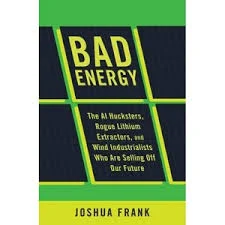
A recent dialogue between environmentalist Bill McKibben and journalist Ezra Klein, broadcast on Klein’s prominent podcast, highlighted a pervasive optimism regarding the accelerating pace and affordability of green energy. However, this hopeful narrative faces a robust challenge from Joshua Frank, an editor at Counterpunch, whose new book, Bad Energy: The AI Hucksters, Rogue Lithium Extractors, and Wind Industrialists Who Are Selling Off Our Future (Haymarket Books, 2026), argues that the current trajectory of the green energy transition is fundamentally flawed, driven by profit motives rather than genuine planetary salvation. Frank’s work initiates a critical examination of the ecological and social costs embedded within the rush for renewables, advocating for a radical re-evaluation of our approach to climate change that transcends capitalist frameworks.
The Optimistic Narrative: "Clean Energy Abundance" Takes Center Stage
The podcast discussion between Bill McKibben, a leading voice in climate activism, and Ezra Klein, a prominent New York Times columnist and host, offered a nuanced but ultimately optimistic outlook on the climate crisis. Klein encapsulated their exchange with a "good news, bad news" summary. The bad news, as widely acknowledged by the scientific community, is the undeniable acceleration of climate change, with global temperatures continuing to rise and extreme weather events becoming more frequent and intense. The Intergovernmental Panel on Climate Change (IPCC) reports consistently underscore the urgency of drastic emission reductions to avert catastrophic consequences, a reality that forms the stark backdrop to all climate discussions.
However, the "good news" presented by Klein and McKibben points to a paradigm shift in the energy sector. Klein enthusiastically noted, "Green energy is getting better and cheaper, faster than we had ever dared hope." This assertion is supported by a significant milestone: in April 2025, the energy think tank Ember reported that all new global electricity demand was met by green power. This unprecedented achievement, deemed "unimaginable even a few years ago" by Klein, signals a pivotal moment where renewable sources like solar and wind are not just supplementing, but actively expanding the world’s energy supply. This rapid deployment and cost reduction have fueled a vision of "clean energy abundance," which Klein describes as "a new form of energetic wealth." For proponents, this signifies the possibility of offering a future of "more and better" – a radical departure from traditional environmentalist calls for austerity and sacrifice – making the promise of a sustainable future tangible and immediate.
McKibben, echoing this sentiment, has often highlighted the global surge in renewable adoption. During the interview, he reportedly advocated for allowing Chinese electric vehicles into the United States, citing their superior quality and affordability compared to models like Tesla. He also pointed to countries like Australia and China as examples of booming solar markets. Indeed, reports from the International Renewable Energy Agency (IRENA) and the International Energy Agency (IEA) have consistently shown a dramatic increase in renewable energy capacity additions worldwide, often surpassing fossil fuel additions in recent years. The decreasing Levelized Cost of Energy (LCOE) for solar and wind power has made them the cheapest forms of new electricity generation in many regions, further bolstering the "abundance" narrative.
A Counter-Narrative Emerges: Joshua Frank’s "Bad Energy" Critique
Despite the celebratory tone surrounding green energy’s progress, not everyone shares this unqualified enthusiasm. Joshua Frank, a seasoned journalist and editor at Counterpunch, presents a starkly contrasting perspective in his recently published book, Bad Energy: The AI Hucksters, Rogue Lithium Extractors, and Wind Industrialists Who Are Selling Off Our Future. Frank’s central thesis challenges the very premise of the current green transition, arguing that it is not primarily an effort to save the planet but rather a new frontier for profit-driven industries. He contends that the "significant, haphazard expansion of green energy in recent years – from large solar projects to wind energy to mining for renewables – has destroyed communities and ecosystems."
Frank’s critique extends to the fundamental capacity of renewables to meet escalating energy demand, particularly from the rapid proliferation of data centers in wealthier nations, often driven by the burgeoning demands of artificial intelligence. He argues that this ever-expanding consumption model is inherently unsustainable. His book, published by Haymarket Books in 2026, takes readers on a global journey, illustrating the profound costs of this rush for renewables. From the copper mines of Montana and Bolivia to the vast wind farms in Wyoming and the geopolitical battleground of deep-sea mining in the South Pacific, Frank meticulously details the environmental degradation and social displacement caused by what he terms "critical mineral capitalism."
In a recent interview with Corporate Crime Reporter, Frank explained the genesis of his book, rooted in observations from his home in Southern California. "Living in southern California, I see all of these industrial sized so-called renewable developments in the Mojave Desert," Frank stated, describing the sight as "alarming." He contrasted this with the dismantling of California’s residential solar program by Governor Gavin Newsom, attributing it to the influence of large utilities like PG&E. According to Frank, these utilities prioritize centralized grid control and expansion, masking their profit motives under the guise of climate action. He highlighted Newsom’s "deep ties to PG&E," citing financial contributions to his campaigns and a "revolving door" of personnel between the utility and government. This pattern, Frank suggests, exposes how corporate interests actively undermine decentralized, community-based energy solutions.
Frank further elaborated on the "frothing at the mouth" eagerness of energy companies to exploit critical minerals, viewing it as a continuation of historical extractive practices. He questioned the narrative that figures like Elon Musk and his Tesla vehicles represent a genuine solution, asking rhetorically, "Can we really consume our way out of climate chaos?" His investigation, he revealed, led him to conclude that such an approach is fundamentally flawed.
The Environmental and Social Costs of Extraction
The pursuit of green energy, as currently practiced, relies heavily on the extraction of critical minerals such as lithium, copper, nickel, and cobalt. These materials are essential not only for electric vehicle batteries but also for solar panels, wind turbines, and the extensive transmission lines required to transport power from large-scale generation sites. Frank argues that this demand is spurring "hundreds of new huge mines all over the globe," representing "a continuation of the extractive industries that came before it." He contends that there is "really not much difference" in the destructive impact, irrespective of whether the end product is fossil fuel or renewable energy infrastructure.
Frank emphasizes the profound "externalities" of this mining boom, particularly its impact on rural and Indigenous communities globally. These communities often bear the brunt of environmental pollution, land degradation, and cultural desecration, with many mining projects encroaching upon sacred sites. He criticizes "Big Green groups" for often "blindly accept[ing] policies because they are labeled Green," without adequately scrutinizing these broader social and ecological consequences.
While acknowledging the necessity of solar technology, Frank differentiates between appropriate and inappropriate deployment. He supports residential solar and building panels on "already disturbed areas, on parking lots, brownfields," rather than in "biologically pristine areas." He highlighted the tragic irony of developing solar farms in the Mojave Desert, a region often mistakenly perceived as a "wasteland." The Mojave, however, hosts endangered species and functions as a vital carbon sink. Developing such deserts for industrial solar projects, Frank warns, "reduc[es] the desert’s ability to absorb our fossil fuel pollution," effectively exacerbating climate challenges under the guise of solving them.
The book also delves into the nascent but highly contentious deep-sea mining industry. Frank expresses grave concerns about the unknown ecological impacts of extracting polymetallic nodules from the ocean floor. The prospect of crushing these nodules to obtain nickel and other elements for batteries "at the expense of wrecking the ocean" raises fundamental questions about what truly constitutes "renewable" or "sustainable" energy. He firmly believes that "abundance requires exponential mining indefinitely," and that without a truly "closed loop system," the concept of abundance for all is an illusion.
Beyond Electric Vehicles: The Transportation Dilemma
The debate extends to the realm of transportation, a sector notorious for its emissions. While Bill McKibben has endorsed Chinese electric vehicles as a step forward, Frank argues that simply replacing gasoline-powered cars with electric ones fails to address the systemic issues of a car-dependent culture. He states, "I’m not opposed to electric vehicles. But that is not an answer to the pollution that our transportation industry produces."
Instead, Frank champions a radical rethinking of urban landscapes focused on "expanding public transit, more bikeability, walkability." He believes that a culture "defined by cars, no matter if it’s going to be one that is electric or gas, has a lot of problems." He points to European cities that restrict vehicles as positive examples, acknowledging that McKibben himself would likely agree with these broader urban planning goals. This stance highlights a crucial divergence: while McKibben sees EVs as a technological fix for emissions, Frank views them as merely shifting the burden of an unsustainable consumption model, unless coupled with fundamental changes in urban design and public infrastructure.
The "Degrowth" Imperative and Systemic Change
Frank’s most profound departure from the mainstream green narrative lies in his advocacy for "degrowth." He criticizes the notion that simply keeping pace with economic growth, even with renewables, is sufficient to address the climate crisis. Citing China as an example, he notes that while its solar capacity has boomed, it often only keeps up with its approximate five percent annual economic growth. Concurrently, China remains the world’s largest emitter of fossil fuels, building new coal plants that continue to release carbon into the atmosphere. "When we talk about expanding renewables, unless it is replacing fossil fuels on a real scale, we are not moving in the right direction," Frank asserts. "I would embrace degrowth. That’s the only way we are going to navigate ourselves out of this."
For Frank, the solution to climate chaos cannot be found by "consum[ing] our way out." Instead, it requires a "rejection of the capitalist interests driving planetary collapse and a radical vision for a truly sustainable future." He argues that the underlying issue is capitalism itself, a point he believes McKibben, despite his past critiques, now rarely addresses. "I don’t believe there is any solution to the climate crisis without radically changing the economic system that underpins it," Frank declares. He connects various social justice movements—from opposing war to advocating for affordable housing—as inherently "fighting capitalism."
When pressed for models of degrowth in practice, Frank admits that no country has fully implemented such a policy by choice. However, he points to Cuba’s experience under a blockade as an instructive, albeit involuntary, example of rethinking food systems, energy, and transportation. He also cites cities like New York City, Copenhagen, and Stockholm for their walkable environments, ample mass transit, and localized food consumption patterns, which result in lower emissions despite ongoing economic activity. While acknowledging their imperfections, these examples illustrate principles of reduced consumption and localized living that align with degrowth philosophies. Frank’s intellectual inspirations include contemporary thinkers like Kohei Saito (author of Slow Down: The Degrowth Manifesto) and earlier figures like Murray Bookchin (The Ecology of Freedom) and E.F. Schumacher (Small is Beautiful), all of whom questioned the paradigm of endless growth.
Divisions Within the Green Movement and Policy Implications
Frank’s book positions itself as "an indirect critique of the abundance movement," meticulously examining its real-world consequences. He points out the parallel between the historical practices of "big fossil fuel giants" who "extract and leave biologically important lands desecrated" and what he now observes with the expansion of renewables. This critique extends to the "vast majority of big green groups," which he suggests have often uncritically supported large-scale industrial projects. He also challenges the "contingent in the abundance movement" and "on the left" who advocate for nuclear power as a climate solution, expressing his own critiques of both hydropower and nuclear energy within Bad Energy.
Anticipating criticism, Frank notes that some have already accused him of being a "shill for Big Oil," an accusation he dismisses as unfounded by anyone who actually reads his book. This reaction underscores the deeply entrenched ideological divisions within the broader environmental movement. While a significant portion of environmentalists and policymakers focus on technological innovation and market-based solutions within existing economic structures, Frank represents a more radical faction that views systemic change, particularly a departure from capitalism, as indispensable.
In terms of policy, Frank proposes a "democratized mining" approach, contrasting it sharply with the current practice of "selling off private lands to multinational corporations that want to come in, extract and leave biologically important lands desecrated." He suggests models like public power authorities, similar to the Tennessee Valley Authority (TVA), as "a step in the right direction." He also highlights alternatives to lithium batteries, such as emerging sodium battery technologies, which could potentially have a lower environmental footprint. Crucially, he advocates for smaller-scale mining operations and ensuring that extracted minerals benefit local communities (e.g., for local battery storage) rather than solely fueling new consumer goods like GM vehicles.
Despite these concrete proposals, Frank acknowledges the current political landscape offers little reflection of his perspective. He notes that while "a contingent in the Democratic Socialists of America (DSA) who are thinking about these issues" exists, such conversations are generally absent at mainstream policy levels, lamenting that "It’s not a conversation happening at that kind of policy level. If it is, I haven’t seen it." This absence, he believes, is a symptom of the broader environmental movement’s failure to adequately address the fundamental economic underpinnings of the crisis.
Joshua Frank’s Bad Energy serves as a crucial intervention in the ongoing discourse about climate action. It forces a critical examination of the celebratory narratives surrounding green energy, compelling readers to confront the often-overlooked environmental and social costs of a transition that, if not carefully managed and radically rethought, risks merely replacing one extractive, growth-driven system with another. The debate between the promise of "clean energy abundance" and the imperative of "degrowth" underscores the profound ideological fault lines that will define the future of humanity’s response to planetary collapse.



 Yuyun Lusiyani
 Ana Megawati
 Joko Widodo
 Eva Lovia
 Jia Lissa
 Pevita Pearce