
 Jia Lissa
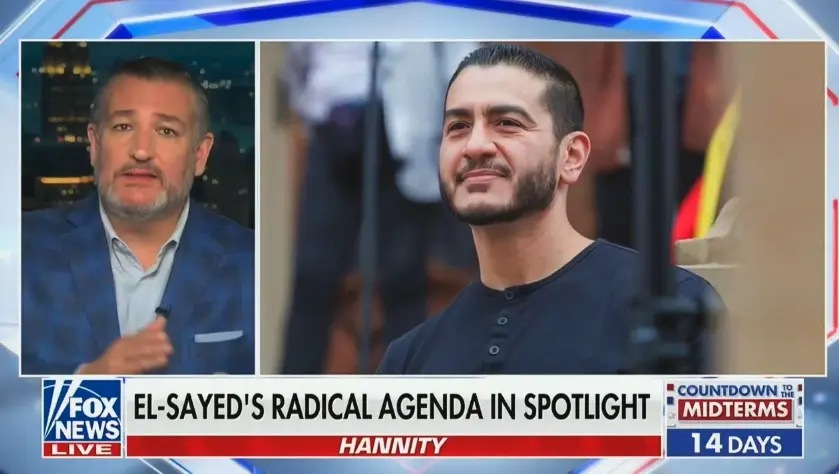
United States Senator Ted Cruz (R-TX) sparked significant controversy during a Tuesday night appearance on Fox News’ Hannity, where he leveled serious, unsubstantiated allegations against Michigan Democratic Senate candidate Abdul El-Sayed. During the broadcast, Cruz suggested that El-Sayed, a physician and former public health official, maintains clandestine ties to the Muslim Brotherhood and would likely commit treason by leaking classified national security information to terrorists if elected to the U.S. Senate. These comments come as the race for Michigan’s open Senate seat intensifies, with El-Sayed locked in a competitive primary and general election cycle against former Representative Mike Rogers (R-MI).
The allegations centered on El-Sayed’s potential access to sensitive information as a member of the legislative branch. Cruz specifically posited a scenario in which Senate Minority Leader Chuck Schumer (D-NY) might appoint El-Sayed to the Senate Intelligence Committee. Cruz argued that because senators do not undergo the standard executive branch security clearance process—instead receiving access to classified material by virtue of their constitutional office—El-Sayed would pose a direct threat to American lives. "I believe this man is Muslim Brotherhood," Cruz told host Sean Hannity. "There would be an unacceptably high risk that American servicemen and women, their lives would be endangered, and that our covert intelligence assets, their lives would be in danger because every reason to believe Abdul El-Sayed would share that classified information with Muslim Brotherhood terrorists."
Profile of the Candidate: Abdul El-Sayed
Abdul El-Sayed is a prominent figure in Michigan politics, currently seeking to become the first Muslim American ever elected to the United States Senate. A Rhodes Scholar and physician, El-Sayed first rose to national attention as the Executive Director of the Detroit Health Department, where he was credited with rebuilding the city’s public health infrastructure following the municipal bankruptcy. He later ran a high-profile campaign for Governor of Michigan in 2018, finishing second in the Democratic primary to Gretchen Whitmer.
El-Sayed’s platform focuses on progressive issues, including universal healthcare, environmental justice, and economic reform. Throughout his career, he has been a vocal advocate for the integration of scientific data into public policy. However, his religious identity and heritage have frequently been the subject of scrutiny from right-leaning media outlets and political opponents. El-Sayed has consistently denied any affiliation with extremist organizations, describing such accusations as rooted in Islamophobia and xenophobia rather than factual evidence.
The Opposition: Mike Rogers and the Michigan Senate Race
The race to fill the seat vacated by retiring Senator Debbie Stabenow (D-MI) is one of the most closely watched contests in the 2024 election cycle. Michigan is a critical swing state, and the outcome of this race could determine the balance of power in the upper chamber of Congress. El-Sayed’s primary opponent on the Republican side is Mike Rogers, a former seven-term U.S. Representative and former Chairman of the House Intelligence Committee.
Rogers, who also served as an FBI special agent, brings a background heavily rooted in national security and law enforcement. This contrast in backgrounds—a public health physician versus a national security veteran—has defined much of the campaign’s early rhetoric. Recent polling from the New York Times and Siena College indicates a narrow margin between the leading candidates, suggesting that every segment of the electorate, including Michigan’s substantial Arab-American and Muslim populations, will play a decisive role in the final outcome.
Chronology of the Allegations
The roots of the allegations cited by Senator Cruz trace back over a decade and involve complex familial dynamics rather than El-Sayed’s personal political record.
- Early 1970s: El-Sayed’s mother was allegedly involved in student activism in Egypt. Right-leaning researchers claim this activism was linked to the Muslim Brotherhood, a transnational Sunni Islamist organization founded in Egypt in 1928.
- 2012: El-Sayed’s half-sister reportedly authored a social media post mentioning their mother’s past activism in the early 1970s. This post has served as the primary source for modern claims linking El-Sayed to the organization.
- 2018 Gubernatorial Race: During El-Sayed’s run for governor, similar allegations surfaced in conservative blogs and social media circles. At the time, El-Sayed dismissed the claims, stating he had no knowledge of his mother’s specific political activities decades before he was born.
- Recent Weeks: As El-Sayed’s Senate campaign gained momentum, the narrative resurfaced in national media. On a recent episode of NBC’s Meet the Press, moderator Kristen Welker questioned El-Sayed about these alleged connections. El-Sayed categorically denied any link to the Muslim Brotherhood, stating, "No, I have no connections."
- Tuesday Night: Senator Cruz appeared on Hannity, accusing El-Sayed of lying on Meet the Press and escalating the rhetoric to include warnings of potential treason and the endangerment of U.S. military personnel.
Understanding Senate Security Clearances
Senator Cruz’s remarks touched upon a factual nuance regarding how members of Congress access classified information. Unlike employees of the Department of Defense or the State Department, who must undergo rigorous background checks conducted by the FBI or the Defense Counterintelligence and Security Agency (DCSA), members of the House and Senate do not receive a traditional security clearance.
Under the "trustee" model of the U.S. Constitution, the act of being elected by the people to a constitutional office is deemed sufficient to grant access to the information necessary to perform legislative duties. This includes access to classified briefings and, for those appointed to specific committees, the nation’s most sensitive intelligence. The Senate Intelligence Committee, which Cruz mentioned, oversees the Central Intelligence Agency (CIA), the National Security Agency (NSA), and other components of the U.S. Intelligence Community.
While the lack of a formal background check for lawmakers is a perennial topic of debate among national security experts, Cruz’s assertion that a specific candidate would use this access to commit treason is a departure from standard political discourse. Treason is the only crime specifically defined in the U.S. Constitution (Article III, Section 3), requiring an overt act of levying war against the United States or providing "Aid and Comfort" to its enemies.
Official Responses and Fact-Checking
The El-Sayed campaign has moved quickly to refute Cruz’s claims, characterizing them as a "desperate attempt to distract voters from the issues that matter." In a statement following the Fox News broadcast, a spokesperson for the campaign emphasized El-Sayed’s record of public service and his commitment to American democratic values. "Abdul El-Sayed has spent his career saving lives and serving the public," the statement read. "To suggest he would betray his country is not only baseless but an insult to the millions of Michigan residents he seeks to represent."
Fact-checkers have noted that there is no public evidence linking Abdul El-Sayed to the Muslim Brotherhood or any other extremist group. The Muslim Brotherhood is not designated as a Foreign Terrorist Organization (FTO) by the U.S. State Department, though it has been designated as such by countries like Egypt, Saudi Arabia, and the United Arab Emirates. Within the U.S. political context, the "Muslim Brotherhood" label has frequently been used by critics to cast doubt on the loyalty of Muslim American public figures, a tactic seen in previous years directed at officials such as Huma Abedin and Representative Ilhan Omar.
Broader Political and Social Implications
The rhetoric employed by Senator Cruz reflects a deepening divide in American political discourse, particularly regarding the intersection of national security and religious identity. Michigan, home to one of the largest and most politically active Muslim and Arab-American populations in the United States, serves as a focal point for this tension.
Analysts suggest that such high-level accusations could have several effects on the 2024 election:
- Mobilization of the Base: For the Republican platform, focusing on national security and potential "radical" influences can serve to mobilize conservative voters who prioritize border security and counter-terrorism.
- Backlash in Michigan: In a state where the "Uncommitted" movement recently demonstrated the significant influence of the Muslim vote, such rhetoric may alienate moderate and independent voters who view the attacks as discriminatory.
- Impact on Congressional Norms: Accusations of treason between sitting senators and potential colleagues mark a significant escalation in the breakdown of traditional Senate decorum.
Furthermore, the focus on El-Sayed’s family history raises questions about the "sins of the mother" doctrine in political vetting. Historically, candidates are judged on their own records and statements; however, in the modern digital age, familial connections from decades past are increasingly used as political leverage.
Conclusion
As the Michigan Senate race moves toward the primary, the discourse surrounding Abdul El-Sayed and Mike Rogers is likely to remain contentious. Senator Ted Cruz’s allegations have added a layer of national security alarmism to a race already fraught with high stakes. While the technical aspects of Senate security clearances remain a valid subject for policy debate, the specific accusation that a candidate would engage in treasonous activity remains an unsubstantiated claim that highlights the volatile nature of the current political landscape.
With Michigan serving as a microcosm of the national electorate, the response to these allegations from voters in Detroit, Dearborn, and Grand Rapids will provide a clear indication of whether such rhetoric remains effective in the 21st-century political arena or if the electorate is moving toward a demand for more policy-oriented campaigning. For now, the El-Sayed campaign continues to lean on its public health record, while opponents like Cruz signal that they intend to make the candidate’s background and perceived affiliations a central theme of the national Republican narrative.


 Nila Kartika Wati

 Eva Lovia

 Lina Irawan

 Yuyun Lusiyani

 Ana Megawati

 Joko Widodo
