
 Jia Lissa
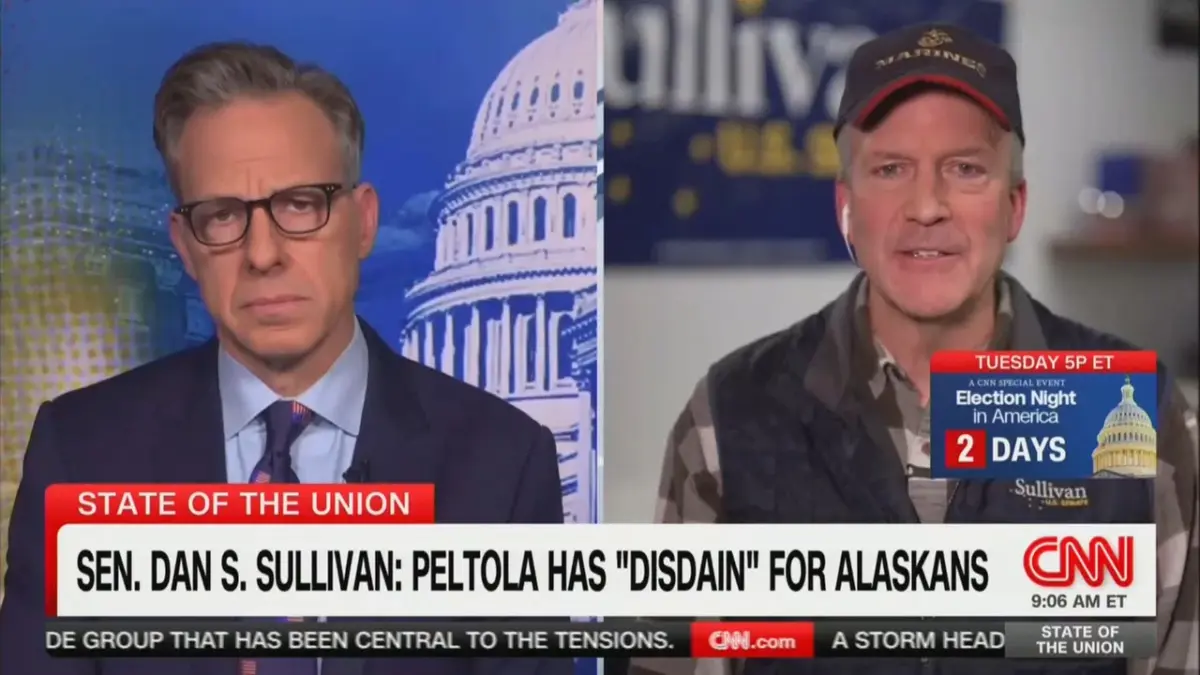
Senator Dan S. Sullivan (R-AK) has issued a scathing rebuke of his political opponent, Representative Mary Peltola (D-AK), following allegations of a coordinated effort to install a "doppelganger" candidate on the Alaskan ballot. The controversy, which has sent shockwaves through the final days of the election cycle, centers on claims that the Peltola campaign and national Democratic organizations recruited a second individual named Dan Sullivan to run for the same office in an attempt to confuse voters and siphon support from the incumbent Republican.
During a high-profile interview on CNN’s State of the Union with moderator Jake Tapper, Senator Sullivan addressed what has been described as a "bombshell" report by The New York Times. The report alleges a months-long, clandestine operation to place Dan J. Sullivan—a man with no prior political profile but a nearly identical name to the Senator—on the ballot. Senator Sullivan characterized the scheme as the epitome of the "rigged system" and "D.C. corruption" that Peltola has frequently campaigned against.
The Anatomy of the "Doppelganger" Allegations
The core of the controversy lies in the recruitment of Dan J. Sullivan, an Alaskan resident who shares a name with the sitting Senator. According to the investigative report by The New York Times, senior aides to Representative Peltola, alongside officials from the Democratic Congressional Campaign Committee (DCCC) and the Democratic substantive leadership, were involved in identifying and encouraging the second Sullivan to enter the race.
The report suggests that the strategy was designed to exploit Alaska’s unique electoral system. By having two "Dan Sullivans" on the ballot, the Peltola campaign reportedly hoped to create enough voter confusion to split the Republican vote share. Senator Sullivan asserted that the evidence against the Peltola campaign is not merely anecdotal but is backed by a substantial trail of digital communication.
"The New York Times article has the receipts," Sullivan told Tapper. "It’s got a ton of text messages in it, all between the people who are undertaking the scheme—her chief of staff, this guy Anton McParland, her campaign manager, and all the DCCC top officials."
Sullivan further alleged that the Democratic Senatorial Campaign Committee (DSCC) and leadership under Senate Majority Leader Chuck Schumer were privy to the operation, receiving regular updates on the recruitment progress. The Senator argued that the frequency and depth of these communications make it impossible for Representative Peltola to have been unaware of the plot.
Contradictory Statements from the Peltola Campaign
The defense offered by Representative Peltola has come under intense scrutiny. In previous public statements, Peltola insisted she had "honestly no idea" about any scheme to recruit a namesake candidate. However, the narrative was complicated by statements from Elisa Rios, Peltola’s former campaign manager and aide.
Initially, Rios reportedly confirmed that Peltola was aware of the efforts to recruit the second Dan Sullivan. Rios later attempted to retract those comments, leading to a confusing series of denials that the Sullivan campaign has framed as evidence of a cover-up.
Senator Sullivan pointed to the relationship between Peltola and her Chief of Staff, Anton McParland, as proof of her involvement. "She is joined at the hip with this guy McParland," Sullivan said. "There is no way that this went on for a year that they weren’t informing her on. It’s just a complete fabrication. She’s got caught lying, and she’s still lying to the Alaskan people."
A Timeline of the Recruitment Effort
The alleged plot appears to have been a long-term strategic initiative rather than a last-minute tactical shift. Based on the investigative findings and Sullivan’s statements, a timeline of the event emerges:
- Early 2025 – Recruitment Phase: Democratic strategists began identifying potential "spoiler" candidates in key battleground states. In Alaska, the focus shifted to individuals sharing the name of the incumbent Republican Senator.
- Mid-2025 – Outreach: Staffers associated with the Peltola campaign and national Democratic committees allegedly made contact with Dan J. Sullivan to discuss a potential run.
- Late 2025 to Early 2026 – Coordination: Text messages cited in the New York Times report suggest weekly updates between campaign leadership and D.C.-based party officials regarding the "Dan Sullivan scheme."
- Filing Deadline – Official Entry: Dan J. Sullivan officially filed his candidacy, ensuring his name would appear on the ballot alongside Dan S. Sullivan.
- October 2026 – The Exposé: Investigative reporting revealed the internal communications of the Peltola campaign, bringing the recruitment effort to light just days before the election.
- The Fallout: Senator Sullivan’s appearance on national television to denounce the move and Peltola’s subsequent denials.
Legal Implications and the Enforcement Act of 1871
During the CNN interview, the discussion turned toward the potential legality of the recruitment scheme. When asked by Jake Tapper if a crime had been committed, Senator Sullivan remained cautious but pointed toward specific federal statutes that might apply.
Sullivan specifically cited the Enforcement Act of 1871, often referred to as the "Anti-Ku Klux Klan Act." While originally designed to protect the rights of newly enfranchised African Americans in the post-Civil War South, the act contains provisions (specifically 42 U.S.C. § 1985) regarding conspiracies to interfere with civil rights, including the right to vote and the fair administration of elections.
"There’s this anti-Ku Klux Klan statute people should take a look at, certainly, that would maybe make this about not being legal at all," Sullivan remarked. Legal experts note that while "ghost candidates" or "spoiler candidates" are a recurring, if controversial, feature of American politics, a proven conspiracy to intentionally deceive voters through the use of a namesake could potentially meet the threshold for electoral fraud or civil rights violations depending on the jurisdiction and the specifics of the deception.
Alaska’s Ranked Choice Voting and Voter Confusion
The impact of a namesake candidate is significantly amplified by Alaska’s electoral system. Alaska utilizes a nonpartisan top-four primary and ranked-choice voting (RCV) in the general election. Under RCV, voters rank candidates in order of preference. If no candidate receives more than 50% of the first-choice votes, the candidate with the fewest votes is eliminated, and their supporters’ second-choice votes are redistributed.
In such a system, the presence of a "Dan J. Sullivan" on the ballot could lead to several scenarios:
- Direct Vote Siphoning: Voters intending to vote for the incumbent might mistakenly select the other Dan Sullivan as their first choice.
- Exhausted Ballots: Voters who only rank one "Dan Sullivan" and pick the wrong one may find their ballot "exhausted" if that candidate is eliminated early, effectively nullifying their intended support for the incumbent.
- Margin of Victory: In a close race, even a fraction of a percentage point redirected toward a namesake candidate could alter the outcome of the redistribution rounds.
Data from previous elections in other states suggests that "ghost candidates" can indeed influence outcomes. In a 2020 Florida State Senate race, a candidate with the same last name as the incumbent was recruited to run; the incumbent eventually lost by a margin smaller than the votes received by the spoiler candidate.
Broader Political and National Implications
The controversy in Alaska is not merely a local concern; it has significant implications for the balance of power in the United States Senate. With a narrow margin currently separating the parties, every seat is vital. The involvement of the DSCC and senior Democratic leadership, as alleged by Sullivan and the New York Times, suggests that the "doppelganger" strategy may have been a high-level tactical decision aimed at flipping a reliably Republican seat.
The reaction from the Republican Party has been one of unified condemnation. National GOP leaders have framed the incident as an assault on the integrity of the democratic process. Conversely, Democratic supporters have largely focused on the legality of the filing, arguing that any eligible citizen has the right to run for office, regardless of their name.
Despite the intensity of the allegations, Senator Sullivan affirmed his commitment to the democratic process. When asked by Tapper if he would accept the election results regardless of the outcome, Sullivan replied, "No, I’m going to accept the election results." However, he made it clear that accepting the results does not mean ignoring the tactics used during the campaign.
Conclusion: The Ethics of Modern Campaigning
As Alaskans prepare to head to the polls, the "Dan Sullivan vs. Dan Sullivan" saga serves as a case study in the evolving—and often aggressive—tactics of modern American political campaigns. The shift from policy-based debates to tactical maneuvers designed to exploit ballot mechanics reflects a deeply polarized environment where the margins for victory are razor-thin.
The coming days will determine whether the alleged scheme will result in the intended voter confusion or if the publicizing of the plot will backfire, galvanizing Sullivan’s base against what they perceive as an unethical "dirty trick." Regardless of the election’s outcome, the legal and ethical questions raised by this recruitment effort are likely to prompt calls for electoral reform and stricter oversight of candidate recruitment processes in Alaska and beyond.


 Nila Kartika Wati

 Eva Lovia

 Lina Irawan

 Yuyun Lusiyani

 Ana Megawati

 Joko Widodo
