
 Yuyun Lusiyani
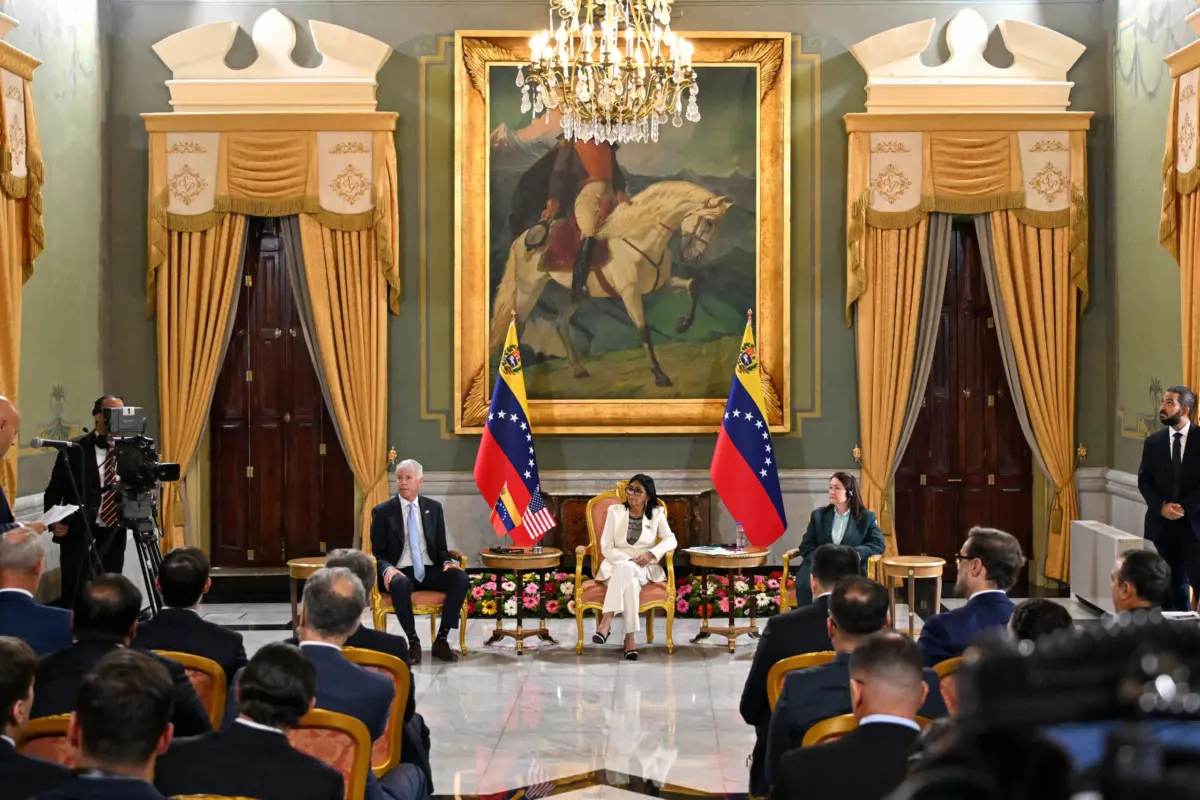
A groundbreaking investigation by ProPublica has revealed the intricate and contentious details of what former President Donald Trump lauded as the "biggest oil deal in world history" – a strategic partnership granting the United States sweeping access to Venezuela’s vast oil reserves. Far from the publicly touted benefits for both nations, the 18-page accord, reviewed by ProPublica, exhibits meticulously crafted terms that overwhelmingly favor U.S. interests and cement the power of a select group handpicked by the Trump administration, while largely sidelining the Venezuelan government and its people. This secretive agreement, signed by Secretary of State Marco Rubio and Defense Secretary Pete Hegseth for the U.S., names Alejandro Betancourt, a Venezuelan oligarch facing multiple money-laundering investigations, as a key partner, raising significant questions about transparency, ethics, and long-term geopolitical implications.
Unveiling the "Historic" Accord
The cornerstone of the deal is the U.S. acquisition of a 35% stake in Betancourt’s firm, North American Blue Energy Partners (NABEP), through a Barbados-registered parent company. This stake is to be acquired at a nominal cost of $0.01 per warrant share, with no upfront payment from the U.S. government, terms set to expire on the deal’s 75th anniversary. While Trump publicly hailed these shares as potentially worth "hundreds of billions" plus dividends, the arrangement’s financial architecture raises eyebrows, particularly given the Pentagon’s Office of Strategic Capital, led by David Lorch, is tasked with executing the transaction, a move questioned by Senate Democrats regarding its legal authority to operate in a sanctioned country like Venezuela.
The agreement also grants the U.S. a deep discount on 20% of NABEP’s oil, priced at $30 a barrel – less than a third of recent market values. Beyond this initial discount, Washington secures "first priority" to purchase all of NABEP’s remaining oil production for the next 50 years, including an irrevocable right to buy its entire supply during a declared U.S. national emergency. Furthermore, the U.S. receives "most favored nation" status, compelling NABEP to disclose any other business agreements and to grant Washington matching terms if more favorable.
The Shadowy Partner: Alejandro Betancourt
A central point of contention and scrutiny is the choice of Alejandro Betancourt as the primary partner. A globe-trotting Venezuelan oligarch, Betancourt has been the subject of money-laundering investigations in Switzerland, Spain, and has surfaced as a suspect in the major U.S. money-laundering probe known as "Operation Money Flight." At the time of the deal’s inception, Betancourt was under house arrest on his Oxfordshire estate in England, battling a Swiss extradition request, with his passports confiscated and travel restricted.
Critics, including prominent Venezuelan opposition leader María Corina Machado, have publicly accused Betancourt of involvement in "obscene corruption" that has exacerbated the suffering of the Venezuelan people. Former U.S. diplomat Brian Naranjo characterized Betancourt as a "totemic, emblematic, corrupt figure" whose "talent…is connections and influence. It is know-who, not know-how."
Despite these serious allegations and legal entanglements, Secretary of State Marco Rubio publicly defended Betancourt, citing a U.S. law enforcement review that found "no investigations of him in our system." Reports further indicate that senior Trump administration officials, including then-Deputy Secretary of State Christopher Landau and former Attorney General Pam Bondi, actively petitioned foreign counterparts to lift Betancourt’s travel restrictions and close investigations into his business dealings, paving the way for his participation in the deal.
Discrepancies and Detrimental Terms for Venezuela

The actual terms of the agreement diverge significantly from the Trump administration’s public pronouncements regarding benefits for Venezuela. While the White House claimed the deal would secure America’s energy dominance for a century and drive Venezuela’s economic recovery through an estimated $200 billion in royalties and tax payments, the document reveals a different reality. U.S. purchasing rights expire in 50 years, not a century, and the underlying operating rights (reportedly 100 years, according to a U.S. official) appear to contradict Venezuelan laws limiting oil concessions to 25 years. Crucially, the text does not explicitly obligate NABEP to pay the heralded $200 billion in royalties and tax payments to Venezuela.
Moreover, the agreement’s promise of "low-cost oil imports" to the U.S. comes with hidden expenses. The discounted $30 a barrel price does not account for the significant cost of processing Venezuela’s heavy crude, which often requires blending with 20% or more of thinner oils to flow through pipelines. The cost of importing millions of barrels of these blending materials is not factored into the purchase price, potentially inflating the actual cost for the U.S.
In a stark illustration of the deal’s imbalance, any disputes between NABEP and the United States are mandated to be settled under U.S. law, specifically before the United States District Court for the Northern District of Texas – a jurisdiction where the Trump Justice Department frequently sought favorable rulings. Venezuelan courts are entirely excluded, effectively stripping Venezuela of its legal recourse within its own sovereign territory regarding this critical resource agreement.
The Architecture of Control and Secrecy
The 18-page agreement is marked as a "sensitive" government document, a classification typically used to shield federal records from public scrutiny. It also includes a confidentiality clause explicitly barring Betancourt’s company from disclosing the "existence and terms" of the agreement. This veil of secrecy has fueled concerns about accountability and transparency.
The governing structure of the venture is designed to ensure long-term U.S. and Betancourt control. A seven-member board will govern for an initial 15-year term, with a majority of its members required to be U.S. citizens at all times. The U.S. government can also appoint a "non-voting observer." Betancourt is the only board member named in the agreement and is protected from removal as CEO by a supermajority vote of five members, a safeguard also extended to changing board composition or executing transactions with certain shareholders. Notably, there is no requirement for any Venezuelan government participation on the board.
The deal offers extensive protections for Betancourt and unnamed investors, with no public disclosures required about executive pay or share distributions. While the agreement mandates "anti-money laundering controls" and external audits, it remains unclear if these reports will ever be made public. Sources familiar with the deliberations suggest that Betancourt’s private company was preferred over publicly traded oil companies like Chevron or Exxon, precisely because it offered "privacy and flexibility," allowing the U.S. government to circumvent shareholder reporting requirements that would apply to public entities.
Official Responses and Justifications
Despite the revelations, the White House, State Department, Pentagon, and NABEP have defended the agreement. White House spokesperson Taylor Rogers asserted that the "historic deal marks a major step toward stabilizing Venezuela’s economy… while more than doubling the United States’ oil reserves." NABEP spokesperson Terry Wade emphasized that NABEP was chosen for its "track record of expanding oil production in Venezuela" and clarified that the agreement was between the company and the U.S. government, not the Venezuelan state. Wade also dismissed blending costs as not meaningfully impacting production prices, stating, "Our barrel economics are strong."
Interim Venezuelan President Delcy Rodríguez, whose backing by the Trump administration facilitated her role, publicly praised the accord as "historic," asserting Venezuela’s continued sovereignty over its natural resources and defending Betancourt’s selection.

A Contentious Road to Agreement: Timeline and Backroom Dealings
The genesis of this deal traces back to January, immediately following the capture and airlift of President Nicolás Maduro by U.S. special operations forces. Trump made it clear his goal was to restore American access to Venezuela’s oil reserves, which U.S. firms had largely been ejected from two decades prior.
Early plans considered publicly held American oil companies to rehabilitate Venezuela’s ailing oil sector, but these stalled due to corporate reluctance or limited access to decision-makers. Instead, Betancourt’s NABEP was "given priority," effectively sidelining major multinationals. Betancourt’s influence had grown within the Trump administration; he served as an interlocutor with the Maduro government, had ties to the Venezuelan opposition, and provided intelligence that aided U.S. operations, including Maduro’s capture. He also cultivated a strong relationship with Delcy Rodríguez, despite his history of being accused of corruption by her influential brother, Jorge Rodríguez.
With the International Development Finance Corporation barred from operating in Venezuela due to U.S. law, alternative financing avenues were explored. By July, the Pentagon’s Office of Strategic Capital, led by David Lorch (who previously worked at Deputy Defense Secretary Steve Feinberg’s private equity firm, Cerberus Capital), emerged as the solution. Lorch, along with other Pentagon and State Department officials, flew to Caracas that month, agreeing in principle to the deal.
On August 5, Betancourt, accompanied by Jacob Hirshman, CEO of Erebor Bank (a new bank backed by Trump supporters Peter Thiel and Palmer Luckey, aiming to reconnect Venezuela to the global economy), was given a "red carpet treatment" at an auxiliary Pentagon office. Lorch presented the alliance as a significant "opportunity" to fulfill Trump’s "America First" energy agenda. The subsequent weeks involved intensive negotiations, with Lorch reportedly keen on structuring the venture to be immune to future administrations seeking to reverse it. The deal culminated on August 28 with Trump’s public announcement on Truth Social, followed by the signing two days later by Hegseth, Rubio, Betancourt, and Orlando Alvarado – a figure identified by the Miami Herald as an unindicted co-conspirator in a scheme to embezzle money from Venezuela’s national oil company. NABEP maintains that neither Betancourt nor Alvarado has ever been charged with any crime.
Broader Implications and Future Scrutiny
The newly revealed details are poised to intensify scrutiny of this unorthodox partnership. Congressional Democrats have already blasted the accord, questioning the wisdom of entangling the U.S. with a relatively unknown foreign oil company led by an individual with a controversial past. They argue that many Venezuelan oil fields are far from production-ready, suggesting a decade or more before global markets or the American public see tangible benefits. Former Ambassador James Story predicts that "Question number one in a new U.S. Congress will be: Why Betancourt? …And was he involved in criminality? It seems reasonable to have a congressional hearing about those questions."
The deal represents a significant gamble, intertwining U.S. strategic energy interests with a private firm and an individual accused of corruption, all while bypassing traditional diplomatic and corporate channels. Its long-term viability, economic impact on Venezuela, and potential for renewed political instability, particularly if a new U.S. administration or Venezuelan leadership seeks to dismantle it, remain profoundly uncertain. The tension between securing American energy dominance and upholding principles of transparency, good governance, and respect for national sovereignty will likely continue to define the narrative around this unprecedented oil agreement.




 Nila Kartika Wati

 Eva Lovia

 Lina Irawan

 Ana Megawati

 Joko Widodo
