
 Amara Maple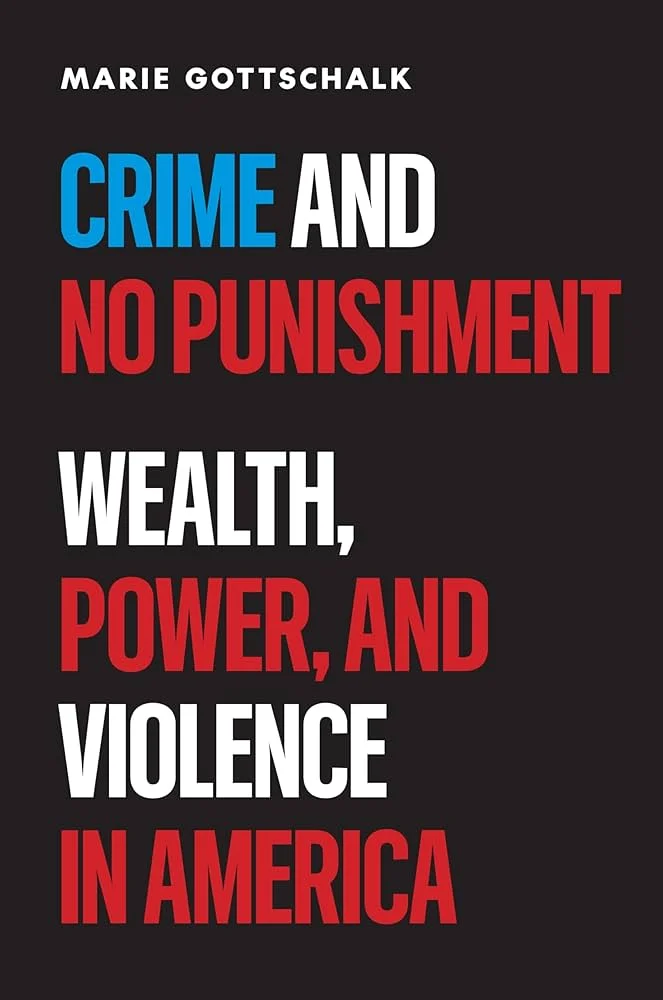
Professor Marie Gottschalk, a distinguished scholar of political science at the University of Pennsylvania, has launched a compelling new critique of the American justice system and its broader societal implications with her forthcoming book, Crime and No Punishment: Wealth, Power, and Violence in America (Princeton University Press, 2025). Known for her expertise in criminal justice, race, and health policy, Gottschalk’s previous work, the award-winning The Prison and the Gallows: The Politics of Mass Incarceration in America (Cambridge Studies in Criminology, 2006), cemented her reputation as a leading voice on the carceral state. However, her latest endeavor marks a significant pivot, directly confronting the long-neglected issue of corporate crime and its pervasive, yet often invisible, impact on American society.
Gottschalk’s central argument posits that a confluence of factors—including corporate impunity, the financialization of the economy, increasingly militarized policing, the burgeoning carceral state, and the ongoing "forever wars" in Afghanistan, Iraq, and beyond—have collectively fostered an environment ripe for corporate, economic, and state violence. This systemic violence, she contends, is actively undermining the legitimacy of American political and economic institutions, creating a crisis of trust and accountability. The book meticulously analyzes how the concentration of economic, political, and military power diverts vital resources, disproportionately harms vulnerable communities, and normalizes various forms of violence and premature death. This systemic neglect, Gottschalk argues, prevents the nation from addressing the fundamental causes of violent street crime and curtailing the alarming rise in "deaths of despair" stemming from suicide, alcoholism, drug overdoses, and chronic diseases.
A Scholar’s Evolution: Confronting a Blind Spot
For much of her career, Gottschalk, like many academics and the broader public, focused predominantly on street crime and the mechanisms of mass incarceration. In an interview with Corporate Crime Reporter, she openly acknowledged this previous oversight, stating, "Like most scholars of crime in the criminal legal system, I mostly ignored white collar and corporate crime in my teaching and research." She described her new book as a "mea culpa," questioning why she hadn’t delved into corporate crime sooner. While her background as a political scientist, rather than a criminologist, initially shaped her focus on mass incarceration and its racial dimensions, she concedes it was a "real blind spot."
This academic introspection highlights a broader trend within scholarly circles and public discourse. Despite compelling evidence that corporate and white-collar crime, alongside state and economic violence, inflict far greater direct and indirect harm on more people in the United States, public and scholarly attention remains disproportionately fixated on violent street crime. This disparity in focus, Gottschalk suggests, is not accidental but a consequence of systemic forces that prioritize the visibility of certain forms of crime while obscuring others.
The Shifting Landscape of the Carceral State
Gottschalk’s earlier work extensively detailed the rise of mass incarceration, particularly its racial dimensions. While the U.S. incarceration rate has stabilized at approximately 600 per 100,000 population, her new research reveals significant shifts within the carceral state. Incarceration rates are now increasing in suburban and rural areas, with individuals in these regions facing a higher likelihood of imprisonment than those in urban centers. Furthermore, while incarceration rates remain disproportionately high for African Americans, the gap between their rates and those for white individuals is narrowing, indicating that "mass incarceration is now affecting a wide swath of Americans." This evolving demographic profile of the incarcerated population underscores the pervasive reach of the carceral system, even as its original drivers and impacts are re-examined.
Intertwined Harms: Corporate Crime and Street Crime
A core tenet of Crime and No Punishment is the intricate connection between corporate crime and street crime, arguing against their common perception as distinct phenomena. Gottschalk explains, "Corporate crime and the related issue of rising inequality means that there are fewer resources around to address what causes street crime and alternatives to incarceration." By creating a "hysteria over street crime," public attention is deliberately diverted from corporate malfeasance. This strategic misdirection fosters a "panic over one while ignoring the other," hindering comprehensive solutions to both.
The financialization of the economy, a process by which financial markets and institutions exert increasing influence over economic activity, is identified as a key driver of this dynamic. It leads to greater concentration of economic and political power, which in turn reduces the likelihood of holding powerful actors accountable for their crimes. This concentration also perpetuates an unequal distribution of wealth and an inequitable tax system, further eroding the resources necessary to address societal problems that fuel both types of crime.
The Invisible Epidemic: Social Murder and Corporate Homicide
The devastating consequences of corporate negligence and malfeasance are often obscured by a narrow definition of "crime." Gottschalk highlights the opioid crisis as a stark example of "social murder," emphasizing that the 108,000 annual deaths from drug overdoses at the crisis’s peak far exceed the number of homicides, dwarfing even the total American fatalities in the Vietnam War. She asserts that while these deaths are not typically attributed to a perpetrator with a gun, the complex corporate and economic factors behind the crisis undeniably constitute a form of violence. Pharmaceutical companies, for instance, have faced multi-billion dollar settlements for their role in aggressively marketing highly addictive opioid painkillers, demonstrating a clear link between corporate practices and widespread harm.
Historically, the prosecution of corporations for deaths resulting from their products or practices has been exceedingly rare. Gottschalk references the infamous Ford Pinto case from nearly forty years ago, where a Republican prosecutor in Indiana brought homicide charges against Ford Motor Company for the fiery deaths of three teenage girls. Despite compelling internal memos suggesting Ford knew of the Pinto’s design flaw, the company was ultimately acquitted. This case marked the last time a major American corporation faced homicide charges in a product liability case. The tragic Boeing 737 MAX crashes, which claimed 346 lives, are cited as a more recent instance where corporate negligence, potentially amounting to manslaughter, went largely unaddressed by criminal prosecution. These examples underscore the systemic failure to hold corporations criminally accountable for deaths and injuries that would, under different circumstances, be classified as homicide or manslaughter if committed by individuals.
Mapping a Way Out: Structural Reforms and Redefining Violence
Gottschalk’s book doesn’t just diagnose the problem; it also maps a comprehensive path forward in its concluding chapter. She advocates for "thinking big" and avoiding "non-reformist reforms" – superficial measures like a few "show trials" of corporate executives that fail to address the underlying systemic issues. Instead, she calls for a fundamental reorientation of national priorities.
Key policy recommendations include:
- Strengthening the Social Safety Net: Implementing robust social programs to support the 70 percent of Americans living paycheck-to-paycheck, addressing the root causes of economic insecurity and "deaths of despair."
- Progressive Taxation and Wealth Tax: Reforming the tax system to ensure a more equitable distribution of wealth, providing the necessary resources for social investments and a stronger regulatory state.
- Reallocating Resources from Military Spending: Critically examining the staggering $1.5 trillion spent annually on the military-industrial complex and redirecting a significant portion of these funds to domestic needs, such as public health, education, and social infrastructure.
- Empowering Regulatory Bodies: Significantly increasing the resources and authority of regulatory agencies and law enforcement dedicated to policing corporate crime, leveling the playing field against powerful corporate interests.
- Structural Accountability: Moving beyond individual prosecutions to examine and dismantle the "structural rot in the system" that enables corporate impunity.
Central to Gottschalk’s approach is a redefinition of "violence." She argues that using the term "violence" rather than "corporate crime" or "white-collar crime" is crucial because it immediately conveys the severity of harm. "When people hear white-collar crime, they think it’s a victimless crime or not a big deal," she observes. By reframing issues like the Boeing crashes, the Pinto deaths, the grossly inequitable economic system, and the unprecedented decline in life expectancy as acts of violence, Gottschalk aims to broaden public understanding and galvanize action. "That’s violence to your society. That’s a society that is dying. I use the word violence a lot in my book and in the title of my book because people have a hard time thinking about corporate murder," she explains.
Obstacles to Accountability: The Revolving Door and Political Containment
Gottschalk’s analysis delves into the systemic impediments to corporate accountability, including the "revolving door" phenomenon, where corporate lawyers cycle between high-level government positions and lucrative private sector roles. This practice, she argues, often results in political appointees at the Department of Justice prioritizing corporate interests over rigorous enforcement. She cites the example of the "secret opioid memo" from August 2019, where line prosecutors in Virginia were reportedly poised to criminally prosecute those responsible for the opioid crisis, only to be stopped by political appointees at the Justice Department. Similar patterns emerged during the 2008 financial crisis, where individuals with strong ties to Wall Street filled key administration roles, leading to a notable lack of aggressive criminal prosecutions against those responsible.
The use of deferred prosecution agreements (DPAs) and non-prosecution agreements (NPAs) is another critical area of concern. These agreements, which allow corporations to avoid criminal conviction in exchange for penalties and compliance measures, are often negotiated in secrecy, making it difficult for the public to ascertain their terms or verify corporate adherence. Notably, Mary Jo White, later head of the SEC, pioneered the use of DPAs for major corporations as U.S. Attorney in 1994, with the Prudential Securities case. While proponents argue DPAs avoid devastating "collateral consequences" for innocent employees and the broader economy, critics like Gottschalk contend they allow corporations to escape genuine accountability.
Political figures who challenge corporate power often face concerted efforts to "contain" their influence. Gottschalk highlights strategies employed against Senator Elizabeth Warren, who has been a vocal critic of corporate wrongdoing and the lack of enforcement. Revelations from the "Epstein files" exposed a 2015 email exchange between Kathy Ruemmler (a former White House counsel for Barack Obama, then a corporate lawyer) and Jeffrey Epstein, discussing a "PR strategy for MJ White v. Elizabeth Warren," with Ruemmler deriding Warren as "the worst." Similarly, Gottschalk notes that Timothy Geithner, former Treasury Secretary, also pursued a "we have to contain Elizabeth Warren" strategy. These instances reveal a bipartisan effort within elite circles to neutralize prominent critics of corporate power, underscoring the formidable political obstacles to achieving meaningful reform.
Academic Landscape and the Call for Interdisciplinarity
Gottschalk also reflects on the challenges of pursuing such expansive, interdisciplinary research within contemporary academia. She observes that the field of political science has increasingly modeled itself after economics, prioritizing mathematical modeling and the analysis of "really small problems" over grander, systemic inquiries. This trend, she suggests, can isolate scholars who venture into interdisciplinary work that crosses criminology, sociology, history, and political science, especially when addressing controversial topics like corporate crime and the concept of "empire" in relation to the United States.
However, Gottschalk finds strength in a network of like-minded colleagues across various disciplines and senses a growing public hunger for understanding complex societal dynamics, particularly in the wake of phenomena like the rise of Donald Trump. She pushes back against simplistic explanations, advocating for a nuanced understanding of how policies like "small government, low taxes, anti-regulation"—often associated with neoliberalism—are selectively applied, ignoring the massive build-up of the prison system, military, and corporate subsidies that contradict this narrative.
Crime and No Punishment is poised to spark critical conversations, urging a radical re-evaluation of how American society defines, addresses, and ultimately suffers from violence in its myriad forms. By connecting the dots between seemingly disparate issues—from mass incarceration and economic inequality to corporate malfeasance and military spending—Gottschalk provides a powerful framework for understanding the systemic roots of America’s intertwined crises of justice, legitimacy, and public health. Her call to "think big" and demand structural change offers a challenging yet hopeful vision for a more equitable and accountable future.




 Yuyun Lusiyani
 Joko Widodo
 Eva Lovia
 Pevita Pearce
 admin
admin
 Lina Irawan