
 Amara Maple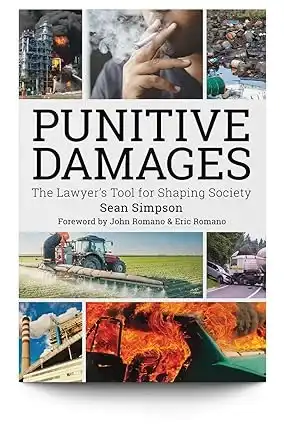
With corporate criminal prosecutions on a noticeable decline, a critical question emerges for society: how do we effectively deter corporate misconduct and ensure accountability? This pressing concern forms the core of San Diego trial lawyer Sean Simpson’s new book, Punitive Damages: The Lawyer’s Tool for Shaping Society, which argues passionately for the robust application of punitive damages in civil litigation as a vital, if often underutilized, mechanism to curb corporate avarice and recklessness.
The Retreat of Corporate Criminal Enforcement
The past few decades have witnessed a discernible shift in the landscape of corporate accountability. Data from the Department of Justice (DOJ) and independent analyses consistently point to a reduction in the number of corporate criminal prosecutions, particularly against large corporations and their executives. Following a brief uptick in the wake of the Enron and WorldCom scandals of the early 2000s, which spurred the Sarbanes-Oxley Act, the trend has largely moved towards deferred prosecution agreements (DPAs) and non-prosecution agreements (NPAs). While these agreements often involve significant financial penalties and promises of internal reforms, critics argue they frequently fail to hold individual executives accountable or impose a sufficiently deterrent "sting" that criminal convictions would.
For instance, the Syracuse University Transactional Records Access Clearinghouse (TRAC) has reported significant declines in federal corporate crime prosecutions over the last decade, highlighting a retreat from aggressive enforcement actions. Between 2011 and 2021, TRAC data indicated a steady decrease in the number of individuals and organizations prosecuted for white-collar offenses, with corporate prosecutions showing a particularly sharp drop in some periods. This trend has fueled a perception among some legal experts and consumer advocates that major corporations, especially those deemed "too big to fail" or "too big to jail," often escape the full force of criminal law. The complexities of prosecuting corporate entities, coupled with immense legal resources wielded by large firms and the potential economic fallout of dismantling a major corporation, present formidable challenges for government prosecutors.
In this environment, Simpson contends that the traditional pillars of corporate deterrence – criminal sanctions and civil agency fines – have become increasingly inadequate. Civil agencies such as the Food and Drug Administration (FDA), the Environmental Protection Agency (EPA), the Equal Employment Opportunity Commission (EEOC), or state insurance commissioners, while having important regulatory functions, often levy fines that are "relatively rare and modest" in comparison to the vast profits and resources of multinational corporations. These fines, while corrective in intent, frequently fall short of providing a true deterrent against deeply entrenched patterns of misconduct, effectively becoming a mere "cost of doing business." This allows corporations to weigh the potential fines against the profits generated by questionable practices, often finding the latter more favorable.
Punitive Damages: A Potent, Underutilized Weapon
Against this backdrop, Simpson positions punitive damages as "some of the only remaining forces we have to combat corporate greed and recklessness." Unlike compensatory damages, which aim to make the injured party whole by covering actual losses such as medical bills, lost wages, and pain and suffering, punitive damages serve two distinct purposes: to punish the wrongdoer for egregious behavior and to deter similar conduct by the defendant and others in the future. They are awarded in cases where the defendant’s actions demonstrate malice, fraud, oppression, or a reckless disregard for the rights and safety of others.
Simpson’s book aims to re-empower trial lawyers to aggressively pursue these claims. He observes that, despite their potential, punitive damages are frequently "overlooked or intentionally avoided" by attorneys. This avoidance stems from several practical and systemic challenges, including the heightened burden of proof required in most states (often "clear and convincing evidence" rather than a "preponderance of the evidence"), the difficulties in collecting such awards, and the widespread lack of insurance coverage for punitive damages in many policies. For example, many liability insurance policies explicitly exclude coverage for punitive damages, meaning that corporations must pay these awards directly from their own coffers, which can increase the financial risk for defendants and potentially complicate settlement negotiations. These factors contribute to a perception that punitive damages claims are inherently more complex, time-consuming, and risky to pursue.
Judicial Skepticism and the Shifting Legal Landscape
Adding to the hurdles, Simpson points to a discernible bias against punitive damages within the judiciary. "Judges tend to inherently be negative about punitive damage cases," he notes, attributing this sentiment to several factors. Many judges, having served as referees, prioritize predictability and settlement over the "fireworks" and unpredictability that can accompany punitive damages trials. The quasi-criminal nature of punitive damages, which blend civil relief with a form of punishment, can also make some judges uncomfortable, viewing it as encroaching upon the domain of criminal law. Furthermore, the notion that punitive awards are solely for "big megabucks" or that corporations are already adequately protected by law contributes to a reluctance to uphold substantial awards. Judges, often seeking to avoid reversals on appeal, may also be influenced by appellate court trends that favor reductions in punitive awards.
This judicial skepticism, coupled with persistent efforts by corporate defendants to "dismiss our punitive damages claims, such as the standard motions to strike and dismiss," creates an uphill battle for plaintiffs. Even if initial motions are overcome, subsequent efforts to "knock out punitive damages will continue" throughout the litigation process, requiring trial lawyers to invest significant extra work and resources. This includes rigorous discovery, expert testimony on corporate wealth, and complex legal arguments, all of which add to the cost and complexity of litigation.
The Landmark Impact of State Farm v. Campbell
A pivotal moment in the erosion of punitive damages’ deterrent power was the 2003 U.S. Supreme Court decision in State Farm Mutual Automobile Insurance Co. v. Campbell. This landmark ruling, arising from a bad-faith insurance claim against State Farm that resulted in an initial compensatory award of $2.6 million and a punitive award of $145 million, significantly constrained the permissible scope of punitive damages by introducing a "single-digit ratio" guideline. The Court stated that "few awards exceeding a single-digit ratio between punitive and compensatory damages, to a significant degree, will satisfy due process." It further suggested that, in most cases, an award of punitive damages that is more than nine or ten times the compensatory award would likely violate the Due Process Clause of the Fourteenth Amendment, citing concerns about arbitrariness and excessive awards.
Simpson highlights how this guideline, intended as a framework for scrutiny, has been widely "misinterpreted" by lower courts. What the Supreme Court articulated as a flexible guideline for reviewing disproportionately large awards has often been adopted as a de facto "absolute max" or a strict cap of 10:1, if not lower. This misinterpretation has had profound consequences, as evidenced by Simpson’s own experience where a jury’s $180 million punitive damages award in a pregnancy discrimination case was reduced to a mere $6 million by a judge, citing State Farm v. Campbell. The core issue in that case involved an employer who discriminated against a pregnant employee, with one supervisor even threatening, "I’m about to punch you in the belly and get that damn thing out of you so you can get back to work." Such a stark reduction, Simpson argues, "took away the sting" and undermined the award’s intended deterrent effect, signaling to corporations that even egregious misconduct might incur only a fraction of the intended penalty.
Statutory Caps and Corporate Protections
Beyond the judicial interpretation of State Farm v. Campbell, many states have independently imposed statutory caps on punitive damages, further limiting their potential impact. These caps vary widely, with some states setting them as a multiple of compensatory damages (e.g., Florida’s cap of three times compensatory damages or $500,000, whichever is greater) and others imposing absolute monetary limits. For example, Texas caps punitive damages at two times economic damages plus an amount equal to non-economic damages, up to $750,000, or $200,000, whichever is greater. Virginia caps punitive damages at $350,000, regardless of the compensatory award. These legislative measures are often the result of aggressive "tort reform" campaigns, typically spearheaded by business groups and insurance companies, which argue that excessive punitive awards stifle innovation, increase costs for consumers, and create an unpredictable legal environment.
Simpson acknowledges that, historically, "there have been plenty of laws providing corporations with the protections they may need to prevent putting them out of business." Case law has long instructed courts that punitive awards should not be "so extensive as to disrupt the defendant’s livelihood." However, he contends that these efforts to "save corporations from financial extinction have backlashed," leading to a situation where corporations are often "protected from getting hit with more than a slap on the hand." This creates a perverse incentive structure where the cost of a "slap on the hand" is far less than the potential profits derived from wrongful conduct, thus failing to deter future misbehavior. The impact is a systematic weakening of the only legal tool designed specifically to deter malicious corporate behavior.
The "Tort Reform" Narrative: A Corporate Triumph
Simpson forcefully argues that corporations have largely "won the political argument over tort reform." For decades, well-funded campaigns, often backed by insurance industry and corporate lobbies, have "brainwashed the public into thinking that our legal system is screwed up and these plaintiffs’ lawyers are sleazy money grubbers." These campaigns, exemplified by "stop lawsuit abuse" billboard ads that began appearing forty years ago, have successfully shifted public perception, creating a cultural aversion to lawsuits and skepticism towards plaintiffs’ claims, including those for punitive damages. Groups like the U.S. Chamber of Commerce and the American Tort Reform Association have been instrumental in advocating for legislative changes that limit damages and restrict access to courts.
This narrative has had tangible effects, not just on public opinion but on legislative and judicial outcomes. The ability of powerful corporate interests to "prime the pump of our political system" through lobbying in Washington, D.C., means that legislative agendas often prioritize protections for businesses over the rights of individuals seeking redress for corporate harm. Simpson critically observes, "We’ve had an oligarchy in this country since the 1960s, but it has never been as obvious as it is today," highlighting the immense influence of corporate wealth on policy and legal frameworks. The result is a legal environment increasingly shaped to favor corporate defendants, making it harder for individuals to seek full justice.
The Apathy and Power Dynamics in Corporate Crime Prosecution
Simpson extends his critique to the realm of criminal prosecution for corporate misdeeds. He attributes the weakness of such prosecutions to a combination of factors: apathy, lack of resources, and sheer corporate power. Prosecutors often "don’t want to take on the monsters" – major corporations like Facebook or financial giants – due to the immense complexity, the protracted legal battles, and the public scrutiny involved. The resources required to investigate and prosecute complex corporate fraud, environmental crimes, or product liability cases are often beyond the capacity of many district attorneys’ offices or even specialized federal units. The last time a major American corporation was criminally prosecuted for homicide in a products case, for example, was the Ford Pinto prosecution more than forty years ago, a stark indicator of the rarity of such aggressive criminal enforcement today.
Beyond the practical challenges of "too much work" and insufficient "staff and resources," Simpson suggests an "inherent desire to protect these corporations." This protection, he implies, can stem from various sources, including judges’ personal financial interests (e.g., stock portfolios) or a broader political climate that prioritizes economic stability and corporate growth over stringent accountability. He cites former Attorney General Pam Bondi’s testimony regarding the Epstein files, where she questioned the focus on Epstein when "The Dow is at 50,000," as an illustrative example of this prioritization of economic indicators over specific instances of alleged wrongdoing. This creates a systemic bias against aggressive corporate criminal enforcement.
Unaddressed Grievances and Missed Opportunities
The cumulative effect of these challenges is a significant number of unaddressed grievances and missed opportunities for justice. Simpson estimates that "twenty to twenty five percent of tort cases that could include punitive damages" are foregone by lawyers who choose not to pursue them, often due to the perceived difficulty and increased workload. This translates to potentially thousands of instances where corporate misconduct goes unpunished beyond mere compensatory relief, failing to send a strong message to the corporate world.
Moreover, many winnable court cases are never even brought. A "similarly high" percentage of individuals, particularly in worker injury cases, may not know their legal rights, struggle to find an attorney, or harbor a cultural aversion to lawsuits. Fear of retaliation, such as losing their job, also prevents many from seeking justice. The ongoing efforts to limit attorneys’ fees in states like California further restrict access to justice by making it less economically viable for lawyers to take on complex, high-risk cases that require extensive investigation and litigation. This creates a significant gap in accountability, where victims of corporate malfeasance are left without recourse.
A Call for Collective Action and Reform
Simpson’s book is more than an analysis; it is a "how-to" guide, designed to equip trial lawyers with the tools to push back against these systemic forces and "restore meaning to punitive damages awards." He emphasizes the imperative for lawyers to "continue pushing forward in our pursuit for punitive damages so that corporations and other ill-motivated defendants do not go unchecked." He stresses that this is a collective fight: "We must break the pattern of letting someone else take on the big corporations. We are all in this together. The only way we can make a difference is to collectively work to keep corporate corruption in check."
The current state of affairs, where corporations can "laugh off punitive damages awards and continuing to engage in despicable conduct – because they can," is an "insult to our efforts." However, Simpson views this not as a reason for despair but as a powerful "motivation… to continue pushing for reform." He hopes that through "collective experiences, we can continually build a stronger front to challenge corporate abuse and other bad behavior deserving of punishment." This collective effort would involve sharing strategies, educating new lawyers, and advocating for legal reforms that strengthen, rather than weaken, the power of punitive damages.
Ultimately, Simpson argues that in the "quiver of arrows we use as lawyers, the lone arrow to control corporate misconduct is punitive damages." Restoring its efficacy requires not only a re-commitment from the legal profession but also a broader societal recognition of its vital role in holding powerful entities accountable when other mechanisms fall short. Without robust punitive damages, the deterrence gap for corporate wrongdoing will only continue to widen, leaving society vulnerable to unchecked greed and recklessness and undermining the fundamental principles of justice and corporate responsibility.




 Yuyun Lusiyani
 Joko Widodo
 Eva Lovia
 Pevita Pearce
 admin
admin
 Lina Irawan