
 Amara Maple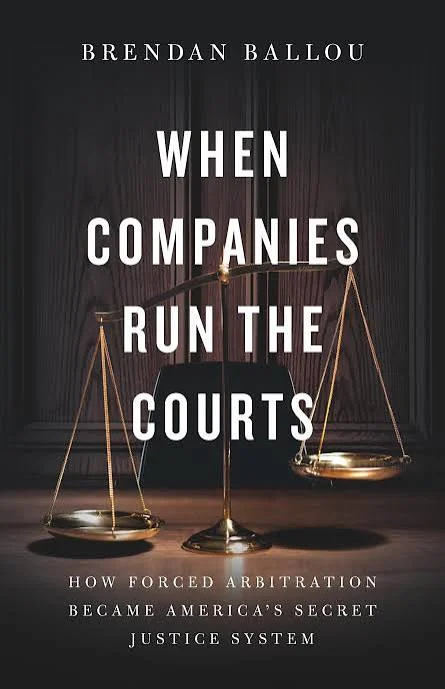
A shadow justice system operates across the United States, largely hidden from public view, where legal disputes are resolved in secret, and the arbiters are often compensated by the very corporations they are tasked with judging. This pervasive mechanism, known as forced arbitration, effectively bars millions of Americans from their constitutional right to a jury trial, trapping workers and consumers in a system where outcomes overwhelmingly favor powerful corporate entities. This alarming trend is the subject of a new exposé by Brendan Ballou, a former federal prosecutor and CEO of the Public Integrity Project, titled When Companies Run the Courts: How Forced Arbitration Became America’s Secret Justice System (PublicAffairs, 2026). Ballou’s work meticulously uncovers how this obscure legal framework shields companies from accountability, enabling unchecked corporate misconduct, banking deception, and even predatory behavior.
The Architect of Secrecy: Understanding Forced Arbitration
Forced arbitration clauses are embedded in countless agreements that individuals unknowingly accept daily. From clicking "I agree" to a streaming service’s terms and conditions to signing employment contracts, consumers and employees often waive their right to pursue legal action in traditional courts. Instead, they are shunted into private arbitration panels. These panels operate with stark differences from public courts: decisions are confidential, there is no public record of proceedings or rulings, and the "judges" (arbitrators) are paid by the corporations involved in the dispute. This inherent conflict of interest, coupled with the lack of appeal options, creates a system where individuals typically face insurmountable odds.
"I wanted to explain how our legal system favors big companies over regular people," Ballou told Corporate Crime Reporter in a recent interview. "I wanted to tell that story through this specific issue of forced arbitration. I felt that if I could do that, I could explain how the legal system can bend toward the very powerful." Ballou’s research reveals that, in some years, the number of cases filed before large arbitration providers surpasses the total number of civil cases in the entire federal court system. Yet, this statistic only scratches the surface of the problem. Forced arbitration doesn’t just reroute cases; it fundamentally "kills cases entirely," rendering legitimate claims "fundamentally unfair and fundamentally unaffordable" for those who should be seeking justice.
A Judicial Coup: The Rise of Forced Arbitration
The widespread adoption of forced arbitration is not a sudden phenomenon but the culmination of decades of legal and political maneuvering. The story, according to Ballou, begins in the 1980s, fueled by a narrative of a "litigation explosion" in the United States. This narrative, often propagated by powerful corporate interests, claimed that an influx of frivolous lawsuits was stifling businesses and bankrupting companies. However, Ballou notes, "the evidence doesn’t match the story. And it’s not clear if that litigation explosion even happened." Data suggests that litigation rates in the U.S. are generally comparable to those in other developed nations.
Despite the dubious premise, this "litigation explosion" narrative provided fertile ground for a concerted effort by conservative judges and business lobbies to push consumers and employees out of the public court system. The primary vehicle for this shift was the reinterpretation of the Federal Arbitration Act (FAA) of 1925. Originally intended to facilitate arbitration between sophisticated commercial entities of equal bargaining power, the FAA was gradually reconfigured by the Supreme Court to apply to virtually any contract, including "contracts of adhesion"—the ubiquitous "click to accept" or "take it or leave it" agreements that individuals sign without negotiation every day.
A pivotal development came with Supreme Court decisions that not only upheld forced individual arbitration but also largely dismantled the ability to bring class action lawsuits in arbitration. This meant that individuals who previously might have joined a class action to collectively challenge a company’s wrongdoing—for example, if a company stole small amounts of money from thousands of customers—would now be forced to pursue their claims individually. For many, the cost and effort of individual arbitration for relatively small sums made such cases entirely unfeasible, effectively allowing companies to escape accountability for widespread, minor infractions.
The Scales of Justice Tipped: Disparate Outcomes
The practical implications of forced arbitration are stark. Studies by various consumer and labor advocacy groups, corroborated by Ballou’s findings, indicate a dramatic disparity in outcomes compared to traditional courts. In small claims courts, consumers are reported to win up to 90 percent of their cases. In contrast, within forced arbitration, the success rate for individuals plummets to a mere 20 to 30 percent. This imbalance is attributed to several factors:
- Financial Incentive: The arbitration firms and individual arbitrators are paid by the companies, creating a potential bias towards repeat clients.
- Lack of Precedent: Arbitrators are not bound by legal precedent, leading to inconsistent rulings and making it difficult for individuals to predict outcomes.
- Information Asymmetry: Corporations often have vastly superior resources, legal teams, and access to data, placing individuals at a significant disadvantage.
- Forum Selection: Arbitration clauses often stipulate the location of arbitration, which can be geographically distant and financially prohibitive for individuals, as seen in cases where a dispute with a local firm in West Virginia could be rerouted to a panel in a major city or even another country.
Ballou highlights the pervasive nature of these clauses: "Eighty percent of Fortune 500 companies use forced arbitration with their customers and employees. Sixty million private employees have their employment governed by forced arbitration agreements." This widespread adoption means that a vast segment of the American population is operating under a legal framework that fundamentally limits their access to justice.
Case Studies: Personal Tragedies in a Private Court
The human cost of forced arbitration is perhaps its most compelling and tragic aspect. Ballou recounts several harrowing examples:
- Jeffrey Piccolo and Disney: The case of Jeffrey Piccolo illustrates the far-reaching and seemingly absurd application of forced arbitration. Piccolo’s wife suffered a fatal allergic reaction at a Disney World restaurant after being assured the food was safe. When Piccolo sought to sue Disney for wrongful death, the corporation attempted to compel him into arbitration. Their argument? Piccolo had signed an arbitration agreement years earlier when he subscribed to Disney Plus, a streaming service. This meant that a seemingly unrelated digital contract could strip him of his right to a public trial for the death of his spouse. While Disney ultimately relented due to intense negative publicity, the fact that such a maneuver was legally permissible underscores the alarming power of these clauses.
- Jane Doe on a Cruise Ship: Ballou begins his book with the anonymized case of "Jane Doe," a worker on a cruise ship who was allegedly raped by a coworker. Due to an arbitration clause in her employment contract, she was forced to arbitrate her sexual assault case, not in a U.S. court, but in the Philippines—a location dictated by her employment agreement. The outcome of her case remains unknown, hidden behind the impenetrable veil of arbitration secrecy.
These cases are not isolated incidents but symptomatic of a systemic issue where individuals, even in cases of severe injury or egregious misconduct, find their access to justice severely curtailed.
The Veil of Secrecy: Why Arbitration Remains Hidden
One of the most insidious aspects of forced arbitration is its inherent secrecy. Unlike public court proceedings, arbitration typically operates behind closed doors. "The proceedings are secret," Ballou explains. "You can’t walk in or dial into an arbitration proceeding. The written decisions are not published. Typically, you can’t see what the judge ruled or why. And often, you can’t talk about the result of the arbitration."
This lack of transparency has profound implications:
- No Public Record of Misconduct: When corporate wrongdoing is resolved in secret, there is no public record for consumers, regulators, or potential employees to consult. This allows companies to repeatedly engage in harmful practices without public scrutiny or consequence.
- Absence of Precedent: The lack of published decisions means no legal precedent is established, preventing the development of case law that could guide future disputes or deter similar corporate actions.
- Erosion of Trust: The public’s trust in the justice system is eroded when a significant portion of legal disputes is handled in a clandestine manner, especially when the perception of bias is strong.
Challenging the Constitution: The Erosion of Rights
The constitutional right to a jury trial, a cornerstone of American jurisprudence, is effectively waived through forced arbitration agreements. Despite numerous constitutional challenges, the Supreme Court has consistently upheld the enforceability of these clauses. The Court’s reasoning hinges on the principle that individuals can contractually agree to waive certain rights, and that the Federal Arbitration Act prioritizes the enforcement of arbitration agreements.
Ballou notes, "The Supreme Court has made it clear that you can contract away your right to a jury trial. I don’t necessarily agree with that decision. The Supreme Court says that arbitration agreements, no matter how unfair, even if they are unconscionable, will be enforced according to their terms." This staunch stance by conservative justices has solidified forced arbitration’s place in the American legal landscape, making it incredibly difficult for individuals to reclaim their right to a public trial.
Corporate Defense: Arguments for Arbitration
While Ballou’s book critically examines the negative impacts of forced arbitration, it is important to acknowledge the arguments put forth by its proponents, primarily corporations and business advocacy groups. Their arguments often center on:
- Efficiency and Speed: Arbitration is touted as a faster and more efficient way to resolve disputes compared to the often lengthy and bureaucratic public court system.
- Cost-Effectiveness: Businesses argue that arbitration is less expensive than litigation, reducing legal costs for both parties and ultimately benefiting consumers through lower prices.
- Expertise: Arbitrators are often chosen for their specific expertise in the industry relevant to the dispute, which proponents argue leads to more informed decisions than a generalist judge or jury.
- Privacy: The confidentiality of arbitration is sometimes presented as a benefit, particularly for sensitive business disputes or personal matters, allowing parties to avoid public disclosure.
- Reduced Burden on Public Courts: Proponents argue that arbitration helps alleviate the caseload burden on an already strained public judiciary.
However, critics like Ballou contend that these purported benefits often come at the expense of fundamental fairness, transparency, and the public’s right to justice.
Legislative Efforts and the Path Forward
In recent years, there has been growing bipartisan concern regarding the scope and impact of forced arbitration, particularly in cases of sexual harassment and assault. This concern culminated in the passage of the "Ending Forced Arbitration of Sexual Assault and Sexual Harassment Act of 2021." This landmark legislation, signed into law in March 2022, prohibits the enforcement of pre-dispute arbitration agreements in cases involving claims of sexual assault or harassment, allowing survivors to pursue their claims in court.
While this act represents a significant step forward, it is a targeted reform, addressing only a specific subset of forced arbitration clauses. Millions of Americans remain bound by arbitration agreements for other types of disputes, including wage theft, discrimination, consumer fraud, and wrongful death, as highlighted by the Jeffrey Piccolo case. Advocates for broader reform continue to push for legislation that would restore the right to a jury trial for all types of disputes, such as the "Fairness in Arbitration Act."
Broader Implications: A Threat to Public Accountability
The existence and proliferation of America’s secret justice system have profound implications for public accountability and the rule of law. When companies can operate with reduced fear of public litigation, the incentive to maintain high ethical standards, protect workers, and serve customers diligently diminishes. It creates an environment where corporate misconduct can fester unchecked, shielded by secrecy and a biased dispute resolution process.
Brendan Ballou’s When Companies Run the Courts serves as a critical exposé, pulling back the curtain on a system that, by its very design, undermines fundamental principles of justice and transparency. It underscores the urgent need for a national conversation and concerted action to restore meaningful access to justice for all Americans, ensuring that the powerful are held to account, not in the shadows, but in the light of public scrutiny. The ongoing struggle against forced arbitration is not merely about legal technicalities; it is about the very foundation of a fair and equitable society.




 Yuyun Lusiyani
 Joko Widodo
 Eva Lovia
 Pevita Pearce
 admin
admin
 Lina Irawan