
 Jia Lissa
The long-standing economic partnership between the United States and Canada reached a historic nadir on Monday as President Donald Trump engaged in a high-stakes rhetorical battle with Ontario Premier Doug Ford. The exchange, characterized by sharp personal insults and threats of sweeping economic sabotage, follows a series of aggressive trade maneuvers that have destabilized the North American markets. After Premier Ford suggested the President could "kiss my ass" in response to newly imposed 50 percent tariffs, President Trump took to social media to deliver a blistering rebuttal, targeting the Premier’s family legacy and Canada’s fundamental economic viability.
The confrontation represents a significant fracture in the cross-border relationship, which has historically been defined by the world’s largest integrated trading partnership. The escalation began earlier on Monday when Premier Ford, representing Canada’s most populous province and industrial heartland, reacted to the President’s latest protectionist measures. By Monday afternoon, the President responded via Truth Social, signaling that the "special relationship" between the two nations has been replaced by a doctrine of aggressive transactionalism.
The Escalation of Rhetoric: Trump’s Rebuttal
On Monday afternoon, President Trump dismissed Premier Ford’s criticisms as "bluster," shifting the focus from policy to personal character. In a post that quickly circulated across international diplomatic circles, the President invoked the memory of the Premier’s late brother, former Toronto Mayor Rob Ford, to undermine Doug Ford’s standing.
"Lots of ‘bluster’ from Doug Ford, who is the Premier of the Canadian Province of Ontario, but who is better known as the less charismatic, intelligent, and overall unimpressive brother of the late, great, Rob Ford," the President wrote. By contrasting the Premier with his late brother—a figure Trump has previously praised for his populist appeal—the President sought to marginalize the Ontario leader’s influence within the broader North American conservative movement.
The President’s critique extended beyond personal insults to a broader condemnation of the Canadian state. He asserted that the United States has been "carrying Canada for decades," arguing that the northern neighbor is entirely dependent on American markets for its survival. "The U.S.A. will always be far bigger, richer, and stronger than Canada," Trump stated. "Without the United States, Canada couldn’t survive—It’s where they get all of their money."
The Energy Standoff: Threats to Infrastructure
One of the most concerning developments in the exchange was the explicit threat regarding energy infrastructure. Premier Ford had earlier suggested that Ontario, a major exporter of hydroelectricity to the American Northeast and Midwest, could retaliate by cutting off power supplies to U.S. manufacturing facilities. This move would potentially cripple industrial operations in states like Michigan, Ohio, and New York, which rely on the integrated North American power grid.

President Trump countered this threat by reminding Canadian leadership of Canada’s own vulnerabilities regarding energy transit. "Remember, much of the Electricity, Oil, and Gas that Canada gets is transported through the U.S.A.," Trump noted. This likely refers to major pipeline corridors, such as Enbridge’s Line 5, which carries light crude oil and natural gas liquids from Western Canada through the Great Lakes region to refineries in Ontario and Quebec.
The President’s warning that "consequences for Canada will be far WORSE" if Canadian officials do not "fall in line" suggests a willingness to weaponize energy transit rights. Such a move would represent a departure from decades of energy security agreements and could lead to significant shortages on both sides of the border, though Canada’s reliance on U.S. transit for its domestic supply remains a critical strategic bottleneck.
Ford’s Defiance: "He Can Kiss My Ass"
The President’s social media response was triggered by an earlier, raw interview given by Premier Ford to CTV News. Ford, who has often been compared to Trump due to his own brand of populism, appeared to have reached a breaking point regarding the 50 percent tariffs imposed on Canadian goods.
"He can kiss my ass as far as I’m concerned," Ford told reporters, signaling a move away from the more cautious diplomatic tone usually adopted by provincial leaders. "We’re gonna go at him full-steam. We need to throw everything and the kitchen sink at him."
Ford characterized the President as a "bully" and invoked the legacy of Ronald Reagan to justify a policy of strength and retaliation. "As Ronald Reagan said—if you come to a draw with a bully, what stops that bully from coming at you the next day, and the next day? And that’s all Donald Trump is, is a bully. He’s gonna have a rude awakening."
The Premier’s aggressive stance reflects the mounting pressure in Ontario, the center of Canada’s automotive and manufacturing sectors. The 50 percent tariffs threaten to make Canadian-made vehicles and parts uncompetitive in the U.S. market, potentially leading to mass layoffs and plant closures in cities like Windsor, Oakville, and Oshawa.
The Broader Context: Prime Minister Carney’s Retaliation
The feud between Trump and Ford is unfolding against the backdrop of a larger federal conflict. Canadian Prime Minister Mark Carney has already pledged a "dollar-for-dollar" retaliatory tariff package against American imports. Carney, a former Governor of the Bank of England and the Bank of Canada, has taken a technocratic but firm approach to the trade war, arguing that Canada cannot allow its industries to be decimated by unilateral American protectionism.
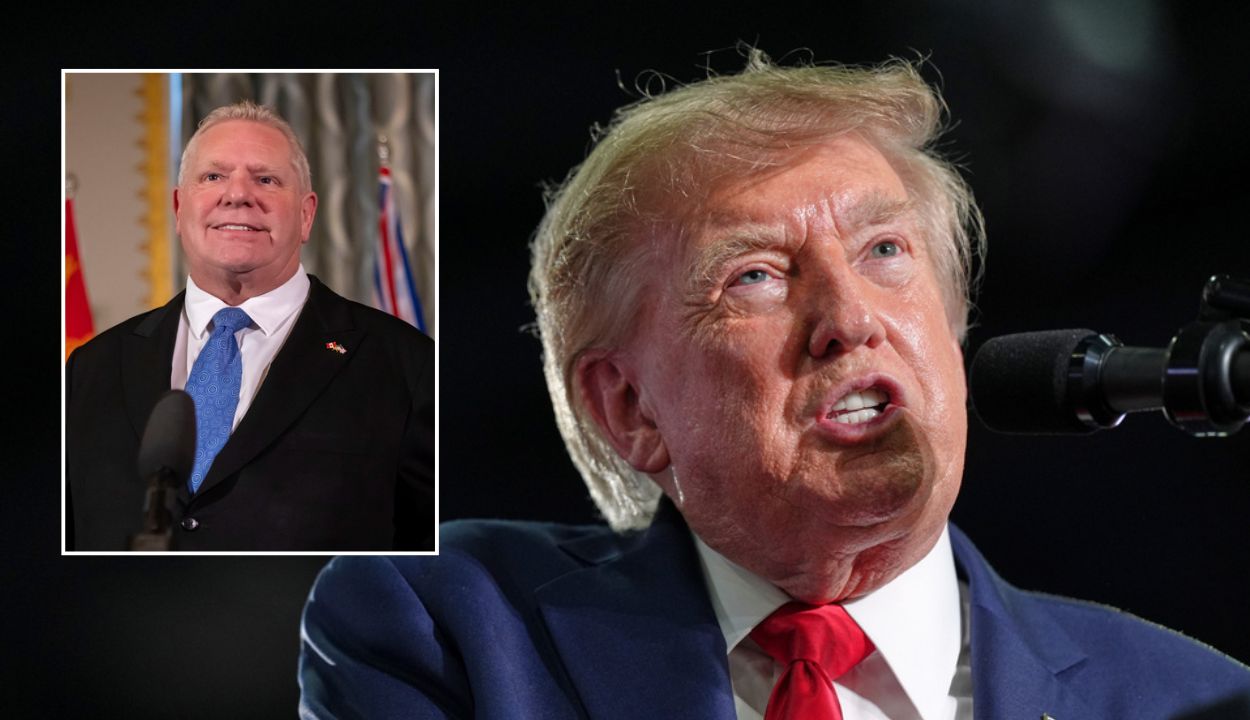
President Trump, however, dismissed Carney as "inept" and labeled Premier Ford as Carney’s "flunky." The President claimed that Canada’s unemployment rate has surged to 10 percent and that businesses are "fleeing for the United States" due to the current administration’s policies. "The days of ripping off our Farmers, and other Businesses, are OVER!" the President concluded.
While the 10 percent unemployment figure cited by the President is higher than most official estimates, economists note that the trade uncertainty has indeed slowed capital investment in Canada. The Canadian dollar has also seen significant volatility as traders weigh the risks of a prolonged shut-down of the world’s most integrated supply chain.
Economic Implications and Data Analysis
The stakes of this rhetorical battle are rooted in the massive volume of trade between the two entities. According to data from the U.S. Department of Commerce and Statistics Canada, bilateral trade in goods and services exceeded $770 billion in 2025. Ontario alone accounts for nearly half of Canada’s exports to the United States.
- Automotive Integration: The North American auto industry relies on parts crossing the border as many as seven times before a vehicle is finished. A 50 percent tariff, if sustained, would effectively dismantle the "Just-in-Time" manufacturing model that has existed since the 1965 Auto Pact.
- Energy Security: Canada is the largest foreign supplier of energy to the U.S., including oil, natural gas, and electricity. Ontario Power Generation and Hydro-Québec provide essential base-load power to the New England ISO and MISO (Midcontinent Independent System Operator) grids.
- Agricultural Impact: Trump’s mention of "ripping off our Farmers" likely refers to long-standing disputes over Canada’s supply management system for dairy and poultry, as well as grain grading issues.
Market analysts warn that if the "kitchen sink" approach mentioned by Ford is implemented, the resulting inflationary pressure in the United States could be substantial. Retaliatory tariffs on American consumer goods, combined with higher costs for Canadian raw materials (aluminum, steel, and lumber), would likely be passed on to American consumers.
Timeline of the 2026 Trade Crisis
- August 10: The Trump administration announces a surprise 50 percent tariff on all Canadian steel, aluminum, and automotive imports, citing national security concerns and a "massive trade deficit."
- August 12: Prime Minister Mark Carney holds an emergency cabinet meeting, announcing a reciprocal tariff list targeting American bourbon, dairy, and high-tech components.
- August 20: Ontario Premier Doug Ford meets with manufacturing CEOs in Toronto, pledging to protect "every single job" in the province.
- August 24 (Morning): Premier Ford gives a fiery interview to CTV, telling the President to "kiss my ass" and threatening to cut off cross-border electricity exports.
- August 24 (Afternoon): President Trump responds on Truth Social, insulting the Premier’s intelligence and threatening to block Canadian energy transit through U.S. pipelines.
Future Outlook and Diplomatic Fallout
The current trajectory suggests a period of prolonged economic decoupling between the two neighbors. Diplomatic sources indicate that communication between the White House and the Prime Minister’s Office has effectively ceased, with both sides dug into their respective positions.
The "rude awakening" Ford promised may manifest in legal challenges through the USMCA (United States-Mexico-Canada Agreement) framework or the World Trade Organization (WTO). However, the President has historically shown a willingness to ignore multilateral rulings in favor of bilateral leverage.
For the residents of Ontario and the American border states, the immediate concern remains the stability of the power grid and the viability of the manufacturing sector. As the two leaders trade barbs, the integrated economy that took decades to build now faces its most existential threat since the Great Depression. The coming weeks will determine whether cooler heads in the U.S. Congress and the Canadian Parliament can intervene, or if the "clowns" and "bullies" identified by each side will continue their path toward a full-scale economic divorce.


 Yuyun Lusiyani
 Joko Widodo
 Pevita Pearce
 admin
admin
