
 Pevita Pearce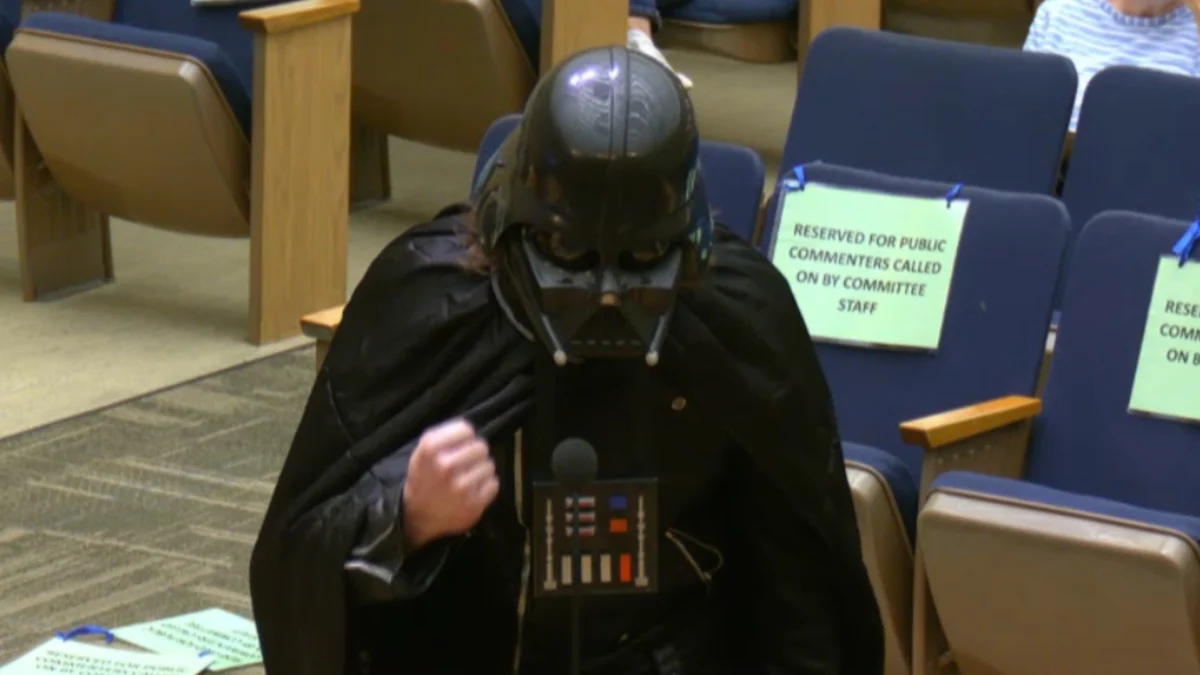
In a striking display of political satire and performative activism, an individual dressed as the Star Wars antagonist Darth Vader appeared before the San Diego Public Safety and Livable Neighborhoods Committee on August 19 to protest the city’s expansion of automated surveillance technology. The costumed speaker used the persona of the Sith Lord to mock the San Diego Police Department’s (SDPD) use of Flock Safety cameras, an automated license plate recognition (ALPR) system that has become a flashpoint for privacy advocates across the United States. While the presentation was framed in the lexicon of science fiction, the underlying message addressed a growing tension in municipal governance: the balance between public safety through technology and the protection of civil liberties.
The incident occurred during a period of public comment regarding the city’s technological infrastructure and law enforcement budget. The speaker, whom the committee addressed as "Mr. Vader" or "Darth Vader" to maintain the decorum of the proceedings, utilized the character’s association with the fictional Galactic Empire—a totalitarian regime known for its absolute surveillance and military might—to draw parallels to contemporary policing strategies.
A Theatrical Critique of Municipal Surveillance
The costumed advocate addressed the committee twice during the session, tailoring each speech to specific concerns regarding the city’s priorities. In his first appearance, the speaker focused on the allocation of city funds, adopting a persona that praised the prioritization of police spending over social services.
"We need SPD to have more money, more money for the emperor to rule over the entire universe," the speaker declared, utilizing a voice modulator to mimic the character’s iconic breathing and tone. "We do not need parks, we do need libraries, we do not need daycare centers, we do not need homeless shelters. All we need is money for our Stormtroopers. Anyone that disagrees is part of the Rebel Alliance and is scum."
This satirical approach highlights a recurring debate in San Diego’s City Hall. Critics of the current administration have frequently argued that the city’s budget disproportionately favors law enforcement at the expense of community infrastructure. By framing the police as "Stormtroopers" and social services as unnecessary obstacles to imperial rule, the speaker aimed to characterize the city’s fiscal policies as authoritarian.
The Controversy Surrounding Flock Safety Technology
The core of the "Darth Vader" testimony focused on Flock Safety cameras. Flock Safety is a private company that provides ALPR technology to thousands of law enforcement agencies and neighborhood associations across the country. The system uses high-speed cameras to capture images of license plates and vehicle characteristics (such as make, model, and color), which are then stored in a searchable database.
In his second testimony, the speaker specifically addressed the committee’s reliance on these cameras. "The Emperor is a fan of Flock, and we must continue utilizing Flock technologies so that we can follow and surveil the rebel scum as they move from playground to playground, from playground to pool, from pool to gymnasium," he stated. He further joked that the technology would allow him to "stalk my ex-girlfriend" and locate "the hidden base on Hoth," a reference to the ice planet in the Star Wars franchise.
The humor, however, masked a serious critique of the "dragnet" nature of ALPR systems. Unlike traditional police work, which often targets specific suspects, systems like Flock record the movements of every motorist within their field of vision, regardless of whether a crime has been committed. This creates a historical record of a person’s movements, which privacy organizations like the American Civil Liberties Union (ACLU) and the Electronic Frontier Foundation (EFF) argue violates the Fourth Amendment’s protection against unreasonable searches.
Chronology of San Diego’s Surveillance Expansion
The appearance of the costumed speaker follows a multi-year effort by the City of San Diego to reintroduce and expand its "Smart Streetlights" and ALPR programs.

- 2016-2020: San Diego initially deployed thousands of "Smart Streetlights" equipped with cameras. However, the program faced significant backlash after it was revealed that the police were using the footage without a clear oversight policy.
- 2020: The city shut down the camera portion of the streetlights following public outcry and the passage of the Transparent and Responsible Use of Surveillance Technology (TRUST) Ordinance.
- 2022-2023: The SDPD proposed a new plan to install 500 Flock Safety cameras. This proposal was met with skepticism by the city’s newly formed Privacy Advisory Board (PAB), which raised concerns about data security and the potential for the technology to be used to track individuals seeking reproductive healthcare or participating in political protests.
- November 2023: Despite the PAB’s recommendation to delay, the San Diego City Council approved a $1.1 million contract with Flock Safety.
- August 19, 2024: The Public Safety and Livable Neighborhoods Committee meeting served as a forum for ongoing public feedback, leading to the "Darth Vader" testimony.
Technical Specifications and Privacy Concerns
Flock Safety cameras are distinct from traditional CCTV. They utilize "Vehicle Fingerprint" technology, which allows law enforcement to search for vehicles based on specific traits even if the license plate is missing or obscured. The data is typically stored for 30 days, although this retention period can vary based on local department policies.
The primary concerns cited by privacy advocates include:
- Data Sharing: Flock’s "TALON" network allows different law enforcement agencies to share data across jurisdictional lines. Critics argue this could allow out-of-state agencies to track individuals traveling to California for services that may be restricted in their home states, such as abortion or gender-affirming care.
- Mission Creep: While the technology is often marketed as a tool to solve violent crimes or find missing persons, data suggests it is frequently used for low-level offenses or general surveillance.
- Lack of Empirical Evidence: Some independent audits have questioned the efficacy of ALPR systems in significantly reducing crime rates compared to traditional investigative methods.
The speaker in the Darth Vader costume addressed these concerns by singling out Councilmember Jennifer Campbell. He suggested that officials were using "Jedi mind tricks" to convince the public that the erosion of privacy was in their best interest.
Official Responses and Police Justification
The San Diego Police Department has consistently defended the use of Flock cameras as a force multiplier that allows a thinly stretched police force to operate more efficiently. According to the SDPD, the cameras have already been instrumental in locating stolen vehicles and providing leads in felony investigations.
During previous council sessions, Chief of Police Scott Wahl (then Assistant Chief) emphasized that the technology is not used for facial recognition and that the data is purged automatically unless it is tied to a specific criminal investigation. Supporters of the program argue that in an era of rising retail theft and "smash-and-grab" robberies, ALPR technology provides the objective evidence necessary to secure convictions.
Committee members at the August 19 meeting generally allowed the costumed speaker to finish his remarks, maintaining a neutral stance toward the theatrical delivery. However, the use of such satire underscores the difficulty the city faces in building public trust around surveillance.
Broader Implications for Urban Governance
The "Darth Vader" incident in San Diego is part of a larger national movement known as the "De-Flock" campaign. Across the country, activists are using a variety of methods—from legal challenges to public mockery—to highlight the rapid proliferation of private surveillance networks funded by public tax dollars.
From a journalistic perspective, the event illustrates a shift in how citizens engage with local government. When traditional public comments and policy recommendations from advisory boards are perceived to be ignored by elected officials, citizens often turn to "spectacle" to garner media attention and force a public conversation.
The implications of San Diego’s surveillance choices extend beyond the city limits. As one of the largest cities in the United States to adopt a robust Flock Safety network, San Diego serves as a test case for how modern municipalities manage the intersection of "Big Tech" and "Big Policing." The satirical warning from a fictional galactic tyrant serves as a poignant, if unconventional, reminder that the tools built for public safety are often the same tools that can be used for total public oversight.
As the city continues to roll out the remaining units of its 500-camera contract, the debate over Flock Safety is unlikely to dissipate. The Privacy Advisory Board continues to monitor the program’s impact, and legal challenges regarding the city’s adherence to the TRUST Ordinance remain a possibility. For now, the image of a Sith Lord standing at a municipal podium remains a potent symbol of the public’s anxiety regarding a future where every movement is tracked, recorded, and stored in a digital ledger.




 Yuyun Lusiyani
 Joko Widodo
 Eva Lovia
 admin
admin
 Lina Irawan