
 Jia Lissa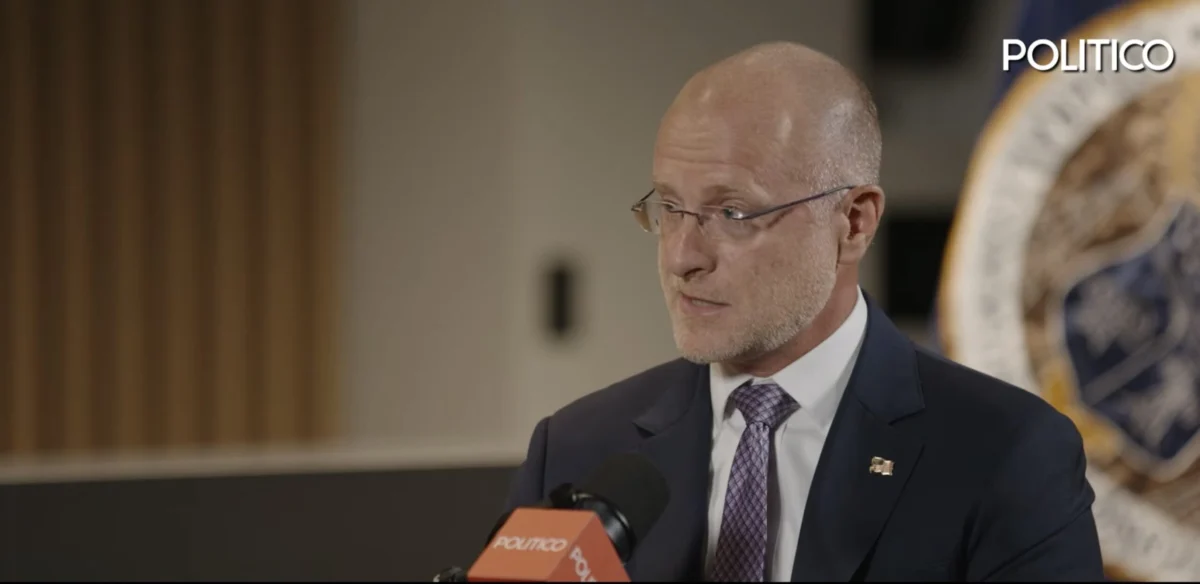
Federal Communications Commission (FCC) Chair Brendan Carr has forcefully rejected allegations that the regulatory agency is being utilized as a tool for political retribution against major news organizations. During an expansive interview with Politico’s Dasha Burns on The Conversation podcast, Carr defended the commission’s ongoing investigations and license reviews involving several of the nation’s largest broadcast networks, including ABC, CBS, and NBC. The interview, released on Friday, comes amid escalating tensions between the federal government and the media establishment, as critics argue that the FCC is increasingly mirroring the adversarial rhetoric of President Donald Trump.
Carr, who has become a prominent figure in the administration’s efforts to overhaul media regulation, maintained that his actions are rooted in the rule of law rather than political vendettas. Addressing the "speech police" label frequently applied by his detractors, Carr stated, “I don’t view the FCC as the speech police.” He argued instead that the agency is simply returning to its core mandate of ensuring that broadcast licensees operate in the "public interest," a standard he suggests has been neglected for decades.
The Evolution of the FCC and the Public Interest Standard
To understand the current friction between the FCC and the media, it is necessary to examine the regulatory framework that governs American broadcasting. Unlike cable news or digital platforms, broadcast networks such as ABC, CBS, and NBC operate using public airwaves. In exchange for this privilege, the Communications Act of 1934 requires these stations to serve the "public interest, convenience, and necessity."
Historically, the FCC has interpreted this mandate with a relatively light touch, particularly regarding news content, to avoid First Amendment conflicts. However, under Carr’s leadership, there has been a notable shift toward a more interventionist approach. Carr argued in the Politico interview that "licenses are not sacred cows" and suggested that if a broadcaster fails to meet the public interest standard, their right to the airwaves should be scrutinized.
This shift has coincided with a period of intense hostility between the executive branch and mainstream media. President Trump has frequently called for the revocation of broadcast licenses for networks he deems biased or unfair. While the FCC is technically an independent agency, the alignment between Carr’s regulatory focus and the President’s rhetoric has sparked a national debate over the agency’s independence.
A Timeline of Escalating Tensions
The friction between the FCC and major broadcasters has built steadily over the past several months, marked by a series of specific enforcement actions and public statements:
- Late 2025 – Early 2026: President Trump intensifies his public criticism of "fake news" networks, specifically naming NBC and CBS in social media posts and at rallies, suggesting their licenses should be challenged.
- March 2026: FCC Chair Brendan Carr signals a new era of "rigorous oversight," stating that the agency would no longer rubber-stamp license renewals for major networks without a thorough review of their public interest obligations.
- May 2026: The FCC opens an investigation into CBS following a controversial interview edit, with Carr questioning whether the network intentionally misled the public.
- June 2026: Investigations are expanded to include ABC and NBC, focusing on "equal time" provisions and the accuracy of news reporting under the umbrella of the public interest standard.
- July 2026: ABC files a formal complaint in federal court, accusing the FCC of "attempted censorship" and alleging that the investigations are a direct result of political pressure from the White House.
- July 31, 2026: Brendan Carr sits down with Politico to defend these actions, claiming the agency is merely "applying and enforcing the laws that Congress passed."
The "Gas Station Sushi" Analogy and Public Trust
A central theme of Carr’s defense is the declining level of public trust in traditional news media. During the interview, Carr cited internal and external data to illustrate what he views as a crisis of credibility for the networks. He famously quipped, “Fifteen percent of people would eat gas station sushi. Only 8 percent of people say they have a great deal of trust” in the media.
While intended as a joke, the comment reflects a deeper regulatory philosophy: if the public no longer trusts the media, then the media is failing its "public interest" obligations. Supporting data from recent Gallup and Pew Research Center polls corroborate Carr’s point regarding the trust deficit. A 2025 Gallup poll found that trust in the media to report news "fully, accurately and fairly" had dropped to near-record lows, with only 31% of Americans expressing a "great deal" or "fair amount" of confidence.
Carr argues that the FCC’s role is to address this deficit by ensuring broadcasters remain accountable. “My view is not to take the gavel and weaponize it,” Carr told Politico. “But my view is also not to take the gavel and bury it in the sand.”
Political Alignment and the "Pit Bull" Symbolism
The interview also touched upon the personal and political relationship between Carr and President Trump. Dasha Burns highlighted a visible symbol of this connection: a mug frequently used by Carr that depicts him as a pit bull on a leash held by Trump.
Carr did not shy away from his political leanings, admitting, “Look, there’s no question that I’m broadly aligned with President Trump.” He defended the President’s right to criticize the press, asserting that the First Amendment protects the President’s speech just as it protects the media’s. “The president has every right in the world… to express his views, to push back on media,” Carr said.
However, critics argue that the line between a President expressing views and a regulatory agency acting on those views is dangerously thin. The "pit bull" imagery, while perhaps intended as a sign of tenacity, has been seized upon by opponents as evidence that the FCC has abandoned its role as an independent arbiter.
Responses from Broadcasters and Legal Experts
The reaction to Carr’s comments and the FCC’s recent actions has been swift and largely critical from the media sector. In its recent court filing, ABC described the FCC’s investigations as a "thinly veiled attempt to chill investigative journalism and punish networks for coverage that is unfavorable to the administration."
Legal experts have also weighed in on the potential First Amendment implications. Constitutional scholars suggest that while the "public interest" standard is broad, using it to investigate the content of news broadcasts enters "uncharted and dangerous territory."
"The FCC has historically avoided content-based reviews because of the risk of government censorship," said Michael Bennett, a former FCC staffer and communications attorney. "If the commission begins to decide what is ‘fair’ or ‘accurate’ in a news broadcast, it effectively becomes a state-run media monitor. That is exactly what the First Amendment was designed to prevent."
Conversely, some conservative media watchdogs have praised Carr’s approach. They argue that for too long, the "public interest" standard was a "hollow phrase" that allowed networks to operate with a perceived liberal bias without consequence.
Broader Implications for the Future of Media
The current standoff between the FCC and major networks could have long-lasting implications for the American media landscape. If the FCC succeeds in using license renewals as a lever to influence news content, it could lead to a "chilling effect," where networks avoid controversial or critical reporting to ensure their licenses remain secure.
Furthermore, this situation sets a significant precedent for future administrations. If the FCC is established as an agency that fluctuates its enforcement based on the political preferences of the sitting President, the stability of the broadcast industry could be undermined.
As the legal battle with ABC proceeds and the investigations into CBS and NBC continue, the media industry is watching closely. The outcome may determine whether the FCC remains a technical regulator of the airwaves or evolves into a more powerful overseer of the American information ecosystem.
For now, Brendan Carr remains steadfast in his mission. By framing his actions as a necessary correction to decades of regulatory passivity, he is positioning the FCC at the center of the cultural and political fight over the role of the press in a polarized society. Whether this results in a more accountable media or a more controlled one remains the central question facing the commission and the public it serves.

 Yuyun Lusiyani
 Joko Widodo
 Pevita Pearce
 admin
admin
