
 Jia Lissa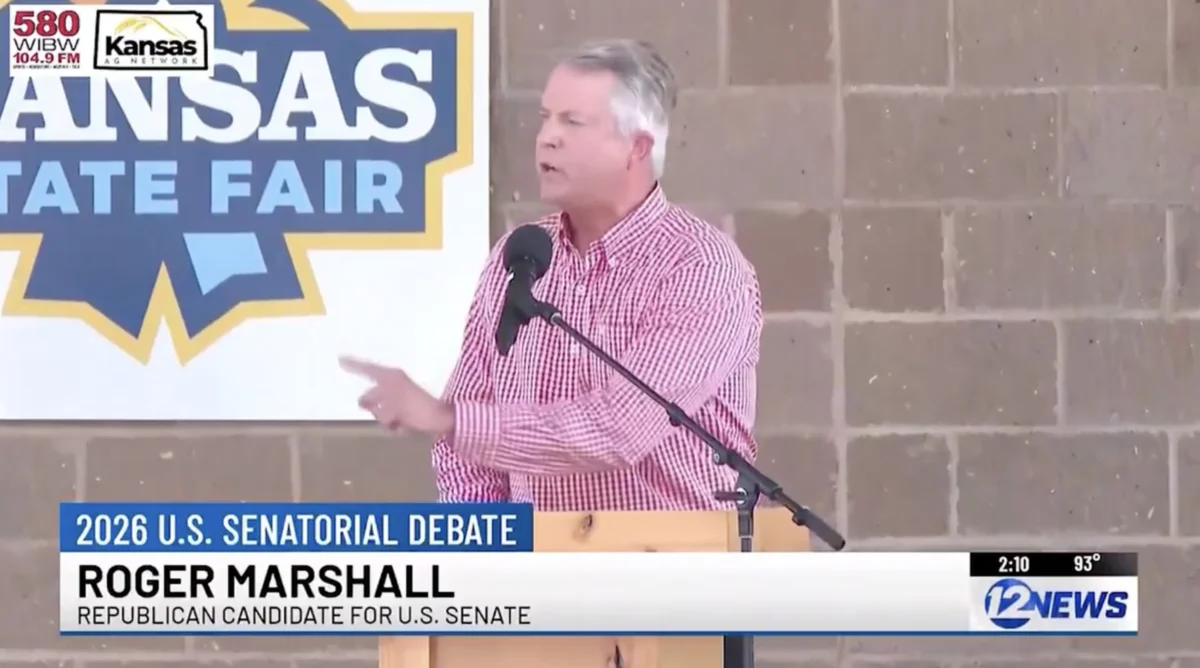
The political atmosphere at the Kansas State Fair reached a boiling point on Saturday as incumbent Senator Roger Marshall (R-KS) faced intense scrutiny from a vocal audience during a high-stakes senatorial debate. Held in Hutchinson, a city central to the state’s agricultural and manufacturing identity, the debate pitted Marshall against his Democratic challenger, the Reverend Adam Hamilton. The event, a long-standing tradition in Kansas politics, was marked by frequent interruptions, boos, and chants from a crowd clearly divided over the Senator’s defense of federal trade policies and his past professional conduct.
The confrontation underscored the deepening tensions within the Republican base in the Midwest, particularly regarding the economic impact of protectionist trade policies and the personal histories of those seeking public office. As the candidates addressed a panel of journalists and a live audience, the discourse shifted rapidly from standard campaign rhetoric to a heated referendum on Marshall’s record and his alignment with former President Donald Trump’s economic agenda.
The Tariff Debate and Agricultural Volatility
The most significant friction of the afternoon began when David Bergmeier of the High Plains Journal questioned Marshall on the efficacy of the Trump administration’s tariff policies. Bergmeier asked specifically whether the Senator believed these policies had achieved their intended goals and if he harbored concerns regarding the long-term ramifications for America’s global standing in the agricultural sector.
Kansas, a state where the economy is inextricably linked to the export of wheat, corn, and soybeans, has a complex relationship with tariffs. While some producers favor protectionist measures against foreign competition, many others fear retaliatory tariffs that close off vital international markets. Marshall’s attempt to pivot the conversation toward a local college football update—mentioning a game between Kansas State University and Washington State—was met with silence and irritation from an audience seeking substantive answers.
When Marshall proceeded to defend the tariffs, stating that they were "meant to bring manufacturing jobs home and to improve our exports" and asserting that "it’s working," the crowd erupted in a chorus of boos. Despite the noise, Marshall maintained his position, citing local data from Reno County. He noted that the county had lost 1,700 manufacturing jobs over the previous two decades but pointed to Superior Boiler in Hutchinson as a success story, claiming the company was in the process of adding 100 new positions.
Analyzing the Economic Data Cited by Senator Marshall
To support his claim that the economic landscape is improving under current trade policies, Senator Marshall cited specific commodity prices during the debate. "Does anybody really care that corn exports are up 50% over the last two years?" Marshall asked the crowd. "The corn prices are now, we’re $5 a bushel. Wheat’s over $8, soybeans $13. Look, these tariffs are working. We’re expanding our export markets because of them!"
Agricultural economists often point out that while high commodity prices can indicate strong demand, they do not exist in a vacuum. The cost of inputs—including fertilizer, fuel, and machinery—has risen significantly over the same period, often offsetting the gains seen in market prices. Furthermore, the volatility of these prices is frequently exacerbated by trade tensions. For example, while corn and wheat prices saw spikes due to global supply chain disruptions and geopolitical conflicts, the long-term stability of Kansas exports remains a point of contention for trade analysts.
Marshall’s assertion that tariffs are a "small portion of the picture" appeared to contradict his earlier statement that they were the primary driver for job growth and export expansion. This perceived inconsistency fueled further heckling from the audience, who remained skeptical of the claim that manufacturing growth across the state was a direct result of federal trade barriers.
The Aerospace Industry and the Bombardier Controversy
The debate occurred against the backdrop of recent threats made by former President Donald Trump regarding the Canadian aircraft manufacturer Bombardier. Earlier in the week, Trump suggested a potential ban on Bombardier selling its planes in the United States. This move is particularly sensitive in Kansas, where the company maintains a massive operational footprint.
Bombardier employs hundreds of workers in Wichita, a city often referred to as the "Air Capital of the World." The aerospace industry is a cornerstone of the Kansas economy, and any federal policy that threatens the viability of major manufacturers like Bombardier or Spirit AeroSystems carries significant political risk. Marshall’s staunch defense of Trump-era trade logic was viewed by some attendees as a betrayal of the local workforce, despite his claims that manufacturing is "growing everywhere."
Critics of the tariff-heavy approach argue that the aerospace supply chain is global and that protectionist measures can lead to increased costs for components, potentially making Kansas-built aircraft less competitive on the world stage. Marshall’s refusal to distance himself from the threat against Bombardier appeared to be a focal point for the frustration expressed by the audience.
Confrontation Over Medical Debt and "Extreme" Collection Practices
The tension in the arena shifted from economic policy to personal ethics when the panel turned to Marshall’s history as an OB/GYN. A recent investigative report, highlighted by the New York Times, revealed that Marshall’s former medical practice had engaged in aggressive debt collection practices, filing lawsuits against approximately 700 patients for unpaid bills.
The report detailed instances where lawsuits were filed against new mothers and individuals living in impoverished areas. These legal actions often resulted in wage garnishments and, in some cases, the arrest of patients who failed to appear in court for debt-related hearings. When the topic was raised, the crowd’s boos transformed into rhythmic chants of "Shame on you!"
Marshall defended the practices, characterizing them as "common, common business practices" for the time. He suggested that the focus on his past medical career was a political distraction. However, his opponent, Adam Hamilton, seized on the moment, later sharing footage of the chants on social media and describing the collection methods as "unbelievably aggressive."
The issue of medical debt is a potent one in Kansas, where the debate over Medicaid expansion has remained a central fixture of state politics for years. For many voters, the revelation that a sitting Senator had overseen hundreds of lawsuits against his own patients struck a chord, transcending traditional partisan lines and highlighting concerns about the "corporatization" of healthcare.
The Candidate Profile: Rev. Adam Hamilton’s Challenge
The Reverend Adam Hamilton, the Democratic nominee, has positioned himself as a moderate alternative to Marshall. As the founding pastor of the United Methodist Church of the Resurrection in Leawood—one of the largest Methodist congregations in the country—Hamilton has built his campaign on a platform of "common sense" and "restoring civility."
During the debate, Hamilton focused on the human impact of policy decisions, particularly in healthcare and education. He argued that the state’s agricultural interests are best served by stable, predictable trade relationships rather than "erratic" tariff threats. Hamilton’s presence at the fair was an attempt to make inroads into rural Kansas, a traditional Republican stronghold where Marshall has historically enjoyed strong support.
Hamilton’s strategy involves appealing to the "exhausted majority"—voters who are disillusioned with the polarizing rhetoric of national politics. By contrasting his background in ministry with Marshall’s record in both medicine and the Senate, Hamilton hopes to flip a seat that has been held by Republicans for decades.
Chronology of Events and Future Implications
The Kansas State Fair debate is often considered the unofficial kickoff to the final sprint of the election season. Following Saturday’s event, both campaigns are expected to ramp up television advertising and grassroots outreach.
- September 8, 2026: The New York Times publishes its investigation into Marshall’s medical debt collection practices.
- September 10, 2026: Former President Trump makes public comments regarding Bombardier, causing concern in the Wichita aerospace sector.
- September 12, 2026: The senatorial debate takes place at the Kansas State Fair in Hutchinson. Marshall is booed over tariffs and medical debt.
- September 13, 2026: The Hamilton campaign releases clips of the debate, focusing on the "Shame on you" chants.
The fallout from the debate suggests that Marshall may face a more difficult path to reelection than previously anticipated. While Kansas remains a reliably "red" state in federal elections, the vocal opposition at a venue as quintessentially Kansan as the State Fair indicates a level of dissatisfaction that could impact turnout or lead to ticket-splitting.
For Marshall, the challenge will be to reconcile his support for national "America First" policies with the specific economic needs of his constituents, many of whom feel the direct sting of trade wars and aggressive financial practices. For Hamilton, the task is to prove that a Democrat can represent the interests of a deeply conservative state by focusing on kitchen-table issues and personal integrity.
As the 2026 midterms approach, the events in Hutchinson serve as a microcosm of the broader national debate: a clash between populist economic theory and the lived realities of the working class, played out in the heart of the American grain belt.




 Yuyun Lusiyani
 Joko Widodo
 Eva Lovia
 Pevita Pearce
 admin
admin
 Lina Irawan