
 Lina Irawan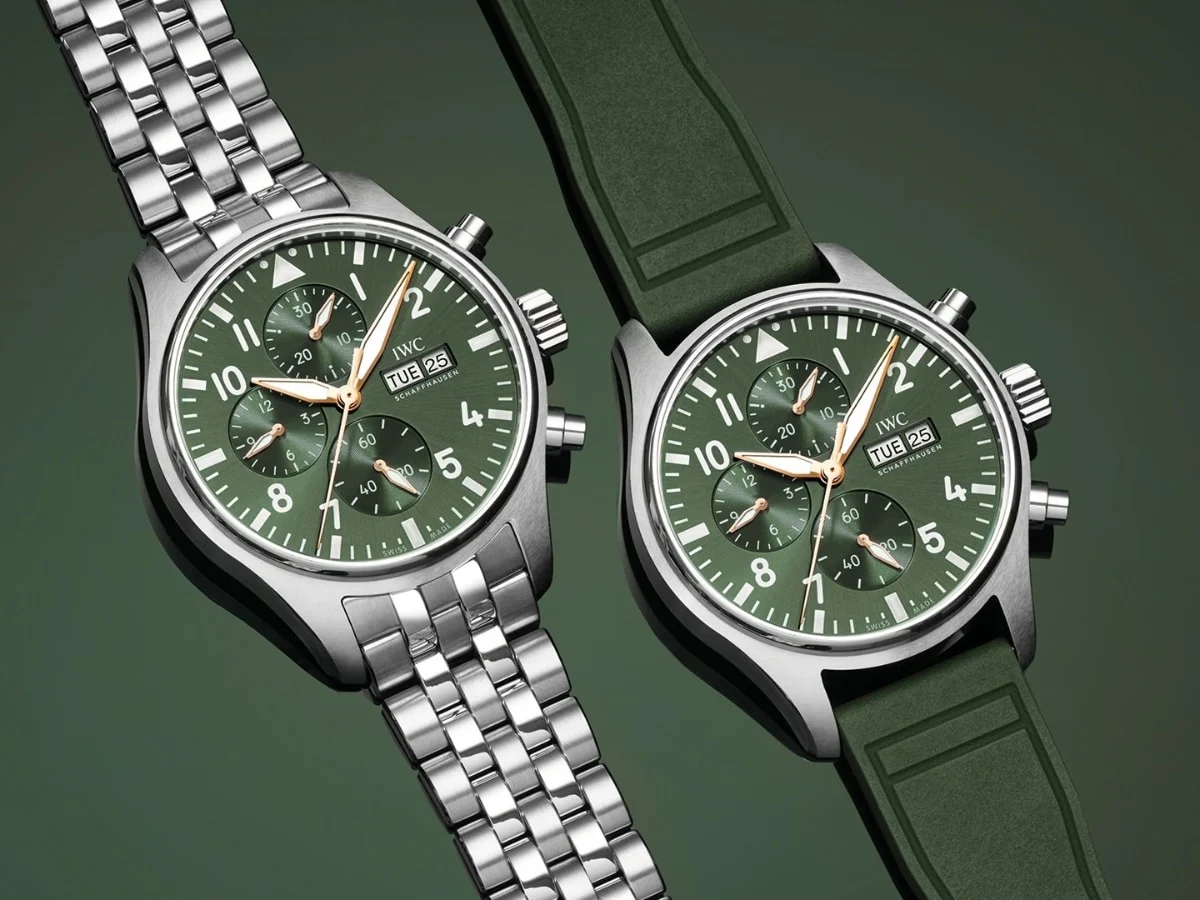
The luxury horological landscape has witnessed a significant shift toward modularity and color experimentation, a trend that IWC Schaffhausen continues to spearhead with its latest release. The new Pilot’s Watch Chronograph, designated as Reference IW378008, represents a strategic evolution of the brand’s most iconic line. By pairing a high-precision mechanical movement with a dual-strap offering and a distinctive olive-green colorway, IWC is targeting a modern demographic that demands both historical pedigree and contemporary flexibility. This release reinforces the Pilot’s Watch collection as the cornerstone of the brand’s identity, blending the utilitarian requirements of aviation with the refined finishes expected of Swiss haute horlogerie.
Design Philosophy and Aesthetic Execution
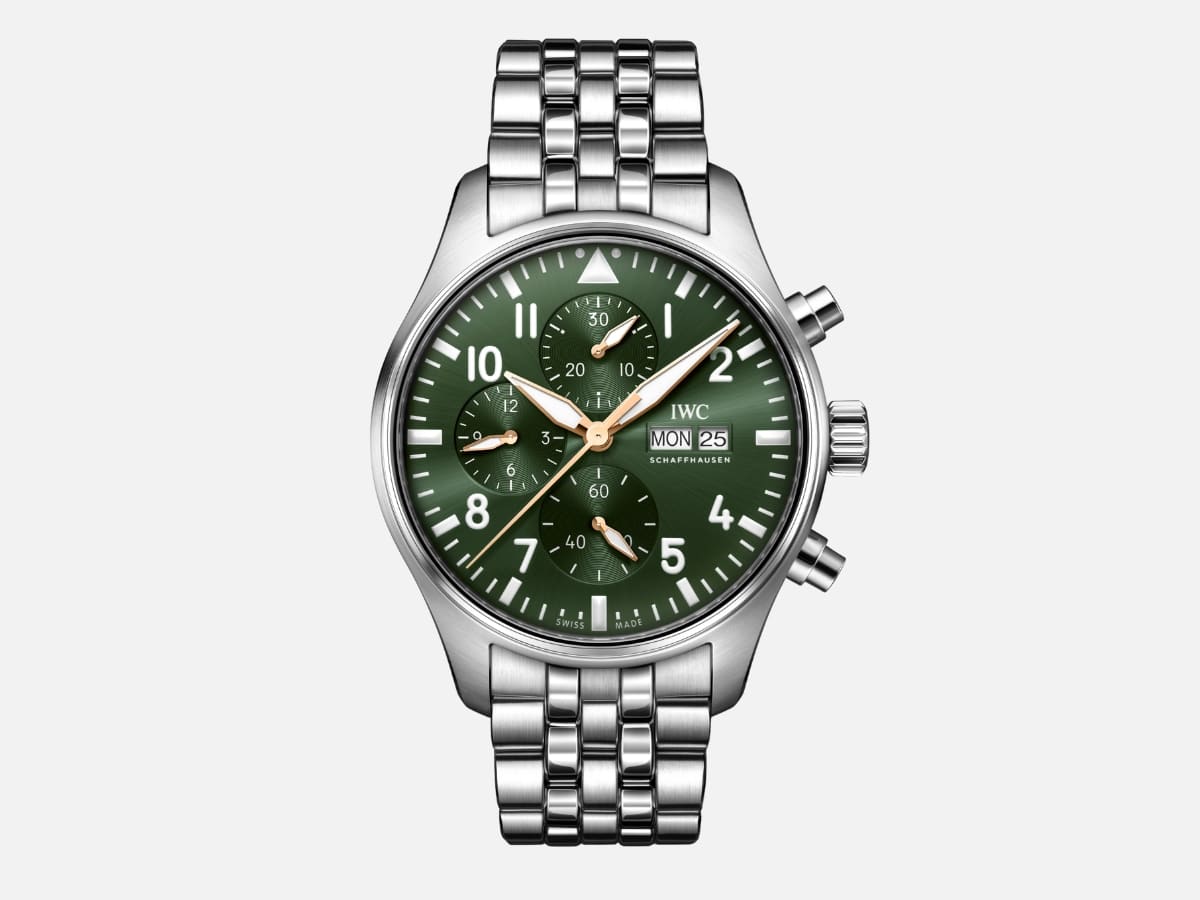
The centerpiece of the Ref. IW378008 is undoubtedly its olive-green dial. While green has become a staple in watch catalogs over the last several years, IWC’s execution here utilizes a vivid shade that balances military heritage with luxury sophistication. The dial is characterized by its high-contrast white Arabic numerals and a crisp outer minute track, maintaining the legibility that has been the hallmark of IWC cockpit instruments since the 1930s.
To elevate the aesthetic beyond a standard tool watch, IWC has incorporated gold-plated hands filled with Super-LumiNova. This choice of gold plating provides a warm counterpoint to the cool, brushed tones of the 43mm stainless steel case. The layout remains classic for the 69000-caliber family: a day-date window at 3 o’clock, a small hacking seconds sub-dial at 6 o’clock, a 12-hour counter at 9 o’clock, and a 30-minute counter at 12 o’clock. This vertical arrangement ensures that despite the density of information, the wearer can discern the time and elapsed intervals at a glance.
The EasX-CHANGE System: A Study in Versatility
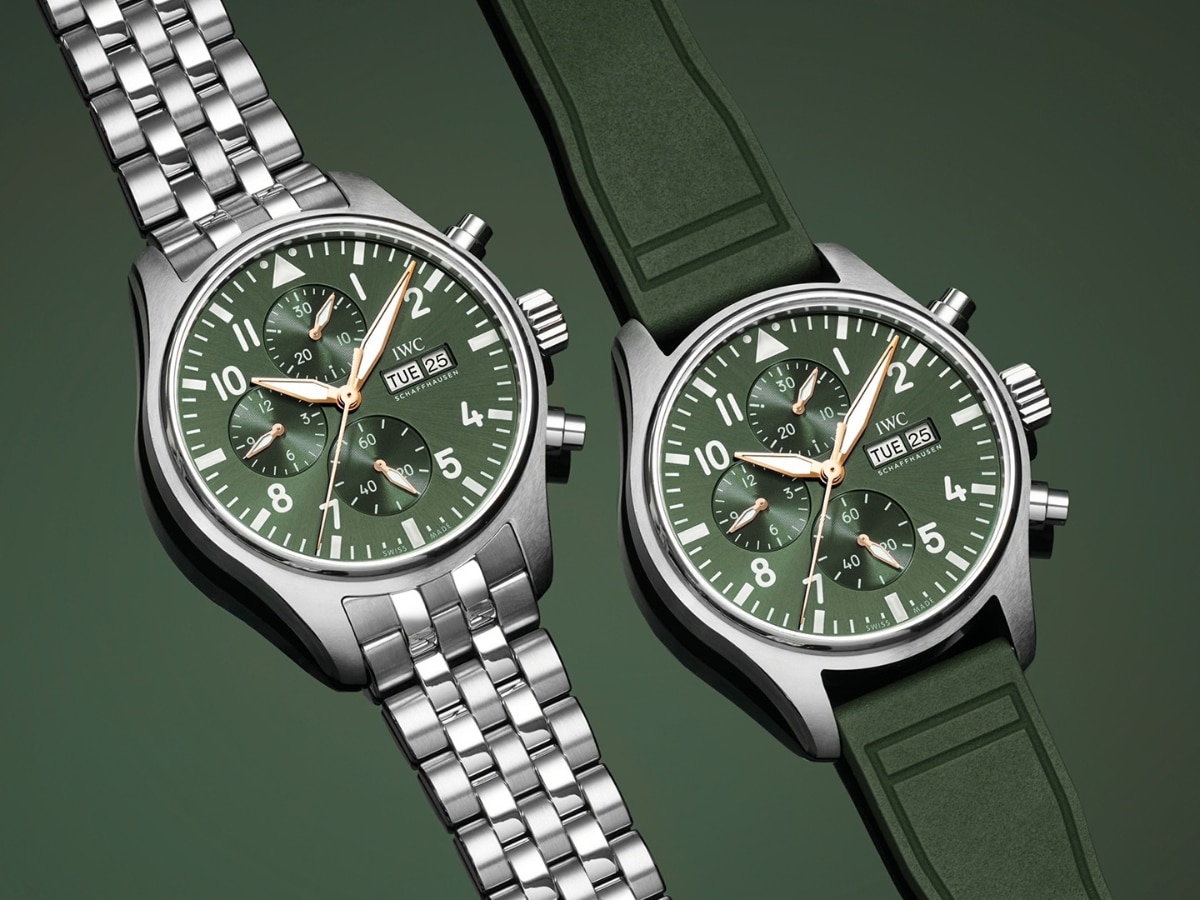
One of the most notable features of this reference is the inclusion of two distinct mounting options: a five-link stainless steel bracelet and a matching olive-green rubber strap. Traditionally, luxury watch buyers were forced to choose between the formal, architectural feel of a metal bracelet or the casual, durable nature of rubber at the point of purchase. IWC’s decision to include both—valued at a retail price of AUD $15,300—acknowledges the changing habits of collectors who transition between professional and leisure environments.
The transition between these two looks is facilitated by the EasX-CHANGE system. This proprietary technology allows the wearer to swap straps by pressing a release catch on the underside of the strap or bracelet, removing the need for specialized tools or the risk of scratching the lugs with a spring-bar tool. This modularity effectively provides the consumer with two different "personalities" for the watch. The steel bracelet, with its polished and brushed surfaces, aligns the piece with the "luxury sports watch" category, while the rubber strap emphasizes its origins as a rugged instrument meant for the cockpit or the field.
Technical Specifications and the Calibre 69385
Underpinning the visual updates is the IWC-manufactured Calibre 69385. This automatic chronograph movement is a testament to IWC’s commitment to vertical integration and mechanical robustness. Unlike modular chronographs, the 69385 is an integrated design featuring a column-wheel control system. The column wheel is a hallmark of high-end chronograph manufacturing, ensuring that the start, stop, and reset functions operate with a smooth, tactile click rather than the jumpy engagement sometimes found in cam-actuated movements.
The movement operates at a frequency of 28,800 vibrations per hour (4Hz) and contains 33 jewels. It provides a power reserve of 46 hours, supported by a highly efficient bidirectional pawl-winding system, a technology reminiscent of the Pellaton system developed by IWC’s former technical director, Albert Pellaton. For many enthusiasts, the highlight of the technical package is the sapphire glass caseback, which reveals the circular graining, Côtes de Genève finishing, and the skeletonized rotor.
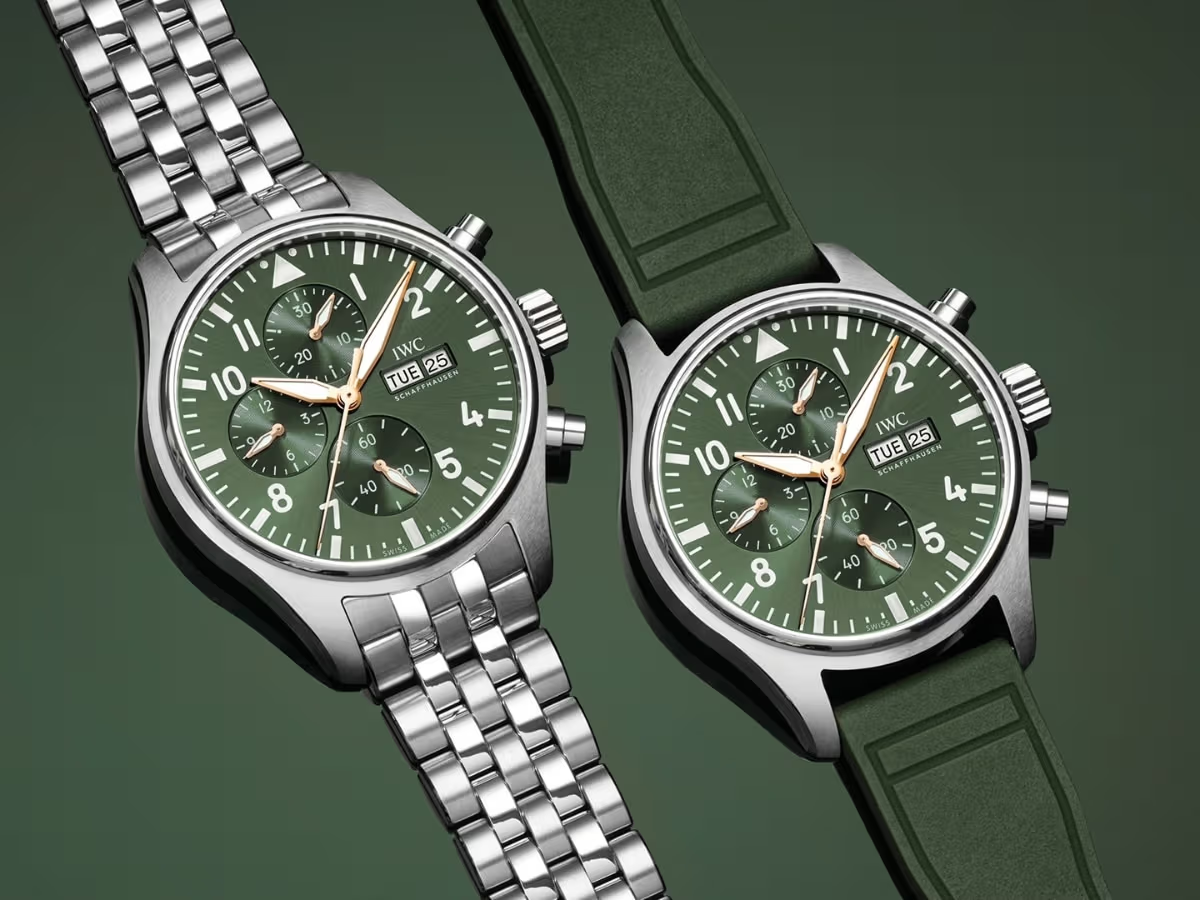
The case itself measures 43mm in diameter with a height of 14.8mm. While substantial, the proportions are designed to sit comfortably on a variety of wrist sizes due to the ergonomic curve of the lugs. The watch is water-resistant to 10 bar (approximately 100 meters), making it suitable for swimming and general aquatic exposure, further reinforcing its status as an all-purpose daily wearer.
Historical Context: A Century of Aviation Excellence
To understand the significance of the Ref. IW378008, one must look at the chronology of IWC’s involvement in aviation. The brand’s journey began in 1936 with the "Special Watch for Pilots," which featured a rotating bezel and an anti-magnetic escapement. This was followed by the legendary Big Pilot’s Watch (52 T.S.C.) in 1940, created for the German Air Force, which established the oversized, legible dial aesthetic that persists today.
In 1948, IWC produced the Mark XI for the British Royal Air Force. This model, perhaps the most famous pilot’s watch in history, utilized a soft-iron inner case to protect the movement from the magnetic fields generated by radar equipment. The chronograph complications were introduced to the Pilot’s collection in the early 1990s, starting with the Ref. 3706. These watches transitioned the Pilot’s line from a niche military tool to a commercial success. The Ref. IW378008 is the direct descendant of this lineage, maintaining the DNA of the Mark series and the 3706 while adopting the materials and manufacturing precision of the 21st century.
Market Analysis and Strategic Implications
The release of a dual-strap, green-dial chronograph is a calculated move within the current luxury market. Industry data suggests that consumers are increasingly looking for "value-add" features in the $10,000 to $20,000 price bracket. By including both a bracelet and a strap, IWC positions itself competitively against rivals who often charge a premium of $1,500 to $2,000 for a standalone steel bracelet.

Furthermore, the choice of green reflects a broader shift in the "color of the decade" for horology. Following the blue-dial craze of the 2010s, green has emerged as the preferred alternative to traditional black or silver dials. However, by choosing an olive shade rather than a bright emerald or forest green, IWC maintains a connection to its military "Tribute to 3705" and "Top Gun" heritage, ensuring the watch does not feel like a fleeting fashion statement.
Industry analysts note that IWC’s focus on the "EasX-CHANGE" system also addresses a growing secondary market for accessories. By making it easier for owners to customize their watches, IWC encourages brand loyalty and long-term engagement with their ecosystem of straps, which includes leather, textile, and ವಿವಿಧ rubber options.
Manufacturing Excellence at the Manufakturzentrum
The production of the Ref. IW378008 takes place at IWC’s state-of-the-art Manufakturzentrum in Schaffhausen, opened in 2018 to celebrate the brand’s 150th anniversary. This facility allows IWC to house movement component manufacturing, plate production, and assembly under one roof. The precision required for the 69385 movement involves tolerances measured in microns, and the use of automated CNC machining combined with traditional hand-finishing ensures a level of consistency that was previously difficult to achieve.
The stainless steel case also undergoes a rigorous finishing process. The juxtaposition of brushed surfaces on the case flanks and polished accents on the bezel and bracelet links requires skilled artisans to ensure that the transitions are sharp and uniform. This attention to detail is what differentiates a mass-produced tool watch from a piece of luxury engineering.
Conclusion: The Evolution of a Classic
The IWC Pilot’s Watch Chronograph Ref. IW378008 is more than just a color update. It is a comprehensive package that addresses the modern wearer’s need for durability, technical prowess, and aesthetic flexibility. By looking back at its 1930s origins while looking forward with modular strap systems and in-house movement technology, IWC has created a timepiece that honors its history without being shackled by it.
As the luxury watch market continues to evolve, the emphasis on "wearability" and "versatility" will likely become the standard. With this latest release, IWC proves that even a design as established as the Pilot’s Watch can find new ways to innovate. Whether worn on a steel bracelet in a boardroom or an olive-green rubber strap on a weekend adventure, the Ref. IW378008 remains a definitive example of why the pilot’s chronograph remains one of the most beloved complications in the world of horology.




 Yuyun Lusiyani
 Joko Widodo
 Eva Lovia
 Pevita Pearce
 admin
admin