
 Jia Lissa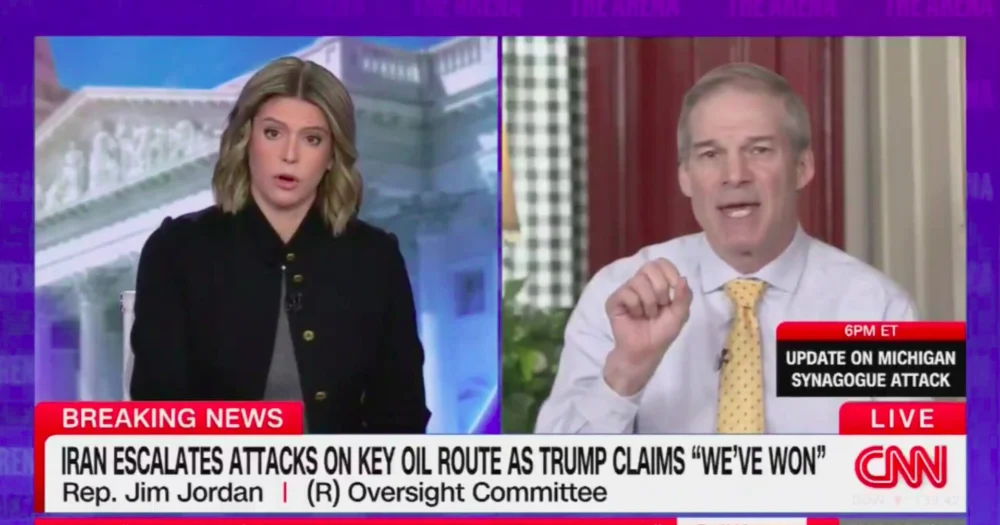
In a high-stakes exchange on CNN’s The Arena, anchor Kasie Hunt confronted Representative Jim Jordan (R-OH) regarding the consistency of Donald Trump’s foreign policy, specifically focusing on the president’s historical criticisms of his predecessor, Barack Obama. The interview centered on the tension between Trump’s past assertions—where he frequently claimed that failed diplomacy would lead to an unnecessary war with Iran—and the current administration’s military operations and "Maximum Pressure" campaign. As the United States enters the third week of a significant military operation involving Iranian interests, the debate over whether the administration is fulfilling or betraying its campaign promises has moved to the forefront of the national political discourse.
Representative Jordan, a staunch ally of the president, defended the administration’s current trajectory by arguing that Donald Trump has remained steadfast in his primary objective: preventing the Islamic Republic of Iran from obtaining a nuclear weapon. However, the confrontation highlighted a significant rhetorical shift from the 2011–2015 era, during which Donald Trump repeatedly used social media and television appearances to warn that any military conflict with Iran would be a sign of a "weak" and "incompetent" presidency.
The Archival Record: Trump’s Previous Stance on Iran
The central tension of the interview arose when Hunt played a series of archival clips featuring Donald Trump from the years preceding his presidency. In these videos, Trump was seen making a series of predictions regarding the Obama administration’s handling of Tehran. "Our president will start a war with Iran because he has absolutely no ability to negotiate," Trump said in one notable clip. In others, he referred to the need to "end these endless wars" and expressed a desire to "expel the warmongers from our national security state."
These statements were part of a broader narrative Trump cultivated during his 2016 campaign and his time as a private citizen, where he positioned himself as a non-interventionist who could achieve better deals through "the art of the deal" rather than through the use of force. Hunt pressed Jordan on how the current military escalation aligns with Trump’s own metric of success. She specifically questioned whether the transition from rhetoric about "stopping wars" to the current reality of active military engagement constituted a failure of negotiation by the president’s own standards.
Jordan’s Defense: The Failure of Backchannel Diplomacy
Rep. Jordan countered the narrative of inconsistency by suggesting that the administration did, in fact, attempt to reach a diplomatic resolution before resorting to military pressure. He pointed to an interview involving Mark Levin and Steve Witkoff, a close associate of the president who has reportedly been involved in various informal diplomatic channels. According to Jordan, these efforts revealed that the Iranian government was not interested in a good-faith negotiation that would permanently end its nuclear ambitions.
"They were willing to sit down with and try to figure this out, try to negotiate," Jordan told Hunt. "And they could tell from those negotiations that Iran was committed to pursuing and getting a nuclear weapon. And they said there is no other alternative." Jordan’s argument hinges on the idea that the "warmonger" label does not apply to a president who uses force only after diplomacy has been exhausted. He further asserted that Donald Trump has done more than every president from Jimmy Carter to Joe Biden combined to stymie Iran’s nuclear capabilities.
A Chronology of U.S.-Iran Tensions and Nuclear Diplomacy
To understand the weight of the current confrontation, it is necessary to examine the long-standing and volatile timeline of U.S.-Iran relations, which has fluctuated between periods of tentative diplomacy and overt hostility for over four decades.
- The 1979 Revolution and Hostage Crisis: The modern era of enmity began with the Iranian Revolution and the subsequent 444-day seizure of the U.S. Embassy in Tehran. This event led to the severance of diplomatic ties that remain broken to this day.
- The "Axis of Evil" and Early Nuclear Discovery (2002–2003): The revelation of a secret uranium enrichment facility at Natanz brought Iran’s nuclear program to the center of global security concerns. President George W. Bush categorized Iran as part of an "Axis of Evil," setting the stage for decades of sanctions.
- The Joint Comprehensive Plan of Action (2015): Under the Obama administration, the P5+1 (the five permanent members of the UN Security Council plus Germany) reached a landmark deal with Iran. The JCPOA required Iran to significantly reduce its stockpile of enriched uranium and allow rigorous International Atomic Energy Agency (IAEA) inspections in exchange for sanctions relief.
- U.S. Withdrawal and "Maximum Pressure" (2018): Donald Trump, fulfilling a campaign promise, withdrew the United States from the JCPOA in May 2018, calling it "the worst deal ever negotiated." This ushered in the "Maximum Pressure" campaign, characterized by crippling economic sanctions intended to force Iran back to the table for a broader deal.
- Escalation and High-Profile Strikes (2020–Present): The relationship reached a boiling point in January 2020 with the U.S. assassination of Iranian General Qasem Soleimani. Following a period of stalemate during the Biden administration’s attempts to revive the JCPOA, the current context—as discussed by Hunt and Jordan—suggests a return to active military posturing and kinetic operations.
Comparative Presidential Approaches to Tehran
Representative Jordan’s claim that Trump has outperformed his predecessors invites a factual comparison of how different administrations have handled the Iranian threat.
- Jimmy Carter: Defined by the Hostage Crisis and the failed "Desert One" rescue mission, Carter’s presidency is often viewed through the lens of a diplomatic and military stalemate.
- Ronald Reagan: Reagan’s tenure saw the Iran-Iraq War and the Iran-Contra scandal, where the U.S. secretly sold weapons to Tehran in a failed attempt to secure the release of hostages in Lebanon.
- George H.W. Bush and Bill Clinton: Both presidents utilized a policy of "Dual Containment," attempting to isolate both Iran and Iraq through sanctions and regional alliances.
- George W. Bush: Focused on the "Global War on Terror," Bush 43 implemented severe financial sanctions but refrained from direct military conflict with Iran while bogged down in Iraq and Afghanistan.
- Barack Obama: Opted for a multilateral diplomatic approach, resulting in the JCPOA. Critics, including Jordan, argue this deal merely delayed Iran’s nuclear ambitions while enriching the regime.
- Joe Biden: Initially sought to restore the JCPOA but faced challenges due to Iran’s increased enrichment levels and its support for regional proxies during the Israel-Hamas conflict.
Jordan’s assertion that Trump has been the most effective relies on the metric of "deterrence through strength," arguing that the current military campaign is the only language the Iranian leadership understands.
Data Analysis: The Iranian Nuclear Breakout and Economic Impact
While the political debate rages, the underlying data regarding Iran’s capabilities provides a sobering backdrop. According to recent reports from the IAEA, Iran’s stockpile of uranium enriched to 60% purity—a short technical step from weapons-grade 90%—has grown significantly since the U.S. withdrawal from the nuclear deal.
Before the 2018 withdrawal, Iran’s "breakout time"—the time required to produce enough fissile material for one nuclear bomb—was estimated to be roughly one year. Current estimates from non-proliferation experts suggest that this window has shrunk to as little as one to two weeks, although the weaponization process (building the actual bomb) would still take longer.
Economically, the "Maximum Pressure" campaign has had a devastating impact on Iran’s domestic stability. The Iranian rial has lost more than 80% of its value against the dollar over the last several years, and inflation has consistently hovered above 40%. Proponents of the current strategy, like Representative Jordan, argue that this economic desperation will eventually force the regime to capitulate or collapse. Critics, however, point out that the regime has historically responded to such pressure by increasing its regional aggression and nuclear brinkmanship.
Broader Implications and Geopolitical Fallout
The current U.S. military operation, described in the interview as being two weeks old, represents a pivotal moment in Middle Eastern geopolitics. If the goal is, as Jordan stated, to prevent a nuclear Iran at all costs, the risk of a full-scale regional war becomes a tangible possibility.
The international community remains deeply divided on the issue. European allies, who were instrumental in the 2015 deal, have largely expressed concern over the abandonment of diplomacy, fearing that a military conflict would destabilize global energy markets and lead to a new wave of migration. Conversely, regional rivals of Iran, including Israel and several Gulf states, have generally supported the more aggressive U.S. posture, viewing the JCPOA as a failed experiment that allowed Iran to expand its influence via proxy groups like Hezbollah and the Houthis.
The exchange between Hunt and Jordan also reflects the domestic political divide in the United States. For the Democratic opposition, Trump’s shift from an "anti-war" candidate to a "commander of a two-week-old campaign" is evidence of a chaotic and inconsistent foreign policy. For the Republican base, it is seen as a necessary evolution of "America First"—using American power to protect national interests when "weak" diplomacy fails.
Conclusion: The Question of Consistency
As the interview concluded, the fundamental disagreement remained unresolved. To Kasie Hunt and the critics she cited, the president’s current actions are a direct contradiction of the very criticisms he leveled against Barack Obama a decade ago. To Representative Jim Jordan and the administration’s defenders, the situation in Iran has changed so fundamentally that the old rules of engagement no longer apply.
The ultimate success of the administration’s strategy will likely be measured by two outcomes: whether Iran is successfully deterred from crossing the nuclear threshold and whether the United States can avoid being drawn into the very "endless war" that Donald Trump once promised to prevent. As military operations continue, the eyes of the world remain on the Persian Gulf, waiting to see if the "Maximum Pressure" campaign leads to a new grand bargain or a historic conflagration.

 Yuyun Lusiyani
 Joko Widodo
 Eva Lovia
 Pevita Pearce
 admin
admin