
 Yuyun Lusiyani
A previously undisclosed financial entanglement has come to light, revealing that a "blind trust" established to shield Texas Attorney General Ken Paxton and his wife, state Senator Angela Paxton, from conflicts of interest, provided a substantial $600,000 cash injection to a construction materials business founded by Scott Sherman, a North Texas home builder who had recently completed a federal prison sentence for mortgage fraud. This revelation, stemming from unreleased records from the Attorney General’s 2023 impeachment investigation, casts a shadow over the integrity of the blind trust and raises serious questions about the financial dealings of the state’s chief law enforcement officer, particularly as he pursues a U.S. Senate seat.
Unraveling the "Blind" Trust’s Veil
The core purpose of a blind trust for public officials is to prevent any overlap between personal investments and official duties, thereby mitigating potential conflicts of interest. Upon becoming Attorney General, Ken Paxton established such a trust, managed by his friend Chip Loper, with the explicit understanding that neither Paxton nor his wife would have knowledge of, or provide instructions regarding, its investment decisions. However, the impeachment investigation records suggest this firewall was largely illusory. Evidence includes Ken Paxton’s apparent knowledge of certain investments, as indicated by text messages and his direct transfer of properties into the trust, and the Paxtons’ declaration of over $93,000 in itemized losses from Wildcatter Sand Services and Grayson County Sand and Gravel on their 2020 federal joint income tax return. Legal and government ethics experts, such as Kathleen Clark, a law professor at Washington University in St. Louis, argue that reporting such transactions on tax returns is "proof positive that there’s nothing blind about this trust." This alleged lack of blindness directly contradicts the ethical standards expected of public officials and, notably, the strict rules governing qualified blind trusts for U.S. Senators, which Paxton would be bound by if elected. Donald Kettl, an ethics expert and former dean of the University of Maryland’s School of Public Policy, highlighted the importance of a candidate adhering to these standards.
The Rise of Wildcatter Sand Services and a Felon’s Second Act
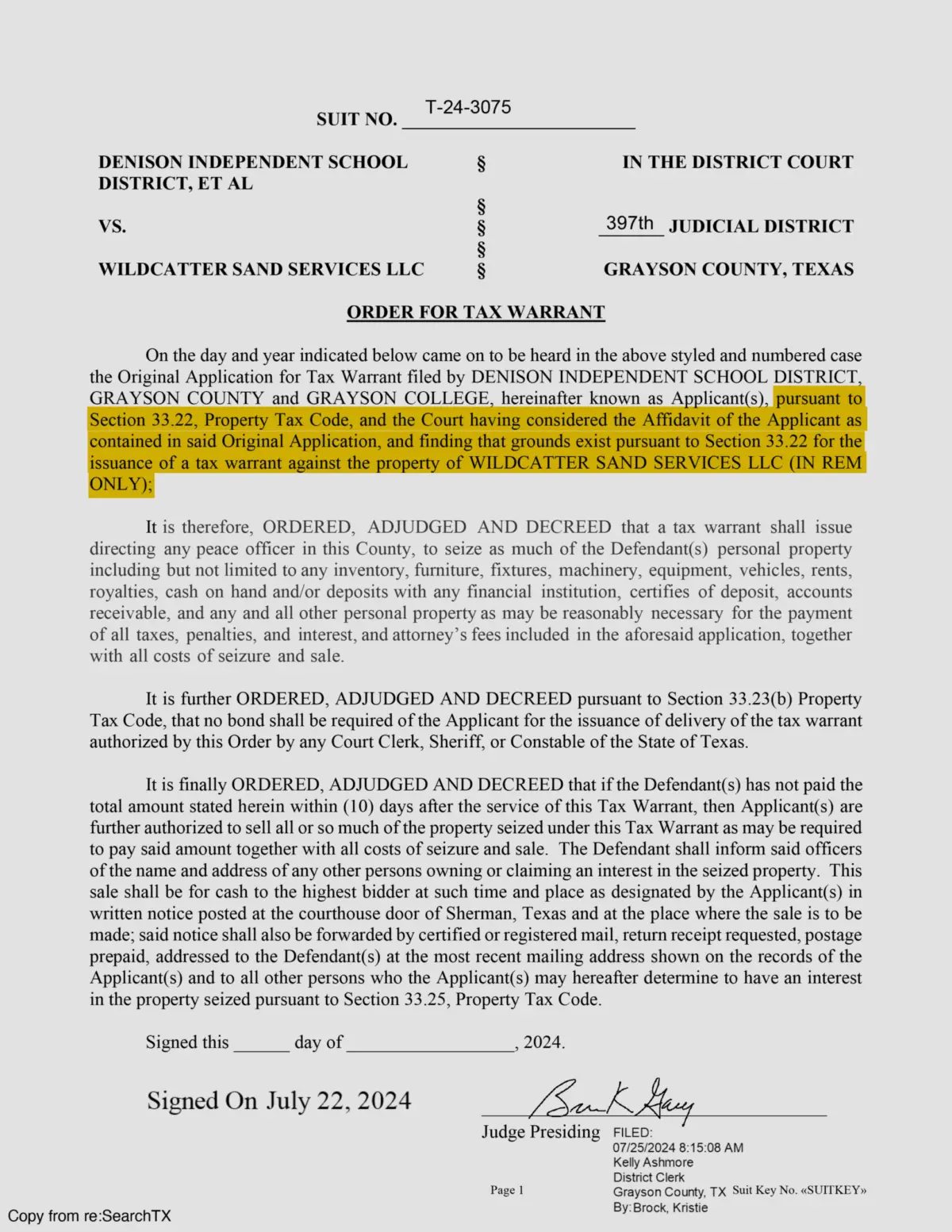
Scott Sherman, the businessman at the center of this controversy, had a checkered past. In 2014, he pleaded guilty to mortgage fraud conspiracy, a federal offense involving the artificial inflation of home prices to secure larger loans for dozens of properties across the Dallas-Fort Worth area through his firm, Artisan Operating LP. Such schemes often lead to significant financial losses for lenders and can destabilize housing markets, carrying substantial penalties, including prison time and hefty fines. After serving his sentence, Sherman re-entered the business world, establishing Wildcatter Sand Services and Grayson County Sand and Gravel with his father. It was into this nascent enterprise, just four years after Sherman’s release from federal prison, that the Paxtons’ blind trust injected $600,000. This substantial capital enabled Sherman to expand rapidly, acquiring a sand mine in Denison and a concrete plant in Gunter, both strategically located in North Texas near the Oklahoma border. The businesses quickly grew into a vast enterprise with multiple locations and subsidiaries, supplying critical materials for the region’s booming construction industry. However, this expansion was allegedly accompanied by a pattern of neglecting local tax obligations.

A Pattern of Neglect: Unpaid Taxes and Environmental Woes
As Wildcatter’s operations expanded, so did its financial obligations, some of which went unfulfilled. Records show that several Wildcatter companies began to accumulate significant tax debts to local governments, including vital school districts. By 2023, Wildcatter Sand Services, the direct recipient of the Paxtons’ trust investment, owed over $31,000 in back taxes to Grayson County. This issue escalated, with multiple Wildcatter entities becoming delinquent on hundreds of thousands of dollars in local property taxes, ultimately forcing local governments to pursue lawsuits to recover the owed funds. These tax shortfalls directly impact the funding available for public services, including education, infrastructure, and emergency services in the communities where Wildcatter operates.
Beyond financial liabilities, Wildcatter’s operations also drew scrutiny for environmental concerns. Neighbors of the Gunter concrete plant, a site acquired post-investment, reported persistent issues with dust clouds, sometimes lasting up to 12 hours a day, coating their properties. The Texas Commission on Environmental Quality (TCEQ), the state’s primary environmental regulatory agency, issued violation notices to Wildcatter Redi-Mix, the company managing the Gunter plant, in 2021 and 2022 for dust-related issues. While some violations were reportedly resolved through measures like paving roads, local residents, organized as advocates against pollution from concrete batch plants, continued to voice concerns, highlighting the ongoing impact on their health and quality of life.
Angela Paxton’s Legislative Vote Amidst Conflict of Interest Concerns
The financial connection between the Paxtons and Wildcatter deepened with state Senator Angela Paxton’s involvement. Beginning in 2022, she served on an advisory board for Wildcatter Materials, the parent company of Wildcatter Redi-Mix. While she characterized her role as "non-governing" in financial disclosures, ethics experts argue that even an advisory position creates a clear appearance of a conflict of interest, especially when combined with her legislative duties.
This perceived conflict became particularly acute during the 2023 legislative session. State Senator Drew Springer, representing the area where Wildcatter’s Gunter plant operated, introduced Senate Bill 471. Springer, who had dismissed local residents’ environmental complaints as "abusive," framed the bill as a measure to prevent the "weaponization of the system" by limiting the TCEQ’s ability to act on residents’ complaints after five "unsubstantiated" complaints within seven years. Opponents, including community advocate Deirdre Diamond, argued the bill’s language was overly vague and would effectively silence residents by making it easier for the TCEQ to disregard legitimate, even if repeated, concerns. Despite the ongoing complaints against Wildcatter Redi-Mix and her position on its parent company’s advisory board, Angela Paxton voted for SB 471’s passage.

Her spokesperson, Matt Welch, defended her vote by citing the bill’s bipartisan support and the need to prevent "frivolous complaints" from diverting state resources. He also stated that she was unaware of any specific complaints or violations against Wildcatter and did not recuse herself because the bill applied to an entire industry, not a specific company. However, ethics lawyers like Andrew Cates of San Antonio contend that state law, which generally bars lawmakers from voting on bills that benefit them or their businesses, often provides "guardrails that they create for themselves are not enough" in such instances. For residents like Deirdre Diamond, who eventually moved away due to health concerns and a feeling of being unprotected, the revelation of the Paxtons’ investment in Wildcatter was a profound disappointment. "You can’t pretend to be about protecting the people when you directly profit from it," Diamond stated, encapsulating the public trust issue.
Financial Lifeline During Impeachment and Legal Battles
The timing of Wildcatter’s financial activity with respect to the Paxtons is particularly striking. In the months leading up to and during Ken Paxton’s 2023 impeachment on charges of corruption and bribery, Wildcatter companies wired over $73,000 to the Paxtons’ blind trust. Specifically, about $10,000 arrived in the two weeks before Angela Paxton voted on the controversial environmental bill, and an additional $12,000 was wired just a week after its passage in the Senate. Between January and June 2023, a total of 15 payments from Wildcatter companies to the trust amounted to more than $83,000. These payments occurred concurrently with Wildcatter companies accruing significant local tax delinquencies.
This period was a tumultuous one for Ken Paxton. In early 2023, he faced intense scrutiny from the U.S. Justice Department’s public integrity unit over allegations by his former senior advisers that he had abused his office to benefit an Austin real estate investor and donor. Simultaneously, Paxton was grappling with a tentative $3.3 million settlement with these whistleblowers, who claimed he fired them for reporting his alleged misconduct. The settlement, which required legislative approval, fueled further outrage among lawmakers who questioned the use of taxpayer funds. After the Legislature declined to act, a judge ultimately awarded the whistleblowers $6.6 million in 2025, a ruling Paxton dismissed as a "bogus judgment."
Amidst this maelstrom, on May 19, 2023, just a week before his formal impeachment, the blind trust wired $9,000 to the law firm of Mitch Little, who would later serve as a key attorney for both the trust and Paxton during his impeachment trial. While it remains unclear if these specific funds were directly used for legal representation, records indicate the trust’s checking account would have lacked sufficient funds for this payment without the earlier deposits from Wildcatter companies. This raises further questions about the "blindness" of the trust and the source of funds used for Paxton’s defense. Ethics lobbyist Craig Holman of Public Citizen noted the severe ethical implications if any of the money served as a "passthrough" for Paxton’s legal fees.
Broader Implications and Public Trust in an Election Year

The revelations of Ken Paxton’s financial ties to a convicted felon’s business, especially one facing tax delinquencies and environmental complaints, and the apparent failure of his blind trust to genuinely shield him from these dealings, pose significant challenges to his public image and the integrity of his office. Paxton, who has cultivated an image as a staunch fighter against fraud, often celebrating prosecutions and declaring his commitment to making "big pharma and fraudsters pay billions," now faces scrutiny over his association with the very type of executive he purports to combat. As Richard Painter, former chief ethics lawyer for President George W. Bush, critically observed, "the attorney general of Texas would have the good sense not to be dealing with a convicted felon."
This scandal is not an isolated incident. Just weeks prior, it was reported that Paxton celebrated New Year’s Eve 2024 in Dubai with two Americans indicted on federal healthcare-fraud charges, further eroding his narrative as the state’s top anti-fraud watchdog. These repeated associations with individuals facing federal charges or convictions undermine public trust and fuel concerns about conflicts of interest.
The timing of these revelations is particularly critical as Ken Paxton is engaged in an expensive and tight race for a U.S. Senate seat against Democrat James Talarico, a state lawmaker. The efficacy and ethical adherence of his blind trust, and his financial judgment in general, are now central to his campaign. If elected, Paxton would be subject to strict U.S. Senate ethics rules regarding blind trusts, which mandate complete ignorance of investments. The current evidence suggests a significant deviation from these standards, prompting questions from ethics experts about his suitability for higher office. The ongoing scrutiny highlights a pattern of alleged financial impropriety and ethical lapses that could significantly impact not only his political future but also public confidence in Texas’s highest legal office. Ken Paxton has consistently maintained that he follows ethics laws, and his spokesperson for Angela Paxton stated her unawareness of Sherman’s criminal history. However, the newly unveiled records present a detailed account that challenges these assertions, demanding further transparency and accountability from the state’s most powerful legal figure.




 Nila Kartika Wati

 Eva Lovia

 Lina Irawan

 Ana Megawati

 Joko Widodo
