
 Pevita Pearce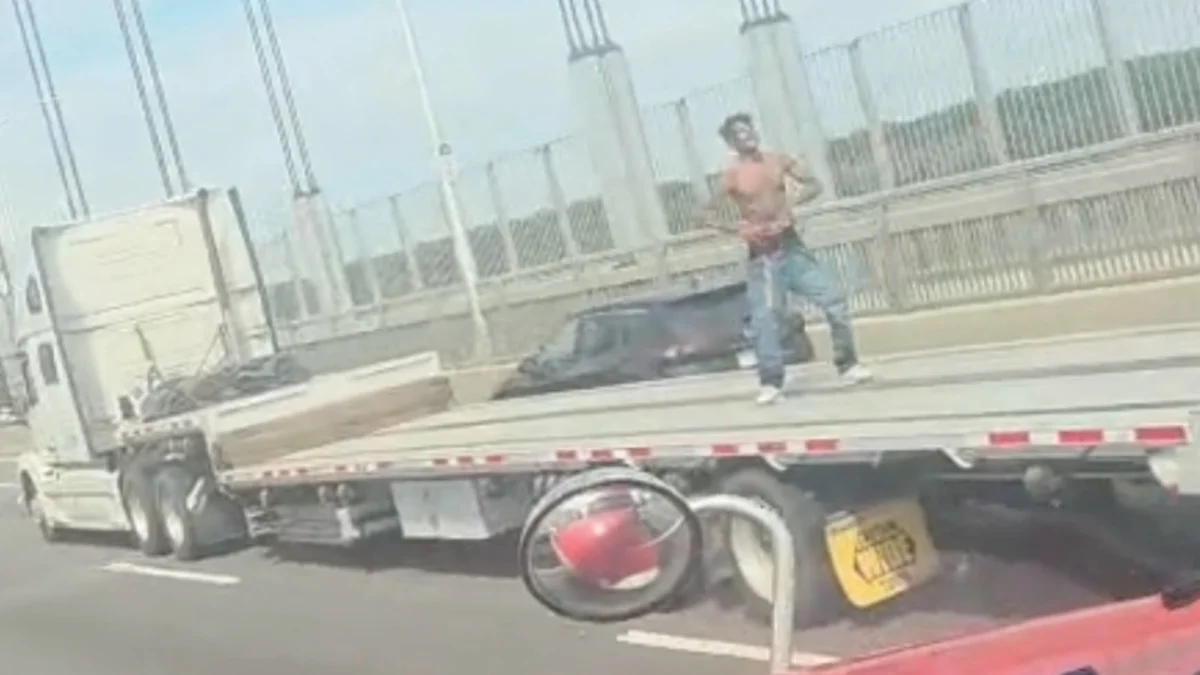
Law enforcement authorities in New York and New Jersey have taken a man into custody following a highly dangerous and unauthorized stunt involving a moving commercial vehicle on one of the world’s busiest bridges. On the morning of September 3, a shirtless man, later identified by officials as Crawford, was observed and filmed dancing on the back of a flatbed semi-trailer as it traversed the upper level of the George Washington Bridge. The incident, which occurred amidst heavy mid-morning traffic, has raised significant concerns regarding motorist safety, bridge security, and the growing trend of high-risk behavior intended for social media consumption.
Detailed Chronology of the September 3 Incident
The events began to unfold at approximately 11:00 a.m. on Tuesday, September 3. As the George Washington Bridge—a critical artery connecting Fort Lee, New Jersey, to Upper Manhattan—carried its usual volume of commercial and passenger traffic, motorists noticed an anomaly on a moving flatbed truck. Crawford was positioned on the open trailer, appearing entirely untethered as the vehicle maintained highway speeds across the Hudson River.
Eyewitness accounts and video footage indicate that Crawford was not merely a passive stowaway but was actively performing for the surrounding traffic. For several minutes, he was seen jumping, dancing, and gesturing toward other drivers. At various points during the crossing, Crawford moved toward the front of the trailer, climbing onto a raised section of the flatbed located directly behind the truck’s cab. He then jumped back down to the main platform of the trailer to resume his dancing.
As the truck proceeded across the upper level, other drivers began to notice the precarious situation. Video captured by John Ortiz, a fellow truck driver who was traveling adjacent to the flatbed, documented Crawford’s erratic movements. Ortiz’s footage shows Crawford grabbing his crotch and appearing to sing or shout toward passing vehicles. The footage, which was later uploaded to the social media platform TikTok, became a primary piece of evidence and a catalyst for public discussion on the incident.
Efforts to Alert the Driver and Public Response
The safety risk posed by Crawford’s presence on the trailer was immediate. Not only was Crawford at risk of falling into the path of oncoming traffic, but his actions served as a major distraction to hundreds of motorists on the bridge. Throughout the duration of the crossing, several drivers attempted to alert the driver of the semi-trailer.
John Ortiz, while filming the incident from his own cab, can be heard in the footage attempting to signal the driver of the flatbed. As Ortiz pulled alongside the truck’s cab, he shouted, “There’s a guy!” in an attempt to notify the operator of the unauthorized passenger. Other motorists reportedly utilized their horns in a rhythmic or persistent fashion to draw the trucker’s attention. Despite these efforts, it remains unclear at what point the driver became aware of Crawford’s presence. The structural design of many semi-trailers, combined with the noise of bridge traffic and the location of the flatbed’s "blind spots," often makes it difficult for operators to detect activity occurring on the rear of their equipment.
Law Enforcement Intervention and Arrest
Upon reaching the New York side of the bridge, the situation was met with a swift response from the Port Authority Police Department (PAPD). Officers, who had been alerted to the situation either through bridge surveillance or motorist reports, intercepted the vehicle as it exited the span.
Crawford was removed from the trailer by Port Authority Police officers. The encounter, however, was not without conflict. According to official reports, the suspect was arrested on a series of serious charges, suggesting a volatile interaction with law enforcement. The charges filed against Crawford include:
- Aggravated Assault: Generally implying an attempt to cause serious bodily injury to another, or causing such injury purposely or knowingly, often involving a law enforcement officer in this context.
- Resisting Arrest: Indicating that the suspect used physical force or other means to prevent officers from effectuating a lawful arrest.
- Disorderly Conduct: Pertaining to the public disturbance and safety hazard created by his actions on the bridge.
Following his arrest, Crawford was transported to a local hospital for a psychiatric and medical evaluation. This is standard procedure in cases where an individual’s behavior is exceptionally erratic or poses a high risk of self-harm. As of the latest updates, officials have not released a motive for Crawford’s actions, nor have they confirmed whether he was under the influence of any substances at the time of the incident.
The George Washington Bridge: A High-Stakes Environment
To understand the gravity of the incident, one must consider the environment in which it took place. The George Washington Bridge is one of the most heavily trafficked bridges in the world, supporting approximately 100 million vehicles annually. It consists of two levels: an upper level with eight lanes and a lower level with six lanes.
The upper level, where Crawford was filmed, is particularly exposed to high winds and features a suspension design that can experience slight oscillations under heavy loads. A fall from a moving vehicle in this environment would almost certainly be fatal, not only for the individual involved but potentially for following motorists who would be forced to take evasive action. The Port Authority of New York and New Jersey maintains a rigorous security presence on the bridge, utilizing a network of cameras and constant patrols to monitor for stalled vehicles, accidents, or unauthorized pedestrians.
The unauthorized entry onto the bridge’s roadway by a pedestrian—especially one clinging to a commercial vehicle—represents a significant breach of safety protocols. Commercial vehicles are subject to strict Department of Transportation (DOT) regulations regarding cargo and passenger safety, and while the driver may not have been at fault for Crawford’s presence, the incident highlights the vulnerabilities of open-deck trailers.
Analysis of Social Media Stunts and Public Safety
The incident involving Crawford is part of a concerning trend of "clout-chasing" or viral stunts performed in high-risk urban environments. The rise of platforms like TikTok and Instagram has created an incentive structure where individuals perform dangerous feats to garner views, likes, and followers.
Earlier this year, New York City authorities dealt with a similar incident on the Queensboro Bridge. In that case, two teenagers were arrested and charged after a TikTok stunt went wrong, leaving a 15-year-old boy trapped inside a bridge shaft. That incident required a complex emergency rescue operation, diverted significant municipal resources, and put both the teens and the rescuers at risk.
Legal experts and public safety officials note that these stunts carry implications far beyond the immediate danger to the performer. They include:
- Resource Diversion: Emergency services, including police, EMS, and specialized rescue units, are diverted from legitimate emergencies to handle preventable stunts.
- Economic Impact: Traffic delays on major spans like the George Washington Bridge can result in thousands of lost man-hours and delays in the delivery of goods, impacting the regional economy.
- Copycat Behavior: Viral videos of successful (or even partially successful) stunts can encourage others to attempt similar feats, leading to a cycle of escalating risk.
Legal and Policy Implications
The charges of aggravated assault and resisting arrest suggest that the legal consequences for Crawford will be substantial. In the states of New York and New Jersey, interfering with the safe operation of a bridge and engaging in a physical altercation with Port Authority officers are treated as serious offenses.
Furthermore, this incident may prompt the Port Authority and commercial trucking associations to review security measures. While it is difficult to prevent a determined individual from jumping onto a slow-moving or stopped truck in urban traffic, increased driver awareness and enhanced surveillance could mitigate such risks. There is also the question of "truck surfing," a variation of "train surfing," which has seen sporadic spikes in popularity in various global metropolitan areas.
The Port Authority of New York and New Jersey has historically maintained a zero-tolerance policy regarding unauthorized access to bridge infrastructure. The bridge’s walkways are strictly separated from vehicular lanes for this exact reason. Any breach of this separation is viewed not just as a traffic violation, but as a threat to the integrity of the transportation network.
Conclusion and Current Status
As of the current reporting period, Crawford remains under medical supervision, and the legal process is expected to proceed once he is cleared by hospital staff. The driver of the semi-trailer has not been charged with any wrongdoing, as there is currently no evidence to suggest the driver was complicit in Crawford’s actions.
The video recorded by John Ortiz remains a central part of the public record of the event, serving as a stark reminder of the unpredictability of modern urban environments. While the incident ended without a fatal accident or a multi-car collision, the potential for catastrophe was high. Public safety officials continue to urge the public to report suspicious or dangerous activity on regional infrastructure immediately by calling emergency services or utilizing the various "See Something, Say Something" hotlines established throughout the New York metropolitan area.
The Port Authority has not released further details regarding how Crawford managed to board the vehicle, though investigations typically look into whether the boarding occurred during a traffic light stop or while the truck was staged in a nearby commercial zone before entering the bridge plaza. For now, the case serves as a definitive example of the intersection between public safety, law enforcement, and the unpredictable nature of viral social behavior.




 Yuyun Lusiyani
 Joko Widodo
 Jia Lissa
 admin
admin
