Jia Lissa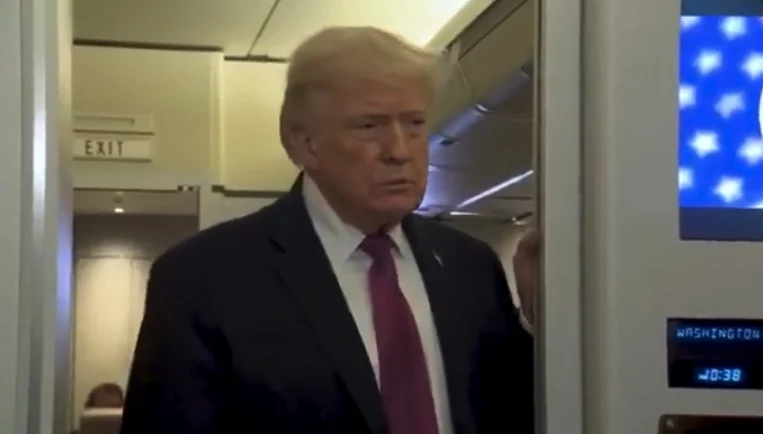
Aboard Air Force One on Friday night, President Donald Trump provided further clarification regarding his administration’s strategy for neutralizing Iran’s nuclear capabilities, specifically addressing his recent claims concerning the recovery of "nuclear dust." The President’s comments followed a week of intense diplomatic and military developments, including the announcement of a ceasefire intended to pause a high-intensity conflict that began in late February. The exchange with reporters highlighted the complexities of a burgeoning agreement with Tehran and the United States’ evolving stance on Israeli military operations in Lebanon.
The discussion focused on a series of statements made by the President earlier on Friday via Truth Social, where he asserted that the United States would recover "nuclear dust" created by B-2 bomber strikes on Iranian facilities. When asked by a reporter to define the term and explain the logistical process of "taking" such material, President Trump stated that the United States would be "going in with Iran" to secure the substances in question. The President emphasized that this recovery would occur after a formal agreement is signed, though he did not provide specific details regarding the composition of the material or the personnel involved in the recovery mission.
The Evolution of the 2026 Conflict
The current geopolitical situation stems from a significant escalation of hostilities that commenced on February 28, 2026. Following months of rising tensions over Iran’s nuclear enrichment levels and regional proxy activities, the United States and Israel launched a coordinated aerial campaign. This operation targeted several high-security installations, including hardened nuclear sites that the administration previously described as "totally obliterated."
The use of B-2 Spirit and potentially B-21 Raider stealth bombers was central to these strikes. These aircraft are capable of deploying Massive Ordnance Penetrators (MOP), designed to reach deeply buried facilities such as those at Fordow and Natanz. The President’s reference to "nuclear dust" is interpreted by defense analysts as a colloquialism for the residual fissile material, enriched uranium stockpiles, or contaminated debris resulting from the destruction of these centrifugal and storage facilities.
The ceasefire announced last week was intended to halt the kinetic phase of the conflict, which had seen significant disruptions to global energy markets and maritime security. While the administration has signaled a move toward a "final deal," the ground reality remains contentious, particularly regarding the status of international shipping lanes.
Strategic Standoff in the Strait of Hormuz
A critical component of the ongoing negotiations involves the Strait of Hormuz, a vital chokepoint through which approximately 20% of the world’s oil supply passes. President Trump recently claimed that the Strait is now "open without restrictions," suggesting a return to maritime normalcy. However, this assessment has been met with resistance from Iranian officials.
Mohammad Bagher Ghalibaf, the Speaker of the Iranian Parliament, indicated via social media that the Strait would remain restricted as long as the U.S.-led blockade on Iranian shipping and ports persists. The U.S. Navy’s Fifth Fleet has maintained a "maximum pressure" maritime screen since March, preventing the export of Iranian crude and the import of dual-use technologies. The discrepancy between the White House’s claims of an open waterway and Tehran’s insistence on continued closure underscores the fragility of the current ceasefire.
Chronology of Key Events: February – April 2026
To understand the context of the "nuclear dust" claims, a timeline of the preceding fifty days is essential:
- February 28, 2026: The U.S. and Israel initiate "Operation Resolute Shield," a massive bombing campaign targeting Iranian nuclear infrastructure and command-and-control centers.
- March 10, 2026: Iran retaliates with ballistic missile volleys targeting regional bases; the U.S. responds by implementing a total naval blockade of the Persian Gulf.
- March 25, 2026: President Trump declares that Iran’s nuclear program has been "totally obliterated" by precision strikes.
- April 10, 2026: Secret negotiations in Oman lead to the announcement of a tentative ceasefire.
- April 17, 2026 (Morning): President Trump posts on Truth Social regarding the recovery of "nuclear dust" and the "PROHIBITION" of Israeli strikes in Lebanon.
- April 17, 2026 (Night): On Air Force One, the President clarifies that U.S. forces or contractors will enter Iran to retrieve nuclear materials following a signed agreement.
Defining "Nuclear Dust" and Technical Implications
The term "nuclear dust" used by the President is not a standard technical term in nuclear physics or arms control. However, within the context of post-strike assessment, it likely refers to several high-priority objectives for the U.S. Department of Energy and the International Atomic Energy Agency (IAEA):
- Recovering Enriched Uranium: If the strikes successfully breached storage canisters, the resulting powder-form uranium hexafluoride or enriched metal fragments would need to be secured to prevent environmental hazards or illicit recovery by non-state actors.
- Verification of Destruction: "Taking" the material allows the U.S. to conduct forensic analysis to determine exactly how far Iran’s enrichment had progressed prior to the strikes.
- Environmental Remediation: The destruction of nuclear facilities often results in localized radioactive contamination. The "dust" may refer to the debris that must be cleared to render the sites inert.
The President’s assertion that "no money will exchange hands" suggests that this recovery is a condition of the ceasefire rather than a purchase of assets, marking a departure from previous diplomatic frameworks like the 2015 JCPOA.
The Lebanon Mandate and the "Hezboolah" Situation
In a move that has surprised many regional observers, President Trump’s Friday communications included a direct "prohibition" on Israeli military activity in Lebanon. This represents a significant shift in the tripartite relationship between Washington, Jerusalem, and Beirut.
For weeks, the Israel Defense Forces (IDF) have been engaged in cross-border operations targeting the militant group Hezbollah—referred to by the President as "Hezboolah." The President stated that "Israel will not be bombing Lebanon any longer" and that "Enough is enough!!!" This directive appears to be an attempt to decouple the Iranian nuclear issue from the broader regional conflict in the Levant.
While the Israeli government has not issued an official response to the "prohibition," the directive places Prime Minister Benjamin Netanyahu’s cabinet in a complex position. Israel has long maintained that its security interests in Lebanon are existential and independent of U.S. diplomatic efforts with Iran. The President’s insistence that the U.S. will "separately" deal with the "Hezboolah situation" suggests a new American-led security initiative in Lebanon, potentially involving diplomatic pressure or targeted U.S. counter-terrorism operations.
Broader Geopolitical and Economic Impact
The implications of these developments are far-reaching. Global markets have reacted with volatility to the conflicting reports regarding the Strait of Hormuz. Oil futures, which spiked to over $120 per barrel in early March, saw a slight decline following the ceasefire announcement but remain sensitive to the ongoing blockade.
Diplomatic Reactions
International reactions have been cautious. European allies have expressed support for the securing of nuclear materials but have called for clarity on the "prohibition" of strikes in Lebanon. UN officials have emphasized the need for IAEA inspectors to be involved in any recovery of "nuclear dust" to ensure transparency and international safety standards are met.
Domestic Political Context
Domestically, the President’s approach has drawn a mix of scrutiny and support. Supporters argue that the "obliteration" of the nuclear sites followed by a physical seizure of the remaining material is the only way to ensure Iran never achieves a breakout capability. Critics, however, have raised concerns about the "going in" aspect of the plan, questioning whether this implies a long-term U.S. ground presence in Iran or a high-risk extraction mission.
Conclusion and Future Outlook
As the administration moves toward formalizing the agreement with Tehran, the focus remains on the logistics of the "nuclear dust" recovery and the enforcement of the ceasefire. The President’s firm stance on halting Israeli operations in Lebanon suggests a pivot toward a broader regional "Grand Bargain," though the success of such a strategy depends on the cooperation of multiple antagonistic parties.
The coming days will likely see high-level meetings between U.S. Secretary of State and Iranian representatives to iron out the details of the "agreement" mentioned by the President. Whether the "nuclear dust" can be safely and effectively removed—and whether the Strait of Hormuz can truly be opened—remains the central question for the stability of the global order in the spring of 2026. For now, the world remains in a state of watchful waiting as the United States attempts to close the chapter on a conflict that has redefined Middle Eastern security.


 Yuyun Lusiyani
 Joko Widodo
 Pevita Pearce
 admin
admin