
 Pevita Pearce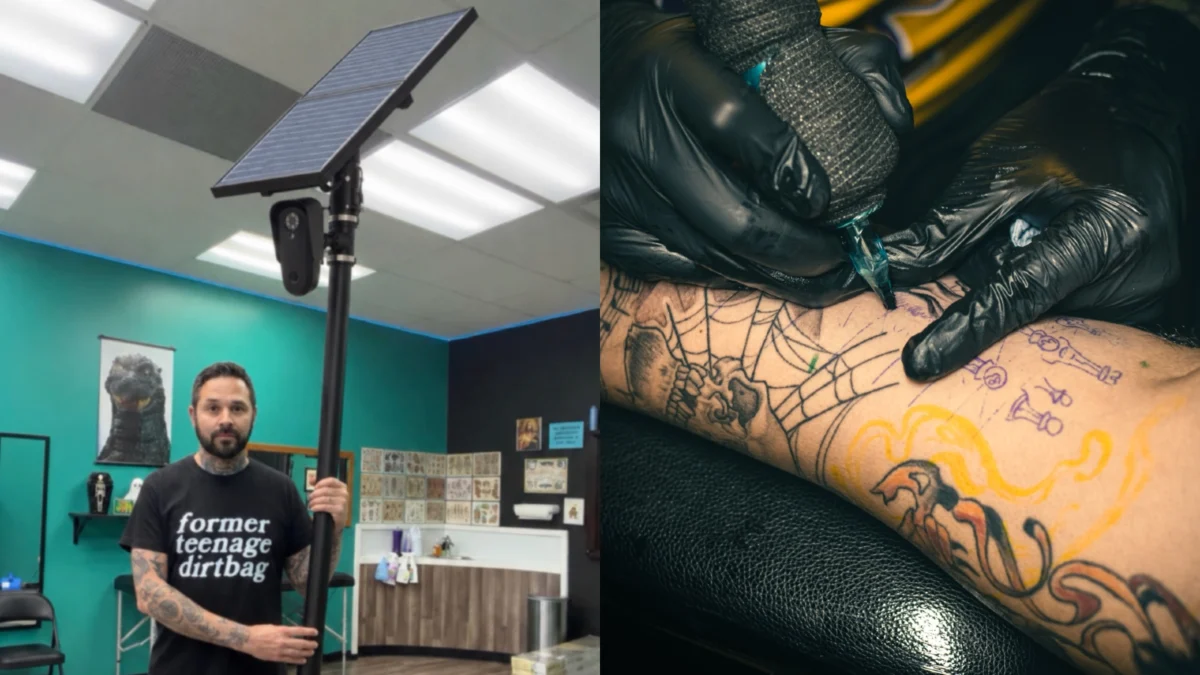
In the quiet community of New Baltimore, Michigan, a local business owner has found himself at the center of a national conversation regarding privacy, surveillance technology, and the boundaries of online satire. Steven Jean, the proprietor of The Alien Body Shop, recently leveraged his social media presence to voice frustration with the increasing prevalence of automated surveillance systems. Jean’s Instagram post, which featured him holding an Automated License Plate Reader (ALPR) manufactured by the technology firm Flock Safety, included a provocative caption: “Free tattoo with every Flock camera.” While Jean has since clarified that the offer was intended as a satirical commentary on the proliferation of high-tech monitoring, the post’s viral trajectory—surpassing two million views—has triggered a series of real-world consequences, including reports of vandalism and at least one arrest.
The incident highlights a growing friction between law enforcement’s reliance on artificial intelligence for crime prevention and a public increasingly wary of pervasive data collection. Flock Safety, a private, for-profit company based in Atlanta, Georgia, has become a primary target for this skepticism. Their cameras are not merely passive recording devices; they are sophisticated AI-driven tools designed to capture “Vehicle Fingerprints,” which include license plate numbers, vehicle make, model, color, and even unique identifying features like roof racks, bumper stickers, or body damage. As these cameras become staples in both public intersections and private neighborhoods, the debate over their necessity versus their intrusion into civil liberties has reached a boiling point.
The Genesis of the Viral Satire
The controversy began when Steven Jean posted an image to his business’s Instagram account, The Alien Body Shop. In the photograph, Jean is seen wielding a Flock Safety camera, a device easily recognizable by its sleek, solar-powered design often mounted on utility poles. The accompanying text offered a "free tattoo" to anyone who brought a similar camera into his shop. Within days, the post transcended the local Michigan tattooing community, circulating through privacy advocacy groups and anti-surveillance circles across the United States.
Jean’s intent, according to his subsequent statements to news outlets including CBS News, was to engage in "satirical entertainment." He sought to highlight what he perceived as an overreach by private tech companies and local municipalities in tracking the movements of citizens who are not suspected of any crimes. However, the nuance of satire is often lost in the rapid-fire environment of social media. Jean reported receiving numerous messages containing images of damaged Flock cameras and videos of individuals actively dismantling the hardware. Most significantly, Jean revealed that one individual contacted him claiming to have been arrested for vandalizing a camera in an attempt to claim the "reward."
In response to the unintended escalation, Jean has issued several clarifications, urging the public not to engage in illegal activities. "Please do not bring Flock cameras to my shop! It’s all about obeying the law and having a good time," Jean stated, attempting to steer the conversation back toward the legal expression of dissent rather than property destruction.
Technical Capabilities and the Rise of Flock Safety
To understand the intensity of the backlash, one must examine the technology that powers Flock Safety. Founded in 2017, the company has rapidly expanded its footprint, now operating in thousands of cities across the United States. Unlike traditional CCTV cameras, which require manual review of footage, Flock’s ALPR systems utilize machine learning algorithms to index every vehicle that passes through their field of vision.
The data collected is stored in a searchable database, typically accessible to law enforcement agencies for a period of 30 days, though this retention period can vary by jurisdiction. The "Vehicle Fingerprint" technology allows police to search for specific criteria even if a license plate is missing or obscured. For instance, an officer can search for "white Ford F-150s with a ladder rack" that passed a specific intersection within a three-hour window.
Flock Safety markets its services as a tool for "eliminating objective crime." The company claims its systems help solve up to 10% of reported crimes in the U.S., particularly in cases involving stolen vehicles, missing persons (Amber and Silver Alerts), and felony warrants. Proponents argue that the cameras provide an unbiased, digital witness that can significantly reduce the time required for investigations.
Privacy Concerns and the "De-Flock" Movement
Despite the touted benefits for public safety, civil liberties organizations such as the American Civil Liberties Union (ACLU) and the Electronic Frontier Foundation (EFF) have raised alarms regarding the lack of federal regulation over ALPR data. The primary concern is the creation of a "pervasive surveillance web" that tracks the movements of law-abiding citizens. Because the cameras log every vehicle, they create a historical record of where individuals go, whom they visit, and how often they frequent certain locations, such as places of worship, medical clinics, or political rallies.
This sentiment has birthed a grassroots "De-Flock" movement, which Jean’s satirical post inadvertently amplified. Activists argue that the privatization of law enforcement tools—where a for-profit company manages the data—adds a layer of opacity that prevents public oversight. In some regions, "De-Flock" campaigns have gained momentum, particularly during holidays like Halloween, where activists use the cover of costumes to map camera locations or advocate for their removal through local city council meetings.
The "De-Flock" sentiment is further fueled by the interconnected nature of the Flock database. Through a feature known as the "TALON" network, different police departments can share their camera data with one another, creating a regional or even national tracking system that operates without a warrant or probable cause.
Chronology of Recent ALPR Controversies
The Michigan tattoo shop incident is part of a broader timeline of events that have brought ALPR technology into the national spotlight:
- 2017: Flock Safety is founded, introducing a subscription-based model that makes ALPR technology affordable for smaller municipalities and Homeowners’ Associations (HOAs).
- 2021-2022: A surge in suburban crime leads to a massive uptick in Flock camera installations across the Midwest and Sun Belt states.
- Late 2023: Privacy advocates launch "Transparency Portals," allowing the public to see which police departments are using Flock cameras and how many "hits" they generate.
- October 2024: The viral "De-Flock" Halloween campaign encourages citizens to identify and document the location of surveillance hardware in their neighborhoods.
- November 2024: Steven Jean’s Instagram post at The Alien Body Shop goes viral, resulting in reported vandalism and a public discourse on the legality of "anti-surveillance" art and satire.
Legal Ramifications and Municipal Oversight
The legal fallout from Jean’s post serves as a cautionary tale regarding the intersection of digital activism and criminal law. Vandalizing a Flock camera is not a minor offense; depending on the jurisdiction and the cost of the hardware (which can range from $2,500 to $3,000 per unit plus installation), such acts can be prosecuted as a felony. Furthermore, the cameras are often equipped with tamper-detection alerts, notifying law enforcement the moment a device is moved or damaged.
Municipalities are also facing legal challenges regarding the deployment of these cameras. In several states, lawsuits have been filed questioning whether the continuous tracking of vehicles constitutes an "unreasonable search" under the Fourth Amendment. While courts have generally ruled that there is no expectation of privacy on a public roadway, the "mosaic theory"—the idea that the sum of many small pieces of data creates a comprehensive picture of a private life—is currently being tested in higher courts.
Some cities have responded to public outcry by implementing stricter usage policies. These include "whitelisting" certain plates to prevent tracking of local residents, shortening data retention periods to 24 hours, and requiring annual audits to ensure the technology is not being used for non-criminal purposes, such as tracking individuals for immigration enforcement or political reasons.
Broader Implications for Social Media and Civil Discourse
The transformation of Steven Jean’s satirical post into a catalyst for property damage underscores the volatile power of social media in the modern era. For small business owners, viral fame can be a double-edged sword. While Jean’s shop received unprecedented exposure, the association with criminal activity and the subsequent need for legal disclaimers have created a complex situation for the artist.
The incident also reflects a shift in how the public engages with surveillance. What was once a niche concern for tech-privacy experts has become a mainstream cultural issue, discussed in tattoo parlors and on social media feeds. The fact that two million people engaged with a post about license plate readers suggests that the "surveillance state" is no longer an abstract concept to the average citizen, but a tangible presence in their daily commute.
As Flock Safety continues to expand—recently announcing new features that integrate with gunshot detection systems and body-worn cameras—the tension between security and privacy is likely to intensify. The Alien Body Shop incident will likely be remembered as a pivotal moment where the frustration of the "tracked" population found a voice in art, even if that voice was misinterpreted as a call to action.
In the final analysis, the debate sparked by a single Instagram post in New Baltimore, Michigan, serves as a microcosm of a global challenge: how to balance the undeniable utility of artificial intelligence in public safety with the fundamental human right to move through the world without being logged, analyzed, and stored in a database. For now, Steven Jean continues to ink his customers, but his "free tattoo" offer remains a stark reminder of the digital eyes that watch over the streets outside his shop.




 Yuyun Lusiyani
 Joko Widodo
 Jia Lissa
 admin
admin
