
 Jia Lissa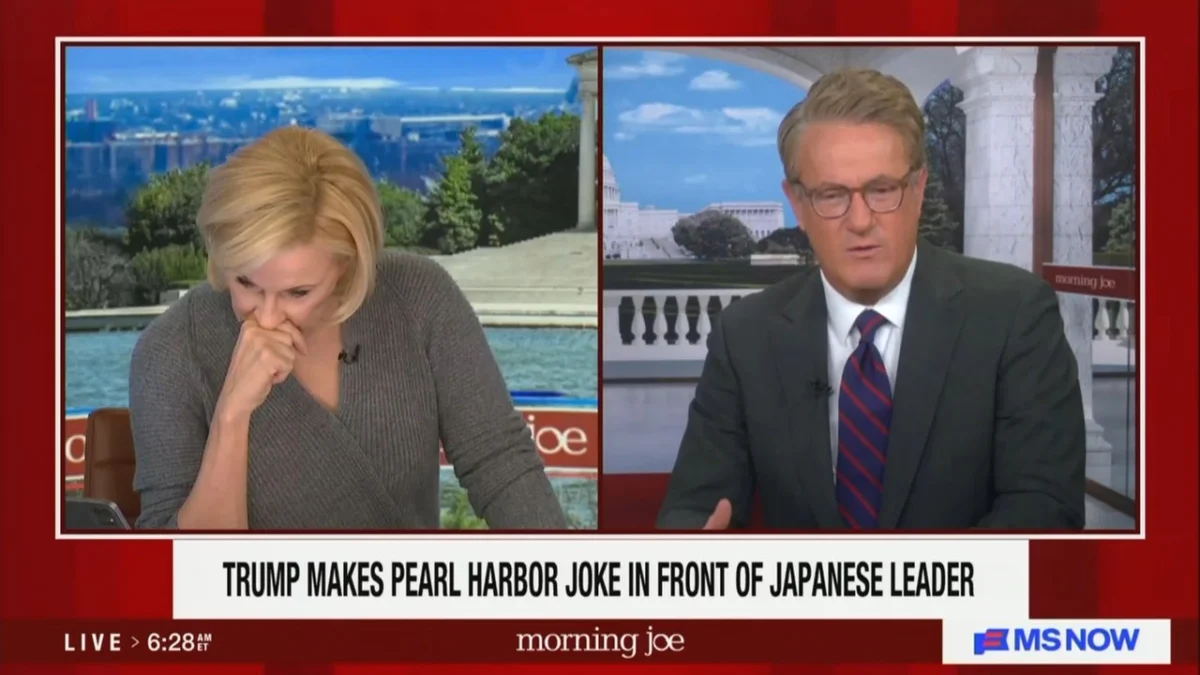
The intersection of modern geopolitics and historical grievances took center stage in the Oval Office this week as President Donald Trump hosted Japanese Prime Minister Sanae Takaichi for a high-stakes bilateral summit. While the meeting was intended to solidify the security alliance between Washington and Tokyo amid escalating tensions in the Middle East and the Indo-Pacific, the proceedings were overshadowed by a controversial rhetorical exchange regarding the 1941 attack on Pearl Harbor. During a joint press availability on Thursday, President Trump responded to inquiries regarding the lack of prior notification given to allies before recent U.S. military strikes in Iran by invoking the surprise attack that drew the United States into World War II. The exchange has since ignited a firestorm of media criticism, most notably from the hosts of MSNBC’s Morning Joe, who characterized the President’s diplomatic conduct as "absurd" and "embarrassing."
The Oval Office Exchange: A Departure from Diplomatic Protocol
The controversy began when a Japanese journalist questioned the President on the lack of communication between the United States and its key strategic partners—including Japan and European nations—prior to the execution of military operations against Iranian targets. The reporter sought to understand why the administration had bypassed traditional consultative frameworks that typically govern the actions of major military alliances. In a response that appeared to catch both the press corps and the Japanese delegation off guard, President Trump countered by referencing the historical events of December 7, 1941.
"Why did you not tell me about Pearl Harbor?" Trump asked, addressing the room and the Prime Minister. He followed the remark by suggesting that Japan, as a nation, places a higher premium on the element of "surprise" than the United States does. The comment, which conflated contemporary military coordination with a conflict that ended nearly eight decades ago, immediately became the focal point of the day’s diplomatic coverage.
Prime Minister Sanae Takaichi, who assumed office as Japan’s first female prime minister and is known for her own brand of conservative nationalism, maintained a composed demeanor during the exchange. However, diplomatic observers noted that the invocation of Pearl Harbor—a sensitive historical touchstone that modern leaders of both nations have spent decades reconciling—represented a significant departure from the carefully curated language of the U.S.-Japan partnership.
Morning Joe Analysis: Mockery and Critique of Transactional Diplomacy
On Friday morning, the cast of MSNBC’s Morning Joe dedicated a significant portion of their broadcast to analyzing the President’s remarks. Host Joe Scarborough, a former Republican congressman, was seen momentarily speechless after reviewing the footage of the Oval Office meeting. Scarborough noted that the behavior was "something you wouldn’t see from any other president," emphasizing that the role of the executive typically involves fostering goodwill and strengthening ties with essential allies rather than revisiting historical traumas in a confrontational or mocking manner.
Co-host Mika Brzezinski was more blunt in her assessment, describing the scene as "definitely not normal" and comparing the exchange to a scripted comedy sketch. "I’m embarrassed for the country," Brzezinski stated, reflecting a sentiment often echoed by critics of the President’s unconventional approach to foreign policy. The hosts argued that such rhetoric undermines the stability of the "rules-based international order" that the U.S. helped establish in the wake of the very war the President referenced.
Guest Anand Giridharadas, a frequent political commentator and author, joined the discussion to provide a deeper analysis of the President’s motivations. Giridharadas posited that the President’s comments were indicative of a "transactional" worldview. He argued that the President lacks a fundamental "gut level" understanding of what it means to be an ally, viewing international relations through the lens of individual deals rather than long-term, institutional partnerships. According to Giridharadas, this transactionalism is manifesting on the global stage in a way that prioritizes domestic political posturing over strategic cohesion.
Chronology of Escalating Tensions and Diplomatic Friction
The Pearl Harbor remark did not occur in a vacuum. It follows a period of heightened friction between the Trump administration and various traditional allies. To understand the gravity of the exchange, it is necessary to examine the timeline of events leading up to the Thursday meeting:
- January–February 2026: Tensions between the United States and Iran escalate following a series of maritime incidents in the Strait of Hormuz.
- March 10, 2026: The U.S. conducts targeted strikes against military infrastructure in Iran, citing "imminent threats" to American personnel.
- March 12, 2026: Leaders from France, Germany, and the United Kingdom issue a joint statement expressing concern over the lack of prior consultation, noting that the strikes could have regional repercussions for their own forces stationed in the Middle East.
- March 15, 2026: President Trump engages in a public spat with the French President, criticizing France’s contributions to NATO and its trade policies.
- March 19, 2026: Prime Minister Sanae Takaichi arrives in Washington D.C. for a pre-scheduled summit. The primary agenda includes the renewal of the U.S.-Japan trade agreement and coordination on North Korean missile defense.
- March 19, 2026 (Afternoon): The "Pearl Harbor" exchange occurs during the joint press availability in the Oval Office.
This timeline highlights a pattern of "America First" unilateralism that has increasingly sidelined the consultative processes of the G7 and other multilateral organizations.
Supporting Data: The Strategic Importance of the U.S.-Japan Alliance
The diplomatic weight of the U.S.-Japan relationship cannot be overstated. Japan remains the cornerstone of U.S. security policy in the Indo-Pacific. According to data from the Department of Defense, the United States maintains approximately 55,000 military personnel in Japan, the largest permanent forward-deployed U.S. force in any foreign country. This presence is facilitated by the Treaty of Mutual Cooperation and Security, which requires the U.S. to defend Japan in exchange for the use of military bases on Japanese soil.
Economically, the stakes are equally high. Japan is the fourth-largest trading partner of the United States. In 2025, bilateral trade in goods and services totaled an estimated $300 billion. Furthermore, Japan is one of the largest foreign holders of U.S. Treasury securities, making its economic stability vital to American financial interests.
Diplomatic experts argue that using historical grievances as leverage or as a "quip" during official meetings risks alienating a public in Japan that is already skeptical of U.S. reliability. Recent polling from the Pew Research Center suggests that while the majority of Japanese citizens value the alliance, confidence in the U.S. President’s handling of world affairs has seen significant volatility over the last several years.
Official Responses and Diplomatic Implications
While the White House has not issued a formal retraction of the President’s comments, administration officials have sought to frame the remark as a lighthearted observation on the nature of military strategy rather than a genuine diplomatic slight. Press Secretary responses indicated that the President was merely illustrating the importance of "operational security" and the necessity of keeping military plans confidential to ensure success.
However, the response from Tokyo has been more measured. A spokesperson for the Japanese Ministry of Foreign Affairs stated that Prime Minister Takaichi remains "focused on the future of the alliance" and the shared challenges of the 21st century. Despite this diplomatic poise, Japanese media outlets have reported a sense of "bewilderment" among officials in the Prime Minister’s Office, who had hoped the summit would focus on concrete security guarantees rather than historical debates.
In the United States, the reaction has split along familiar partisan lines. Supporters of the President view the Pearl Harbor comment as a quintessential example of his "tell-it-like-it-is" style, arguing that it serves as a reminder that the U.S. will no longer be "taken advantage of" by allies who rely on American protection while questioning American tactics. Conversely, foreign policy establishment figures from both parties have warned that such rhetoric provides an opening for adversaries like China and Russia to drive a wedge between Washington and its partners.
Broader Impact: The Evolution of Global Alliances
The "Morning Joe" segment highlighted a broader concern regarding the erosion of diplomatic norms. For decades, the U.S.-Japan relationship was characterized by a "no surprises" policy, where both nations worked in lockstep to manage regional threats. The recent Iran strikes and the subsequent Pearl Harbor remark suggest a shift toward a more volatile, personality-driven foreign policy.
The implications for the Indo-Pacific are particularly significant. As China continues to expand its influence through the Belt and Road Initiative and increased naval activity in the South China Sea, the unity of the "Quad" (the U.S., Japan, India, and Australia) is viewed by many as the primary bulwark against regional hegemony. Diplomatic friction in the Oval Office, even if dismissed by some as mere "political theater," can have real-world consequences for the military coordination and intelligence sharing necessary to maintain regional balance.
Furthermore, the comparison to a Saturday Night Live skit by the MSNBC crew underscores the growing divide between the reality of executive-level diplomacy and the public’s perception of it. When the highest level of international engagement is viewed through the lens of entertainment or absurdity, the gravity of the underlying issues—such as potential war with Iran or the defense of the Pacific—can become diluted in the public consciousness.
As the Takaichi administration returns to Tokyo, the focus will likely turn to whether this incident was a momentary lapse in decorum or a signal of a more permanent shift in how the United States intends to treat its "most important" bilateral partner. For now, the "Pearl Harbor" quip remains a stark reminder of how historical memory continues to shape, and sometimes complicate, the modern pursuit of global security.


 Yuyun Lusiyani
 Joko Widodo
 Eva Lovia
 Pevita Pearce
 admin
admin
 Lina Irawan