
 Jia Lissa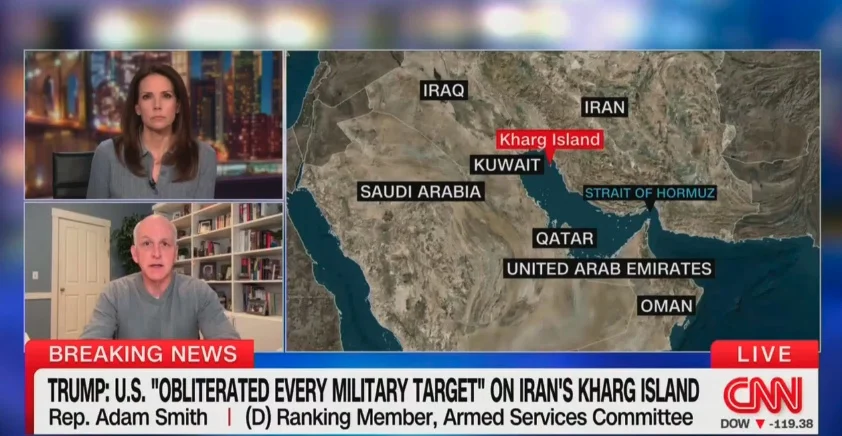
In a stark assessment of the escalating military friction in the Middle East, Representative Adam Smith (D-WA) cautioned on Friday that the United States’ military engagement with Iran is "far from being over," following the White House’s announcement of a major air operation against Kharg Island. Speaking during an appearance on CNN’s OutFront, the high-ranking Democrat and former Chairman of the House Armed Services Committee expressed deep concerns regarding the strategic objectives of the administration and the mounting human and economic costs of a conflict that began in late February 2026.
The comments followed an official statement from President Donald Trump, who confirmed that the U.S. military had "totally obliterated" all military installations on Kharg Island, a critical piece of infrastructure located in the Persian Gulf. While the President emphasized that the strikes were targeted specifically at military assets and avoided direct hits on oil refineries, he issued a stern ultimatum: if Iran continues to obstruct maritime traffic through the Strait of Hormuz, the U.S. will reconsider its restraint regarding Iran’s energy infrastructure.
Strategic Significance of Kharg Island and the Strait of Hormuz
Kharg Island serves as the primary artery for the Iranian economy, facilitating approximately 90% of the country’s total oil exports. Situated roughly 15 miles off the coast of Iran, the island is home to massive storage tanks and deep-water loading terminals that allow supertankers to transport Iranian crude to global markets. By targeting the military defenses on the island, the U.S. has effectively signaled its ability to paralyze Iran’s primary source of revenue at a moment’s notice.
Representative Smith highlighted the gravity of this development, noting that while the island remains a "strategic asset without any question," the decision to strike it marks a significant escalation in the scope of the war. "If we were to shut that off, that is a lifeline for Iran," Smith told guest host Erica Hill. "The devastation to the global economy would be enormous, and we are seeing a full-scale Middle East war that Donald Trump kicked off."
The current crisis was precipitated by the effective closure of the Strait of Hormuz by Iranian forces. The strait is the world’s most important oil transit chokepoint, through which more than 20% of the world’s total petroleum liquids consumption passes daily. Iran’s move to restrict travel through the waterway was a direct response to the commencement of joint U.S.-Israeli bombing campaigns on February 28, 2026.
Chronology of the Conflict: February 28 to March 13, 2026
The rapid descent into open hostilities follows a timeline of escalating strikes and retaliatory measures that have reshaped the geopolitical landscape of the Middle East in less than a month:
- February 28, 2026: The United States and Israel launch a coordinated air campaign against Iranian nuclear research facilities and ballistic missile sites, citing "imminent threats" to regional security.
- March 2, 2026: Iran retaliates with a series of drone and missile strikes targeting U.S. military installations in Iraq and Syria, as well as several locations within Israel.
- March 4, 2026: The Iranian Revolutionary Guard Corps (IRGC) announces the closure of the Strait of Hormuz to "hostile nations," deploying naval mines and fast-attack craft to enforce the blockade.
- March 6, 2026: Iran’s envoy to the United Nations reports that 1,332 Iranian civilians have been killed since the start of the bombing campaign, a figure that sparked international calls for a ceasefire.
- March 9, 2026: Global oil prices surge to record highs as markets react to the prolonged closure of the Strait. Energy analysts warn of a "global supply shock" if the blockade is not lifted.
- March 11, 2026: The Pentagon confirms the deaths of 13 U.S. service members following a missile strike on a logistics hub in the region.
- March 13, 2026: President Trump announces the destruction of military targets on Kharg Island, declaring the mission a success while threatening further action against oil facilities.
Economic Data and Global Market Impact
The conflict has sent shockwaves through the global economy, with energy markets bearing the brunt of the instability. Prior to the strikes on Kharg Island, Brent Crude prices had already climbed significantly, but the threat of a total shutdown of Iranian exports—coupled with the blockage of the Strait of Hormuz—has pushed prices toward unprecedented levels.
According to data from market analysts, the disruption of the 90% of Iranian oil flowing through Kharg Island, combined with the wider regional instability, has led to:
- Gasoline Price Surges: In the United States, the national average for a gallon of regular gasoline has risen by over 40% in two weeks, impacting consumer spending and domestic logistics.
- Shipping Delays: Major maritime insurance companies have suspended coverage for vessels operating in the Persian Gulf, forcing tankers to take longer, more expensive routes around the Cape of Good Hope.
- Supply Chain Disruptions: The increased cost of energy has triggered a ripple effect through the manufacturing and agricultural sectors, raising fears of a renewed inflationary cycle in the U.S. and Europe.
Representative Smith emphasized that these economic consequences are a direct result of a lack of a clear exit strategy. "President Trump uses words about ‘obliterated’ all the time, but we are still a long way from achieving the objectives that he set out," Smith remarked, adding that there is currently "no clear path" to ending the hostilities.
Official Responses and Domestic Political Tension
The Biden-era Democratic leadership, represented by figures like Smith, has become increasingly vocal in its criticism of the Trump administration’s handling of the crisis. While many in Congress initially supported the right of the U.S. and Israel to defend against Iranian aggression, the mounting death toll and economic fallout have fractured the initial consensus.
In his Friday announcement, President Trump remained defiant, framing the Kharg Island operation as a necessary show of strength. "There is nothing they can do about it," the President claimed, referring to the Iranian military’s inability to prevent the destruction of their assets on the island. Trump’s supporters in the GOP have echoed this sentiment, arguing that "maximum pressure" is the only way to force Iran back to the negotiating table and ensure the reopening of the Strait of Hormuz.
However, international reaction has been more critical. The European Union has issued statements urging "utmost restraint," while regional powers such as China and Russia have condemned the strikes on Kharg Island as a violation of international law that threatens global energy security. The Iranian government, for its part, has vowed to continue its "resistance," with a spokesperson for the IRGC stating that the U.S. "has started a fire it cannot extinguish."
Human Cost and Military Reality
The human toll of the conflict continues to rise. The loss of 13 U.S. service members marks the deadliest engagement for American forces in the region in years. Simultaneously, the reported 1,300 Iranian civilian deaths have drawn the attention of human rights organizations, who warn that the urban nature of many Iranian military and research sites makes collateral damage nearly inevitable.
Military analysts suggest that while the U.S. maintains overwhelming air and naval superiority, the "obliteration" of military targets on Kharg Island does not necessarily equate to a strategic victory. Iran’s asymmetric warfare capabilities—including its vast arsenal of drones, sea mines, and proxy militias in Lebanon, Yemen, and Iraq—allow it to continue the conflict despite the loss of conventional military infrastructure.
Representative Smith’s critique centers on this very point: the disconnect between tactical success and strategic resolution. By destroying the defenses on Kharg Island, the U.S. has demonstrated its power, but it has also backed Iran into a corner where its most potent remaining leverage is the continued disruption of the global oil supply.
Broader Implications and Future Outlook
As the conflict enters its third week, the primary question facing the international community is whether the situation can be de-escalated or if it will devolve into a protracted regional war. The threat to Iranian oil facilities remains the "nuclear option" of economic warfare. Should the Trump administration follow through on its threat to strike the oil infrastructure itself, the resulting environmental and economic damage could take decades to repair.
For the United States, the political stakes are equally high. The rising cost of gas and the loss of American lives are likely to become central issues in the domestic political discourse. Representative Smith’s comments reflect a growing concern within the legislative branch that the executive is pursuing a policy of escalation without a defined endgame.
"The cost of this war is expanding," Smith concluded. "And it tells me, with the Kharg Island attack, that this is all very far from being over."
As of late Friday, the Pentagon has not released further details on the specific munitions used or the exact extent of the damage to the island’s infrastructure. Meanwhile, global markets remain on edge, awaiting Iran’s next move in what has become the most significant military confrontation in the Middle East in the 21st century. The international community continues to monitor the Strait of Hormuz, where the world’s energy security hangs in a precarious balance between military might and diplomatic failure.




 Yuyun Lusiyani
 Joko Widodo
 Eva Lovia
 Pevita Pearce
 admin
admin
 Lina Irawan