
 Jia Lissa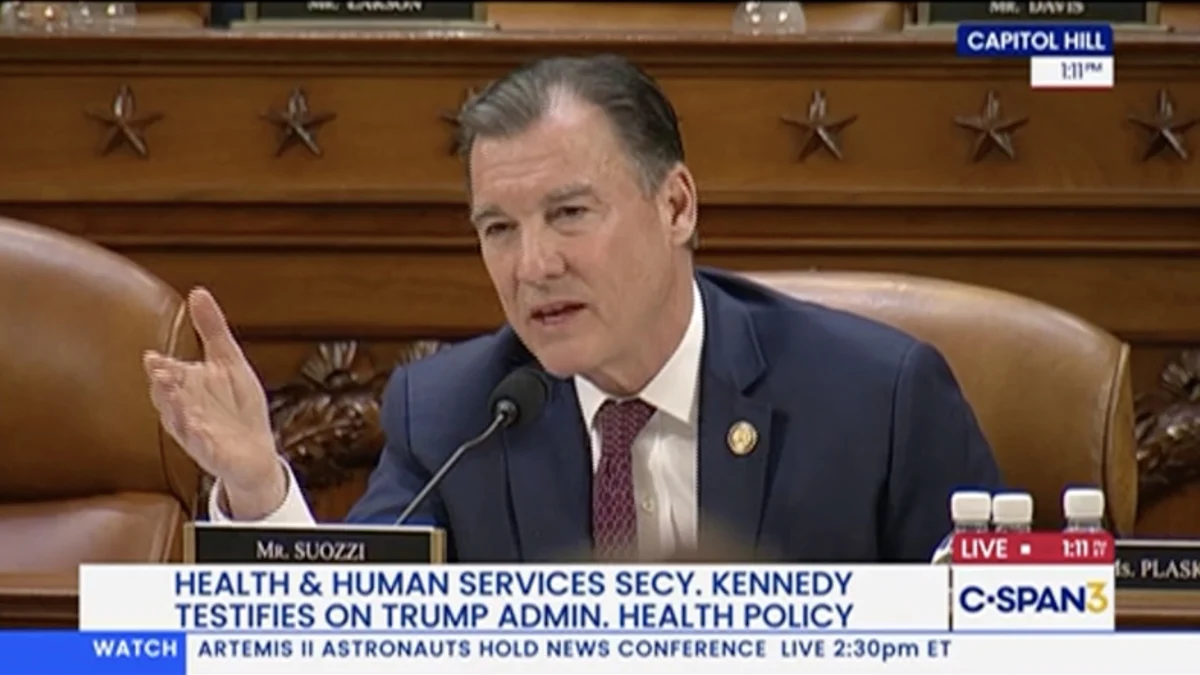
The intersection of legacy politics, fiscal priorities, and public health policy took center stage on Thursday as Representative Tom Suozzi (D-NY) engaged in a pointed exchange with Health and Human Services (HHS) Secretary Robert F. Kennedy Jr. during a high-stakes congressional hearing. The testimony, which was intended to review the administration’s budgetary goals for the upcoming fiscal year, quickly devolved into a debate over the ideological soul of American governance, contrasting the administration’s proposed $500 billion increase in defense spending with significant cuts to federal health agencies and social safety nets.
Representative Suozzi, a veteran legislator from New York’s 3rd district, opened his line of questioning by acknowledging the unique historical context of the witness. Suozzi noted his own family’s long-standing admiration for the Kennedy political dynasty, citing a photograph in his office of his father campaigning with John F. Kennedy in 1960. This personal anecdote served as a rhetorical bridge to a sharper critique of the Secretary’s current alignment with the Trump administration’s fiscal agenda. While Suozzi offered rare bipartisan praise for Kennedy’s focus on regulating food dyes and microplastics—issues that have become central to Kennedy’s "Make America Healthy Again" (MAHA) platform—the cordiality was short-lived as the discussion shifted to the hard numbers of the federal budget.
The Fiscal Divide: Defense Versus Public Health
The core of Suozzi’s interrogation centered on the stark contrast in funding priorities presented by the administration. According to recent budgetary outlines, the executive branch is seeking a $500 billion increase in the defense budget, a move justified by proponents as necessary to counter growing geopolitical threats from China and Russia and to modernize the nation’s nuclear triad. Conversely, the same budget proposes at least $10 billion in cuts to agencies under the HHS umbrella, including the National Institutes of Health (NIH) and the Centers for Disease Control and Prevention (CDC).
Suozzi pressed Kennedy on how a Secretary tasked with improving national health could reconcile such a massive transfer of resources away from medical research and disease prevention toward the military-industrial complex. "How do you square the increase of the defense budget by $500 billion and cutting money for NIH and CDC?" Suozzi asked, framing the issue as a choice between "war-making" and "well-being."
Kennedy, in response, pivoted to a systemic critique of the existing healthcare infrastructure. He argued that the sheer volume of spending in the past has not yielded a healthier population, asserting that the United States remains "the unhealthiest population on the face of the earth." Kennedy defended the President’s record, claiming that Donald Trump has done more to protect public health than any predecessor by challenging the "status quo" of the "chronic disease epidemic."
Medicaid and the Premium Tax Credit Dispute
The debate intensified when the topic shifted to the Affordable Care Act (ACA) and Medicaid. Suozzi challenged Kennedy on the administration’s plans for Medicaid, the joint federal and state program that provides health coverage to over 80 million low-income individuals. While the administration has officially stated it does not intend to "cut" Medicaid, Suozzi argued that proposed "efficiencies" and the potential implementation of work requirements or block-granting would effectively reduce access for millions of Americans.
"You say he’s not cutting Medicaid," Suozzi remarked. "Nobody buys that, okay? You say he’s not cutting it, we say he is cutting it."
Furthermore, Suozzi highlighted the expiration of the enhanced premium tax credits, which were originally introduced under the American Rescue Plan Act (ARPA) and extended through the Inflation Reduction Act. These credits have been credited with significantly lowering the cost of health insurance for middle- and lower-income families on the ACA exchanges. Suozzi characterized the failure to extend these credits as a direct assault on the financial stability of American households.
Kennedy countered by placing the blame on the previous administration and congressional Democrats, suggesting that the reliance on temporary subsidies was a failure of long-term policy. He maintained that the current administration’s focus is on lowering the actual cost of care by addressing the root causes of illness, rather than simply subsidizing a "broken" insurance system.
A Timeline of the Budgetary Conflict
The friction observed during Thursday’s hearing is the culmination of several months of escalating tension regarding the "Department of Government Efficiency" (DOGE) and its influence on the HHS budget.
- November 2024: Following the election, Robert F. Kennedy Jr. is tapped to lead HHS with a mandate to "disrupt" the agency.
- January 2025: The administration’s preliminary budget outline suggests a shift toward military readiness and border security, with corresponding "belt-tightening" across domestic agencies.
- February 2025: Protests from public health advocacy groups mount as reports surface regarding potential 15% to 20% reductions in NIH grant funding.
- March 2025: Representative Suozzi and other House Democrats form a "Health Security Oversight" task force to monitor the impact of these cuts on local community health centers.
This timeline reflects a broader ideological shift in Washington, where traditional bipartisan support for medical research is being tested by a new populist focus on deregulation and fiscal austerity.
Personal Grievances and the "Politician" Label
The hearing took a notably personal turn when Kennedy attempted to dismiss Suozzi’s criticisms as the product of a "career politician." Kennedy argued that his own perspective was that of an outsider, despite his family’s deep roots in the Democratic Party and his own decades of high-profile public activism.
"You’ve been a politician your entire life," Kennedy stated, prompting an immediate retort from Suozzi.
"And you have been involved in public life your whole life, as well!" Suozzi responded.
The exchange highlighted the friction between Kennedy’s new role as a government executive and his long history as a litigant and activist. When Kennedy claimed he had "never ran for anything" until his recent presidential bid, Suozzi countered by pointing to Kennedy’s historical flirtations with various offices in New York, including the U.S. Senate and the governorship, which Kennedy famously considered but ultimately declined to pursue.
"I have followed you very closely, Bobby," Suozzi said. "You decide not to at the last minute every time!"
This back-and-forth underscored the difficulty Kennedy faces in branding himself as an anti-establishment figure while leading one of the largest and most powerful departments in the federal government.
Supporting Data: The Impact of HHS Cuts
To understand the stakes of the Suozzi-Kennedy debate, one must look at the data regarding the agencies in question. The NIH, with a current budget of approximately $48 billion, is the largest funder of biomedical research in the world. Analysts suggest that a $10 billion cut—as referenced by Suozzi—could result in the loss of thousands of research grants, potentially stalling progress on cancer treatments, Alzheimer’s research, and vaccine development.
Similarly, the CDC’s role in pandemic preparedness and local health department support is heavily dependent on federal outlays. A reduction in funding could weaken the nation’s ability to respond to emerging infectious diseases or the ongoing opioid crisis.
On the other hand, proponents of the cuts argue that the HHS has become bloated and captured by "corporate interests." They point to the rise in obesity, diabetes, and autoimmune disorders as evidence that the billions spent on public health have failed to produce a "return on investment." Kennedy’s supporters argue that by stripping away funding from "ineffective" programs, the administration can force a total redesign of the American food and medical systems.
Broader Implications for the Future of Healthcare
The Suozzi-Kennedy exchange is emblematic of a larger national debate over the role of government in ensuring public health. For Democrats like Suozzi, the solution lies in robust funding, the expansion of the social safety net, and the protection of the ACA. For the new leadership at HHS, the solution is a radical departure from established norms, prioritizing the elimination of environmental toxins and the reduction of federal oversight in favor of "personal health empowerment."
As the budget process moves toward the "mark-up" phase in the House Appropriations Committee, the arguments raised on Thursday will likely become the battle lines for the coming fiscal year. The outcome will determine not only the future of the NIH and CDC but also the accessibility of healthcare for the millions of Americans who rely on Medicaid and ACA subsidies.
The tension between Suozzi’s defense of institutional stability and Kennedy’s drive for systemic disruption suggests that the path forward for HHS will be marked by persistent conflict. While both men agree on the urgency of addressing chronic disease, their fundamental disagreement on the "how"—and the cost—remains an unbridged chasm in the American political landscape. For now, the "Kennedy legacy" remains a point of contention, serving as both an inspiration for traditional liberal policy and a tool for a new brand of health-focused populism.


 Yuyun Lusiyani
 Joko Widodo
 Eva Lovia
 Pevita Pearce
 admin
admin
 Lina Irawan