
 Jia Lissa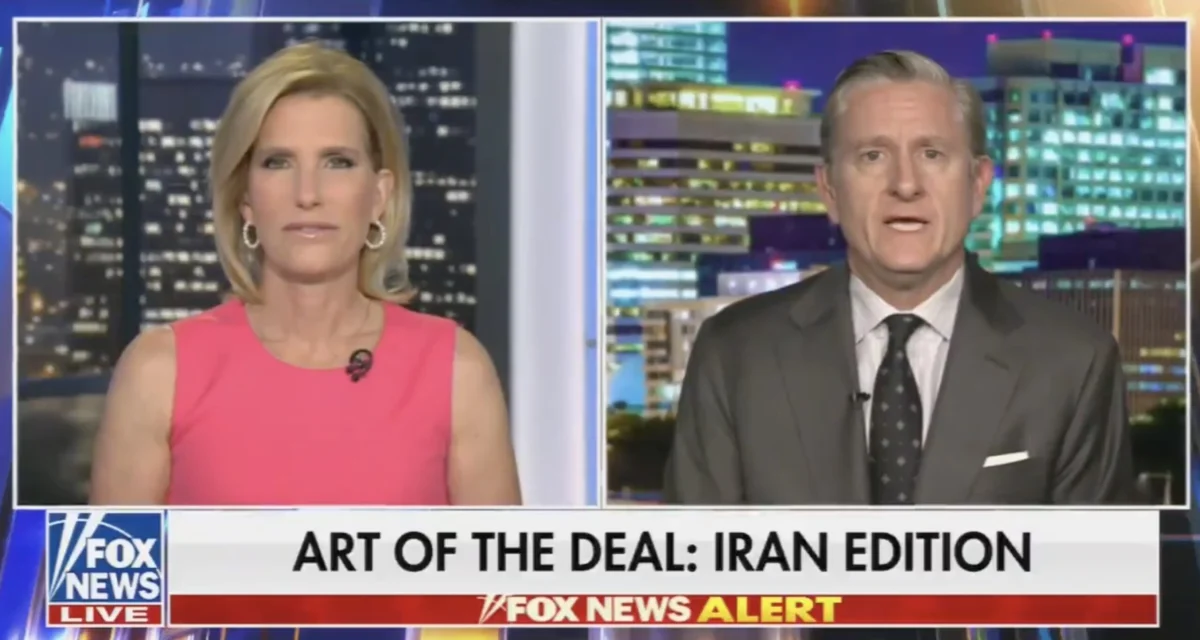
Robert Greenway, the former Deputy Assistant to the President and a primary architect of the Abraham Accords, has signaled a firm endorsement of the current strategic posture toward the Islamic Republic of Iran, urging observers to allow the administration’s tactical approach to reach its conclusion. Speaking in a recent interview with Fox News host Laura Ingraham, Greenway articulated a vision of Iranian geopolitical fragility, asserting that the combination of military pressure and diplomatic isolation has placed the regime in Tehran in an untenable position. The conversation centered on the efficacy of recent military engagements, the status of back-channel negotiations, and the internal state of the Iranian leadership.
Greenway’s remarks come at a time of heightened regional volatility, where the intersection of military kinetic action and psychological warfare has defined the relationship between Washington and Tehran. During the exchange, Greenway utilized the colloquial phrase "let the president cook," a term suggesting that Donald Trump should be afforded the necessary latitude to execute a complex strategic plan without external interference or premature skepticism from the media and political opposition. This sentiment aligns with Greenway’s long-standing advocacy for a "maximum pressure" campaign, which he helped design during his tenure on the National Security Council.
The Context of Military Escalation and Central Command Data
A significant portion of the discussion focused on the sheer scale of recent military activity in the region. Laura Ingraham cited statistics attributed to U.S. Central Command (CENTCOM), highlighting a dramatic surge in kinetic operations against Iranian-linked targets. According to the data provided, the United States has conducted more than 9,000 strikes on Iranian interests and assets since February 28. These operations have reportedly resulted in the sinking or significant damage of more than 140 Iranian naval vessels, marking one of the most sustained periods of naval degradation the Iranian military has faced in the modern era.
Greenway emphasized that these figures are not merely tactical victories but represent a fundamental shift in the regional balance of power. He noted that the United States and Israel are currently achieving an interception rate of between 92 and 94 percent regarding Iranian missile and drone inventories. This high success rate, combined with what Greenway described as a "100 percent success rate" for American offensive strikes, suggests a technological and operational gap that the Iranian regime has been unable to bridge.
The degradation of the Iranian Navy is particularly significant given Tehran’s reliance on asymmetric maritime warfare to project power in the Strait of Hormuz and the Red Sea. By neutralizing a substantial portion of these assets, the U.S. military has effectively restricted Iran’s ability to disrupt global shipping lanes, a primary lever of influence for the regime.
Strategic Leverage and the 48-Hour Ultimatum
The interview also shed light on the specific methods of leverage currently being employed by the Trump administration. Greenway praised the President’s ability to "manufacture leverage" through direct and credible threats to Iranian critical infrastructure. He referenced a specific tactical maneuver in which the administration signaled an intent to target Iran’s power supply and generation facilities unless certain conditions were met within a 48-hour window.
According to Greenway, this ultimatum was the catalyst for bringing Iranian officials to the negotiating table, despite public denials from Tehran. "Lo and behold, we are in negotiations," Greenway stated, suggesting that the threat of domestic infrastructure collapse is a pressure point that the Iranian leadership cannot ignore. The focus on power generation facilities is a calculated move; the loss of electricity would not only cripple the Iranian economy but could also spark significant domestic unrest, as the civilian population would bear the immediate brunt of the failure.
This "infrastructure-first" strategy marks a departure from traditional sanctions-based approaches. While sanctions aim for long-term economic attrition, the threat of immediate kinetic strikes on power grids creates a sense of urgency that forces rapid decision-making within the Iranian high command.
Diplomatic Friction and the Media Narrative
A point of contention during the interview was the discrepancy between official U.S. statements and the reporting from major media outlets such as ABC, NBC, and CNN. Ingraham expressed skepticism regarding the media’s willingness to report Iranian denials of negotiations at face value. The Iranian government has consistently maintained that no such talks are taking place, often characterizing U.S. claims as propaganda.
Greenway dismissed these denials as expected behavior from an adversary facing internal crisis. He argued that a significant portion of the "media enterprise" remains sympathetic to Iranian narratives or is at least prone to skepticism regarding American strategic successes. However, he maintained that the reality on the ground—characterized by military dominance and Iranian internal confusion—tells a different story.
The disagreement highlights the broader "information war" that accompanies modern geopolitical conflicts. For the Trump administration, projecting an image of Iranian weakness and American resolve is essential to maintaining domestic support and deterring further regional escalation. For Tehran, denying negotiations is a matter of regime survival and ideological purity, as admitting to talks under duress would be seen as a sign of weakness by both their domestic hardline base and their regional proxies.
The State of Iranian Leadership: Internal Chaos and Disconnection
One of the most striking claims made by Greenway during the interview was the assessment that the Iranian leadership is currently in a state of "absolute chaos." He attributed this instability to two primary factors: the "dissemination" or systematic removal of key leadership figures and a profound lack of communication between different factions of the government.
Over the past several years, the Iranian security apparatus has suffered significant blows, including the loss of top military commanders and nuclear scientists. Greenway suggested that these losses have left a vacuum that the regime has struggled to fill. Furthermore, he noted that the various branches of the Iranian state—the clerical establishment, the Islamic Revolutionary Guard Corps (IRGC), and the regular military—are increasingly disconnected from one another.
"They are arguing with themselves on how best to proceed," Greenway observed. This internal friction is a critical component of the U.S. strategy. By creating a situation where the regime’s options are limited and its leadership is divided, the administration increases the likelihood of a strategic error by Tehran or a collapse of the current governing structure.
Chronology of the Maximum Pressure Campaign
To understand the current state of affairs, it is necessary to look at the timeline of events that led to this juncture. The strategy articulated by Greenway is rooted in the "Maximum Pressure" campaign initiated during Donald Trump’s first term.
- May 2018: The United States withdraws from the Joint Comprehensive Plan of Action (JCPOA), commonly known as the Iran Nuclear Deal, citing its failure to address Iran’s ballistic missile program and regional proxy activities.
- 2019-2020: The administration designates the IRGC as a foreign terrorist organization and implements a series of "snapback" sanctions designed to cripple the Iranian oil sector.
- January 2020: The targeted killing of Qasem Soleimani, commander of the Quds Force, significantly disrupts Iran’s regional command structure.
- September 2020: The signing of the Abraham Accords, which Greenway helped architect, normalizes relations between Israel and several Arab nations (UAE, Bahrain, Morocco, Sudan), creating a regional coalition aimed at countering Iranian influence.
- 2024 (Recent Context): Following a period of renewed proxy attacks by groups such as the Houthis and Hezbollah, the U.S. military pivots back to a high-frequency strike model, as evidenced by the 9,000+ strikes cited by Ingraham.
This chronology demonstrates a consistent trajectory toward direct military and economic confrontation, with the ultimate goal of forcing a fundamental change in Iranian behavior or a change in the regime itself.
Analysis of Implications and the "Military Solution"
Greenway concluded his assessment with a bold prediction: the conflict may ultimately find its resolution through military means rather than traditional diplomacy. "In the end, I think a military solution is nearly done and will probably be the way this conflict ends," he stated.
This perspective suggests that the administration may view the diplomatic track not as an end in itself, but as a way to manage the transition toward a final military settlement. If the Iranian regime remains unwilling or unable to meet U.S. demands—including the total cessation of its nuclear program and the dismantling of its proxy network—the "military solution" Greenway references likely involves the systematic destruction of Iran’s offensive capabilities and its ability to sustain a modern state.
The implications of such an outcome are profound. A military conclusion to the Iran standoff would reshape the Middle East for decades. It would solidify the security of the Abraham Accords signatories and Israel, while potentially leaving a power vacuum in Tehran that could lead to either a democratic transition or prolonged civil strife.
Conclusion: The Path Forward
The insights provided by Robert Greenway offer a window into the strategic thinking of those who have shaped U.S. policy in the Middle East over the last several years. By framing the situation as a "masterful" execution of leverage, Greenway reinforces the narrative that the United States holds all the cards in the current standoff.
As the five-day window mentioned by Ingraham approaches its conclusion, the international community remains watchful. Whether the Iranian regime will "come to its senses" and accept the terms of the negotiations or continue on a path toward infrastructure collapse remains the central question. For Greenway and his colleagues, the answer is clear: the military and economic foundations of the Iranian regime have been sufficiently eroded, and the final outcome is now merely a matter of time. The strategy of "letting the president cook" implies a belief that the current trajectory is irreversible and that the eventual conclusion will favor American interests and regional stability.

 Yuyun Lusiyani
 Joko Widodo
 Eva Lovia
 Pevita Pearce