
 Jia Lissa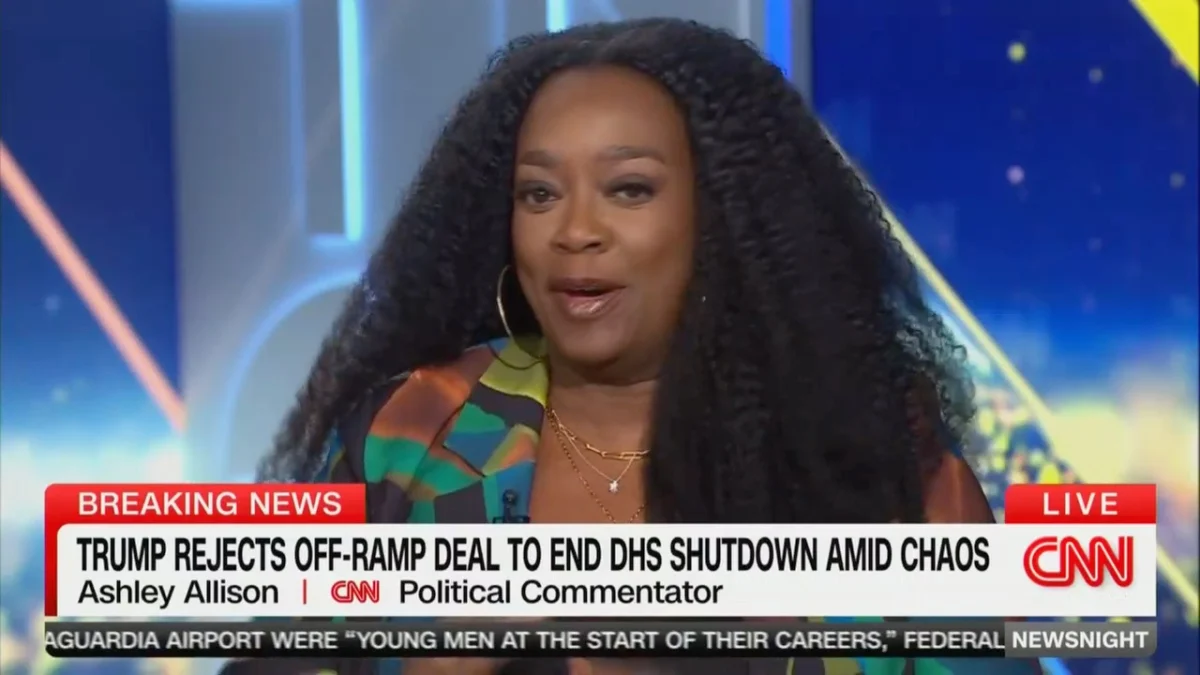
The ongoing legislative impasse over the Department of Homeland Security (DHS) funding reached a new level of public discourse during a recent episode of CNN’s NewsNight, where a debate between political commentators highlighted the deepening fissures within the Republican strategy and the potential political vulnerabilities facing the party. During the broadcast, Scott Jennings, a veteran GOP strategist and CNN commentator, found his own arguments regarding the necessity of ICE funding redirected by colleague Ashley Allison, who characterized his admission of previous funding successes as a tactical error that could provide significant political ammunition for the Democratic Party.
The exchange occurred as guest host Kasie Hunt, filling in for Abby Phillip, led a panel discussion on the federal standoff that has resulted in thousands of Transportation Security Administration (TSA) agents working without pay. As the shutdown enters a critical phase, the real-world consequences have manifested in significant airport delays, with numerous security personnel calling out of work due to the financial impossibility of maintaining their duties without a paycheck. The situation has forced the Trump administration to order Immigration and Customs Enforcement (ICE) agents to fill gaps at airport security checkpoints, a move that critics argue is an inefficient use of specialized law enforcement resources.
The Legislative Standoff and the "Big Beautiful Bill"
At the heart of the current conflict is a disagreement over the funding of Enforcement and Removal Operations (ERO), a subset of ICE. While both parties have expressed a desire to ensure that TSA agents and other essential DHS personnel receive their salaries, the Republican leadership, at the behest of President Donald Trump, has insisted on linking broader DHS funding to specific border enforcement measures.
During the NewsNight segment, Jennings suggested that a potential resolution was on the horizon, involving a phased approach to funding. He noted that he had been in contact with individuals at the White House and indicated that several Republican senators were actively negotiating with the President. Jennings proposed that the government could fund the majority of DHS—approximately 254,000 of the 260,000 employees—while leaving the 6,000 ERO positions for a later "reconciliation plan."
However, Jennings’ justification for this strategy inadvertently provided a counter-argument for his political opponents. He noted that such a phased funding plan was only feasible because President Trump had secured "plenty of money" during the previous summer in what he termed the "Big Beautiful Bill" for ICE operations. Jennings argued that this existing surplus would allow ICE to continue its primary functions even if the current funding bill excluded ERO in the short term.
Ashley Allison, a Democratic strategist, immediately seized on this point. She argued that if ICE currently possesses sufficient funds from previous legislation, the Republican insistence on making current DHS funding contingent on additional ICE money is unnecessary. "The president got so much money in the summer, so why do they actually need more?" Allison asked. She further asserted that Jennings had effectively provided a "runnable clip" for Democratic campaign advertisements, suggesting that the GOP is holding the paychecks of TSA agents and FEMA workers hostage for funding that is not immediately required for operations.
Chronology of the Funding Crisis
The current DHS funding crisis is the result of a series of collapsed negotiations and shifting legislative priorities over the last several months. To understand the current stalemate, it is necessary to examine the timeline of events that led to the partial shutdown:
- Summer 2023: The "Big Beautiful Bill" (as referenced by Jennings) is passed, providing a substantial infusion of capital into ICE and border security infrastructure. This legislation was touted by the administration as a landmark victory for border enforcement.
- Early Fall 2023: As the new fiscal year approached, House Republicans began pushing for the "Save America Act," a stringent border security bill that Democrats argued was too extreme. Funding for DHS became the primary leverage point for this legislation.
- Late Fall 2023: A series of short-term Continuing Resolutions (CRs) kept the department open, but each extension became increasingly difficult to pass as the "Freedom Caucus" within the GOP demanded deeper cuts and more aggressive border policies.
- December 2023 – January 2024: Negotiations reached a fever pitch. Senator John Kennedy (R-LA) confirmed that a deal had been proposed where Democrats would agree to fund every aspect of DHS—including the TSA and FEMA—with the sole exception of ICE’s ERO division. This would have ensured that 98% of the DHS workforce remained paid.
- The Veto of the Deal: Despite support from several Senate Republicans, President Trump reportedly killed the deal, insisting that no DHS funding be passed without the full inclusion of ICE and the Save America Act provisions.
- The Shutdown Impact: With no deal in place, the DHS entered a partial shutdown. While "essential" employees are required to work, they do not receive paychecks until a funding bill is signed.
Supporting Data: The Human and Economic Cost
The impact of the DHS shutdown is not merely political; it has tangible effects on the nation’s infrastructure and the lives of federal employees. The DHS is one of the largest federal departments, and the cessation of pay affects a wide array of services.
- TSA Workforce: There are approximately 60,000 TSA employees nationwide. The average starting salary for a TSA officer is roughly $35,000 to $45,000 per year. For many of these employees, missing even one bi-weekly paycheck results in immediate financial hardship, leading to the "sick-outs" currently being observed at major hubs like LaGuardia, O’Hare, and LAX.
- Operational Strain: According to internal DHS memos, the reassignment of ICE agents to airports to cover TSA absences is a temporary measure that detracts from ICE’s primary mission of investigating human trafficking, drug smuggling, and interior enforcement.
- Airport Delays: Data from aviation tracking services suggests that security wait times at major airports have increased by an average of 45 to 90 minutes during peak hours since the shutdown began. In some instances, investigators from the National Transportation Safety Board (NTSB) reported being stuck in security lines for hours while attempting to reach accident sites.
- FEMA and Disaster Relief: While disaster response remains active, the administrative side of FEMA is hampered, slowing the processing of grants and long-term recovery funds for communities hit by natural disasters.
Official Responses and Political Reactions
The reactions to the shutdown have fallen largely along party lines, though cracks have appeared in the Republican facade. Senator John Kennedy’s admission that a deal was on the table—and subsequently rejected by the President—has frustrated some moderate Republicans who fear the electoral consequences of a prolonged shutdown.
"It would have worked," Senator Kennedy told reporters on Monday, referring to the plan to fund everything but ICE. "We had a path to get the TSA paid and keep the airports moving. But the President wants the whole loaf, and right now, we have no bread at all."
Conversely, the White House has maintained a firm stance. Administration spokespeople argue that funding DHS without fully funding ICE is a "surrender" on border security. They maintain that the Democrats are responsible for the shutdown by refusing to acknowledge the "crisis" at the southern border and refusing to pass the Save America Act.
Democrats, meanwhile, have framed the issue as one of basic governance. Senate Majority Leader Chuck Schumer has repeatedly called for a "clean" funding bill that separates the pay of federal workers from the broader debate over immigration policy. "Holding the paychecks of hard-working Americans hostage to a political agenda is not just bad policy; it’s a failure of leadership," Schumer stated during a floor speech.
Broader Impact and Policy Implications
The debate on CNN highlights a broader tactical dilemma for the Republican Party in an election year. By admitting that ICE is currently well-funded, GOP proponents like Jennings may have inadvertently weakened the "emergency" narrative required to justify a government shutdown. If the agency responsible for deportations and border enforcement is not in immediate financial peril, the argument for keeping TSA agents unpaid becomes harder to sustain for the general public.
The potential for "runnable clips," as mentioned by Ashley Allison, points to the looming 2024 elections. Democrats are likely to use the shutdown to paint Republicans as "anti-worker" and "pro-chaos," focusing on the imagery of long airport lines and struggling federal families. Republicans, on the other hand, will continue to emphasize border security, betting that their base’s concern over immigration will outweigh the temporary inconvenience of a shutdown.
Furthermore, the reliance on "reconciliation" mentioned by Jennings is a complex legislative maneuver. Budget reconciliation allows certain spending bills to pass the Senate with a simple majority (51 votes) rather than the usual 60-vote threshold required to overcome a filibuster. However, reconciliation is subject to strict rules (the "Byrd Rule") and can typically only be used once or twice a year. Using this mechanism for DHS funding would require significant GOP unity and could be challenged by the Senate Parliamentarian.
As the week progresses, the pressure on both the White House and Congressional leadership to find a "Phase One" solution will intensify. The prospect of TSA agents missing a second pay cycle could lead to a total breakdown of airport security operations, which would have a cascading effect on the national economy, costing billions in lost productivity and travel revenue. For now, the stalemate continues, with the words of political commentators serving as a microcosm for a nation divided over the price of security and the mechanics of governance.

 Yuyun Lusiyani
 Joko Widodo
 Pevita Pearce
 admin
admin
