
 Yuyun Lusiyani
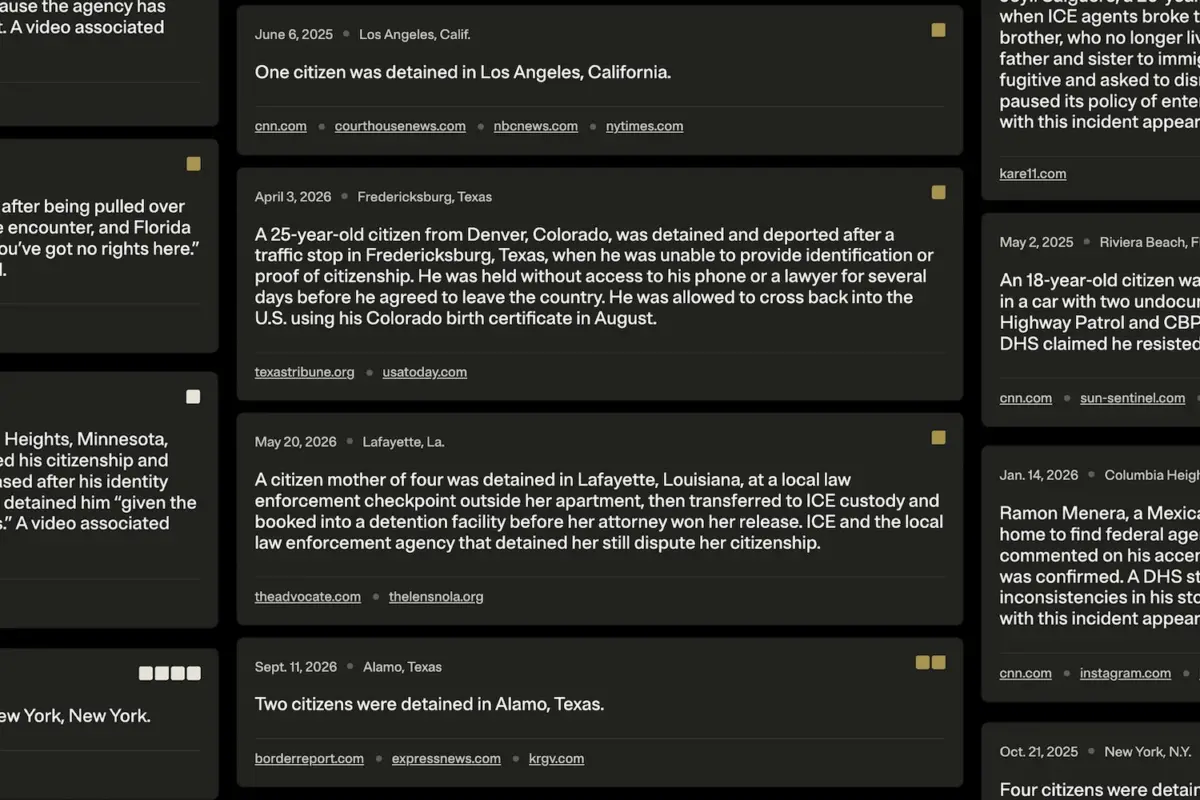
An extensive independent investigation has uncovered more than 500 instances of U.S. citizens reportedly detained by immigration agents since the inception of the Trump administration, from Inauguration Day through October 21, 2026. This comprehensive tally, compiled through meticulous research of public records and media reports, underscores long-standing warnings from legal experts and civil liberties advocates about the potential for aggressive immigration enforcement to infringe upon the rights of American citizens. Despite repeated denials from the Department of Homeland Security (DHS) regarding the arrest of U.S. citizens, the documented cases reveal a troubling pattern that independent observers contend is likely an undercount due to the government’s lack of transparent tracking.
The Scope of the Investigation: Unearthing Undocumented Detentions
The independent investigation, undertaken to bridge a critical data gap left by official channels, painstakingly compiled its list by scouring an array of public information sources. This included sifting through social media posts, analyzing court records, and reviewing reports from local news outlets across the nation. To ensure the veracity of each entry, an incident was only included if it could be corroborated by at least two independent sources. Furthermore, the investigators engaged directly with the Department of Homeland Security, inquiring about each reported incident and cross-referencing against any federal criminal charges that may have been filed in relation to the detentions. This rigorous methodology aimed to construct the most accurate possible picture of an issue that federal agencies largely deny exists.
The findings illuminate a stark contrast between official narratives and on-the-ground realities. While DHS has consistently maintained that it does not arrest U.S. citizens and that agents only detain individuals who fail to cooperate with "lawful commands" or cannot identify themselves, the compiled evidence points to scenarios where citizens were allegedly subjected to detention, injury, and even deportation, often under highly contentious circumstances. The sheer volume of over 500 documented cases, ranging from brief detentions to more prolonged and impactful experiences, suggests a systemic issue rather than isolated incidents. Given that the government itself does not proactively track such cases, the investigative team has cautioned that their compiled list, extensive as it is, almost certainly represents an undercount of the true scope of citizen detentions.
A Chronology of Warnings and Enforcement Escalation
The period covered by this investigation, from Inauguration Day 2017 through October 21, 2026, coincides with a significant shift in U.S. immigration policy and enforcement strategies. Upon taking office, the Trump administration signaled a dramatic expansion of immigration enforcement, prioritizing the apprehension and deportation of undocumented immigrants. Policies such as "zero tolerance" at the border, increased interior enforcement, and broadened authority for Immigration and Customs Enforcement (ICE) and Customs and Border Protection (CBP) agents were swiftly implemented.
Prior to these policy shifts, civil liberties organizations and legal scholars had already issued prescient warnings. They argued that aggressive immigration dragnets, designed to cast a wide net for undocumented individuals, would inevitably lead to the erosion of rights for all residents, including U.S. citizens. These warnings were rooted in the understanding that in high-pressure enforcement situations, agents might make errors in judgment regarding an individual’s citizenship status, or that the burden of proving citizenship could fall unfairly on individuals without immediate access to documentation. The current investigation suggests that these warnings have indeed materialized, with hundreds of citizens caught in the crosshairs of intensified enforcement efforts.
The investigative timeline effectively charts the trajectory of these concerns turning into documented realities. Early cases often involved individuals mistakenly targeted during raids or checkpoints. As enforcement continued, the nature of reported incidents diversified, including citizens documenting ICE activity, those at worksite raids, and even individuals detained following minor traffic incidents. This chronological progression underscores a persistent challenge in balancing national security and immigration enforcement with the fundamental constitutional rights afforded to American citizens.
Illuminating Incidents: Case Studies from the Field
The investigation provides granular detail on numerous incidents, offering a human face to the statistics. These cases highlight a range of circumstances and responses from both citizens and immigration agents:
In Long Beach, California, a citizen riding a bicycle was reportedly tasered, injured, and handcuffed after colliding with an ICE vehicle. Video footage obtained by investigators depicted the ICE vehicle driving the wrong way down a one-way street before swerving toward the cyclist. DHS, however, denied hitting the citizen, instead accusing him of smashing the vehicle’s mirror—an action not captured in the available video evidence. This incident exemplifies the conflicting accounts that often emerge in such encounters.
A particularly disturbing case from Evanston, Illinois, involved a citizen who was injured and detained by ICE agents. The agents were reportedly looking for someone who matched his description. A responding Evanston police officer noted that one agent had blood on his hands, and the citizen ultimately required hospitalization. DHS’s official statement claimed the man did not cooperate with "lawful commands," leading to his detention until he identified himself. This raises questions about the use of force and the standard of proof required for detention.
In Annapolis, Maryland, a citizen leaving a coffee shop was handcuffed, denied a phone call, and held for almost two hours. DHS defended its actions by stating it took the citizen to another location for an interview because "agitators" had gathered, implying a need to remove him from a potentially disruptive environment.
The investigation also documented instances where citizens engaged in protected activities were targeted. In Ventura, California, a citizen documenting ICE activity was reportedly tackled and tasered while already pinned to the ground, raising concerns about freedom of the press and the right to observe public officials. Similarly, in New Orleans, Louisiana, a citizen immigration lawyer was detained and shackled while attempting to film her clients’ detention, illustrating potential infringements on legal advocacy and oversight.
Perhaps one of the most poignant cases involved a citizen mother of four detained in Lafayette, Louisiana, at a local law enforcement checkpoint outside her apartment. She was subsequently transferred to ICE custody and booked into a detention facility before her attorney secured her release. The incident was further complicated by ongoing disputes between ICE and the local law enforcement agency regarding her citizenship status, highlighting the bureaucratic complexities and vulnerabilities citizens face.
A harrowing account from the Bronx, New York, detailed how 19-year-old Jeury Concepcion, a citizen, was tackled by three masked agents while walking in front of a barbershop. He was mistaken for someone else and, according to Concepcion, released far from home with a bloodied head. An agent reportedly apologized. DHS, in its statement, acknowledged temporarily detaining the teen to "safely finish their questioning," again offering a narrative that differs significantly from the citizen’s experience.
Another critical incident occurred in Fredericksburg, Texas, where a 25-year-old citizen from Denver, Colorado, was detained and subsequently deported after a traffic stop. He was unable to provide immediate identification or proof of citizenship and was held without access to his phone or a lawyer for several days before agreeing to leave the country. He was eventually allowed to re-enter the U.S. using his Colorado birth certificate, but not before experiencing a profound violation of his rights and the trauma of wrongful deportation. This case underscores the crucial importance of carrying proof of citizenship and the severe consequences of its absence during encounters with immigration agents.
These individual stories, while diverse in their specifics, collectively paint a picture of enforcement practices that can be aggressive, prone to error, and, at times, seemingly disregardful of the constitutional protections afforded to U.S. citizens.
Official Responses and Lingering Discrepancies
Throughout the investigation, the Department of Homeland Security has maintained a consistent stance: its agents do not arrest U.S. citizens. When confronted with specific allegations, DHS has typically offered explanations that attribute the detentions to citizens’ non-compliance with "lawful commands," their inability to immediately verify identity or citizenship, or situations where individuals were temporarily held to ensure operational safety or complete questioning.
For instance, in response to the Long Beach cyclist incident, DHS denied vehicle contact and instead alleged the citizen damaged property. Regarding the Evanston case, the department cited a lack of cooperation. In the Bronx incident involving Jeury Concepcion, the agency described it as a temporary detention for questioning. These official responses often diverge sharply from the accounts provided by the individuals detained, witnesses, and in some cases, video evidence.
The consistent denial by DHS and its constituent agencies like ICE and CBP presents a significant challenge for accountability. Without official tracking mechanisms for such incidents, and with agencies frequently providing alternative explanations that minimize or deny wrongdoing, it becomes exceedingly difficult to conduct independent oversight or implement corrective measures. This lack of transparency fuels public distrust and raises serious questions about the internal protocols and training governing interactions between immigration agents and the public, especially those suspected of being non-citizens. The discrepancies between reported facts and official statements highlight a systemic problem in the absence of robust, independent review.
Broader Impact and Implications for Civil Liberties
The findings of this investigation carry profound implications for civil liberties and the rule of law in the United States. The detention of U.S. citizens by immigration agents, even if temporary, represents a direct challenge to the Fourth Amendment’s protection against unreasonable searches and seizures and the Fifth Amendment’s guarantee of due process. Citizens are not required to carry identification at all times, nor are they obligated to answer questions from law enforcement without counsel, yet these incidents suggest a practical erosion of these rights when confronted by immigration agents.
One significant implication is the chilling effect these detentions have on communities, particularly those with large immigrant populations or where racial profiling is a concern. When citizens, especially those who are Latinx or appear foreign-born, face the risk of detention, it fosters fear and distrust towards all law enforcement agencies. This fear can discourage individuals from cooperating with police on unrelated criminal matters, reporting crimes, or engaging in civic activities, thereby undermining public safety and community cohesion.
Furthermore, the investigation highlights the vulnerability of individuals who may not immediately possess physical proof of citizenship, such as a birth certificate or passport. While a U.S. citizen does not lose their citizenship by failing to carry such documents, the practical reality on the ground can be that without immediate proof, an individual may be subjected to detention until their status can be verified, a process that can take hours or even days and involve significant emotional and financial strain. The case of the citizen wrongly deported from Fredericksburg, Texas, serves as a stark warning of the ultimate consequence of such vulnerabilities.
The documented injuries, alleged excessive force, and denials of basic rights such as phone calls or access to legal counsel underscore a broader concern about the training and oversight of immigration agents. While agents operate under difficult conditions, their authority must be exercised within the bounds of the Constitution. The repeated incidents suggest a pattern where these boundaries are frequently tested, if not crossed.
This investigation also underscores the critical role of independent journalism and civil liberties organizations in holding government agencies accountable. In the absence of official tracking or transparent reporting by DHS, it falls to external bodies to document and expose potential abuses of power. The rigorous methodology employed, requiring multiple sources for each incident, lends credibility to the findings and makes a compelling case for systemic reform.
The ongoing nature of these detentions, extending through the reported period, signals that this is not merely a historical anomaly but a persistent challenge. It necessitates a renewed national conversation about the scope of immigration enforcement, the protections afforded to all individuals within U.S. borders, and the fundamental principles of due process and civil liberties that define American democracy. The collective weight of over 500 cases demands more than denials; it calls for introspection, accountability, and substantive policy changes to ensure that no U.S. citizen is wrongly detained by agents of their own government.




 Nila Kartika Wati

 Eva Lovia

 Lina Irawan

 Ana Megawati

 Joko Widodo
