
 Yuyun Lusiyani
Four years after North Texas home builder Scott Sherman completed a federal prison sentence for mortgage fraud, his burgeoning construction materials business, Wildcatter Sand Services, received a substantial $600,000 cash infusion. This significant financial boost originated from a supposedly "blind trust" established to prevent Texas Attorney General Ken Paxton and his wife, state Sen. Angela Paxton, from any perceived or actual overlap between their personal investments and their official duties as elected officials. However, previously unreleased records from the Attorney General’s 2023 impeachment investigation reveal that the trust was far from blind, failing to shield the Paxtons from its business dealings, including this controversial investment in Sherman’s enterprise.
The Genesis of a Questionable Investment
The narrative begins with Scott Sherman, a figure who, by 2014, had already pleaded guilty to his involvement in a mortgage fraud conspiracy. This scheme, which spanned numerous properties across the Dallas-Fort Worth area, saw Sherman’s firm, Artisan Operating LP, artificially inflate home prices to secure larger loans for over two dozen residential units. Following his federal prison sentence, Sherman resurfaced in the construction materials sector, building Wildcatter Sand Services and Grayson County Sand and Gravel with his father. It was into this venture that the Paxtons’ trust, overseen by their friend Chip Loper, injected a critical $600,000. The primary purpose of a blind trust, as understood in public ethics, is to prevent public officials from having knowledge of or control over specific assets, thereby avoiding conflicts of interest. The revelations from the impeachment probe, however, paint a picture of a trust that allegedly deviated significantly from these foundational principles.
A Trust Lacking Transparency: Evidence of Non-Blindness
The integrity of the Paxtons’ blind trust has come under intense scrutiny, with multiple pieces of evidence suggesting direct knowledge and involvement by the couple. First, Ken Paxton himself was found to have discussed certain investments with trustee Chip Loper via text messages, directly contravening the trust’s stated terms that Loper would manage assets "without consulting with them or taking any instructions regarding investment matters." Further undermining the trust’s purported blindness, mortgage and deed records show that Ken Paxton purchased eight properties between 2015 and 2026, which he subsequently transferred into the trust. This active management and knowledge of specific assets fundamentally challenge the definition of a blind trust.
Perhaps the most damning evidence comes from the Paxtons’ own federal joint income tax return for 2020, where they claimed more than $93,000 in itemized losses from Wildcatter Sand Services and Grayson County Sand and Gravel. Kathleen Clark, a law professor specializing in legal and government ethics at Washington University in St. Louis, unequivocally stated, "That is proof positive that there’s nothing blind about this trust. If Ken Paxton can report on his tax return a transaction, then he is not blind to the transaction." This direct financial reporting demonstrates an intimate knowledge of the trust’s specific investments and their performance, making the "blind" designation largely semantic. Donald Kettl, an ethics expert and former dean of the University of Maryland’s School of Public Policy, further noted that such conduct would violate U.S. Senate rules regarding blind trusts, which Paxton would be bound by should he succeed in his current U.S. Senate bid. The question, Kettl emphasized, is whether a candidate for such a high office has already adhered to the ethics rules that would be mandated upon election.

Wildcatter’s Expansion, Environmental Woes, and Tax Delinquencies
Following the significant investment from the Paxtons’ trust, Scott Sherman’s Wildcatter companies embarked on an aggressive expansion. This included the acquisition of a sand mine in Denison, North Texas, and a concrete plant in Gunter, both located in Grayson County near the Oklahoma border. While the businesses grew into a vast enterprise with multiple locations and subsidiaries, their operational practices began to draw significant local ire and raise concerns about regulatory compliance.
Residents in Gunter, a community of approximately 2,000, reported persistent issues with dust clouds emanating from Wildcatter and other companies at the site, which they claimed coated their properties for up to 12 hours daily. These complaints led the Texas Commission on Environmental Quality (TCEQ) to issue violation notices to Wildcatter Redi-Mix, the company operating the Gunter plant, in 2021 and 2022. While one dust-related violation was reportedly resolved by paving a road in 2022, local concerns persisted.
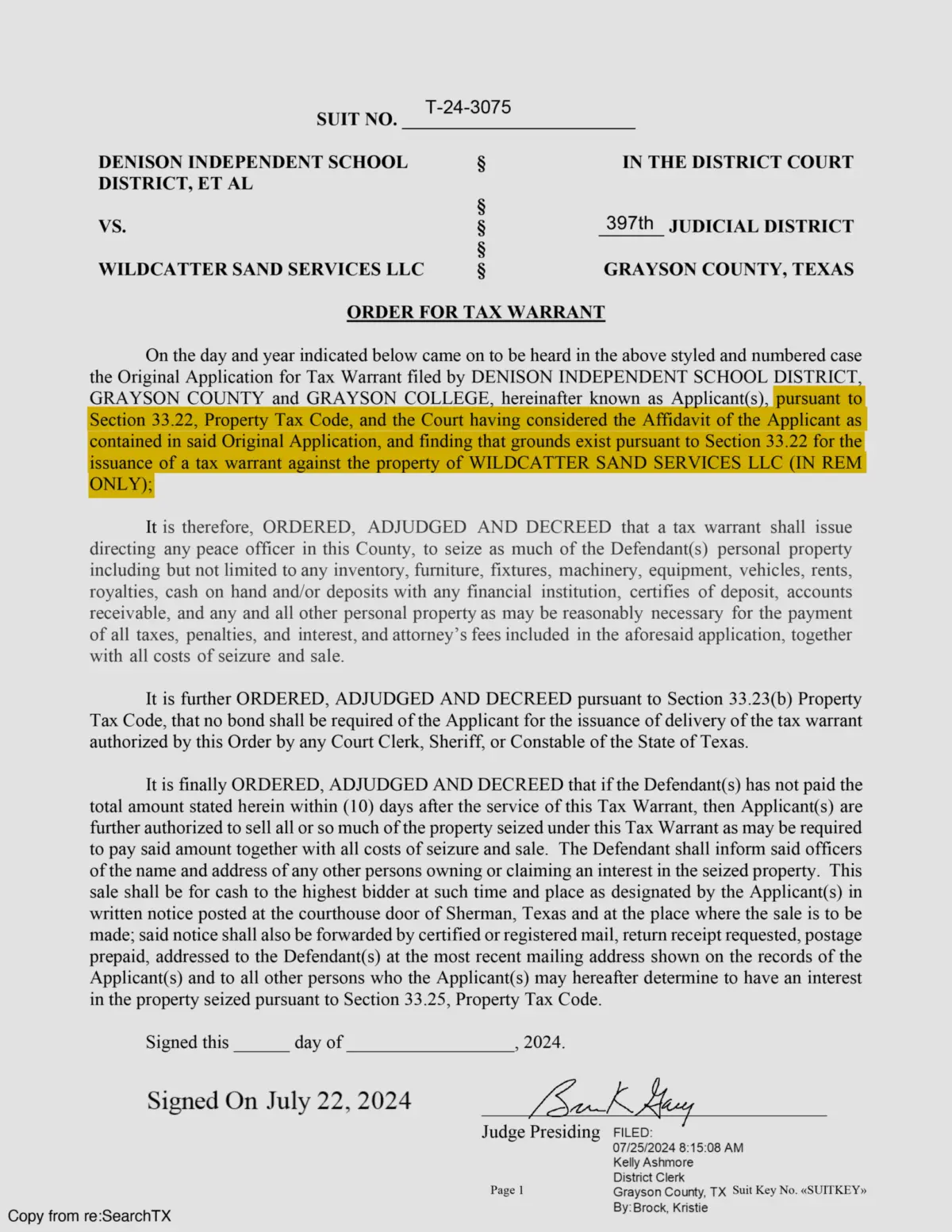
Compounding these environmental issues, some Wildcatter companies began to accrue substantial tax debts to local governments, including school districts. Public records from Grayson County indicate that Wildcatter Sand Services alone owed over $31,000 in back taxes by the time the controversial payments to the Paxtons’ trust occurred. By 2023, several Wildcatter entities had accumulated hundreds of thousands of dollars in delinquent local taxes, leading local governments to pursue legal action to recover these outstanding amounts. The financial challenges faced by these companies, juxtaposed with the significant wire transfers to the Paxtons’ trust, underscore the ethical questions surrounding the entire arrangement.
Angela Paxton’s Advisory Role and a Pivotal Legislative Vote
The ethical complexities deepened with the involvement of state Sen. Angela Paxton. In 2022, she joined the advisory board of Wildcatter Materials, the parent company of Wildcatter Redi-Mix, the very entity that had faced environmental violation notices. While her personal financial disclosures described this role as "non-governing" and the IRS defines advisory boards as lacking legal and financial authority, her association with the company became critically relevant when legislation impacting such businesses came before the Texas Senate.
Neighbors, including respiratory therapist Deirdre Diamond, a lead advocate for a local group fighting pollution from concrete batch plants, continued to voice their concerns. These complaints, despite the TCEQ’s previous notices, were controversially characterized as "abusive" by then-state Sen. Drew Springer. Springer subsequently filed Senate Bill 471, a measure he claimed would prevent the "weaponization of the system" by allowing the TCEQ to disregard residents’ complaints after more than five "unsubstantiated" filings within seven years. Opponents argued the bill’s language was dangerously vague, potentially silencing legitimate grievances by failing to define "unsubstantiated" and ignoring the reality of repeated complaints due to regulatory inaction.

When SB 471 reached the Senate floor, Angela Paxton cast a vote in favor of its passage. Her spokesperson, Matt Welch, defended her vote by citing the bill’s bipartisan support and arguing it was necessary to prevent "frivolous complaints" from "wasting taxpayer dollars" and diverting resources. Welch also stated that Angela Paxton did not recuse herself because the bill did not target a specific company, and she was reportedly unaware of any complaints or violations against Wildcatter. However, ethics experts, including San Antonio lawyer Andrew Cates, contend that she should have disclosed her relationship with the company and recused herself, arguing that state laws barring lawmakers from voting on bills that benefit them or their businesses, even if applied broadly to an industry, should have prompted recusal in this instance. The fact that the lawmaker creating the "guardrails" for herself benefited from the outcome represents a significant ethical dilemma, especially for residents like Deirdre Diamond, who felt their voices were actively suppressed by legislative action benefiting the very companies causing their distress. Diamond, demoralized, eventually moved away, fearing the health impacts on her children and believing regulators favored the companies.
Financial Transfers During Ken Paxton’s Impeachment Crisis
The financial connection between Wildcatter and the Paxtons intensified during a tumultuous period for Ken Paxton. In the months leading up to and during his 2023 impeachment on charges of corruption and bribery, Wildcatter companies wired tens of thousands of dollars to the Paxtons’ blind trust. Bank statements reviewed by ProPublica and The Texas Tribune, part of the previously unreported impeachment documents, reveal more than $73,000 transferred in the months before the environmental bill passed the Legislature. Specifically, about $10,000 arrived in the two weeks preceding Angela Paxton’s vote on the environmental bill, with an additional $12,000 wired the week after its Senate passage. In total, Wildcatter companies made 15 payments between January and June 2023, amounting to over $83,000 to the trust.
These payments occurred as Ken Paxton faced intense legal and political pressure. Early 2023 saw the U.S. Justice Department’s public integrity unit take over an investigation into allegations by his senior advisers that he abused his office – an investigation that was later dropped in 2025. Concurrently, Paxton was navigating a tentative $3.3 million settlement with these whistleblowers, who accused him of firing them for reporting his alleged use of office to benefit an Austin real estate investor and donor. The proposed settlement required legislative approval, sparking outrage among lawmakers questioning the use of taxpayer funds. A judge later awarded the whistleblowers $6.6 million in 2025, a ruling Paxton dismissed as a "bogus judgment."
Amidst this crisis, on May 19, a week before Ken Paxton’s formal impeachment, the blind trust wired $9,000 to the firm of attorney Mitch Little, who subsequently represented both the trust and Paxton during his impeachment trial. Records indicate that the trust’s checking account would not have held sufficient funds for this payment without the earlier deposits from Wildcatter companies that month. While the trust also held an investment account with cash and securities, no distributions from it to the checking account were recorded during that period. Craig Holman, an ethics lobbyist for Public Citizen, highlighted the severe ethical implications if these funds served as a "passthrough" for Paxton’s legal fees, further blurring the lines of the blind trust and potentially leveraging funds from a business facing tax delinquencies for his personal defense.
Neither trustee Chip Loper nor Mitch Little responded to inquiries about this transaction. Angela Paxton’s spokesperson stated she had no knowledge of payments for impeachment lawyers. The full extent of these payments beyond June 2023 remains unknown, as the impeachment investigators’ records concluded at that point. The subsequent year saw two Wildcatter companies become delinquent on nearly $200,000 in 2023 property taxes to local schools, cities, and counties, forcing these governmental entities to pursue legal action to recoup their owed revenues.
Erosion of Public Trust and Broader Implications

The cumulative revelations surrounding the Paxtons’ blind trust, their investment in a business owned by a convicted felon, and the timing of financial transfers amidst legal and political turmoil, raise profound questions about public ethics and the integrity of elected officials. Ken Paxton has consistently championed an anti-fraud stance, declaring, "In Texas, we fight fraud head-on and will not rest until every last corrupt actor is brought to justice," and boasting of making "big pharma and fraudsters pay billions." Yet, doing business with a recently convicted felon, particularly through a trust that appears anything but blind, fundamentally undermines this public narrative and erodes public trust in his role as the state’s chief anti-fraud watchdog.
Richard Painter, former chief ethics lawyer for President George W. Bush, expressed dismay, stating he would have expected "the attorney general of Texas would have the good sense not to be dealing with a convicted felon." Painter also pointed to the pattern of such businesses potentially "pay[ing] out their friends while they’re not paying their taxes, run up debt," questioning why the attorney general would associate with "those kinds of people."
This incident is not isolated. Just weeks prior, The Wall Street Journal reported that Ken Paxton celebrated New Year’s Eve 2024 in Dubai with two Americans who had been indicted on federal healthcare-fraud charges months earlier. While Paxton’s spokesperson attributed his challenges to political persecution, these repeated associations with individuals facing federal charges, or those with past convictions, conflict sharply with his public image and official duties.
The implications extend beyond personal ethics to the very mechanisms designed to safeguard public trust. The apparent failure of the blind trust to function as intended highlights potential loopholes or insufficient enforcement of ethics regulations for high-ranking officials. For Ken Paxton, who is now engaged in an expensive and tight race for a U.S. Senate seat against Democrat James Talarico, these revelations add another layer of scrutiny to his long public career. Voters will undoubtedly weigh these ethical questions, the alleged lack of transparency, and the potential conflicts of interest as they consider his fitness for higher office. The ongoing saga serves as a stark reminder of the continuous need for rigorous ethical oversight and unwavering transparency from public servants to maintain the integrity of democratic institutions.




 Nila Kartika Wati

 Eva Lovia

 Lina Irawan

 Ana Megawati

 Joko Widodo
