Pevita Pearce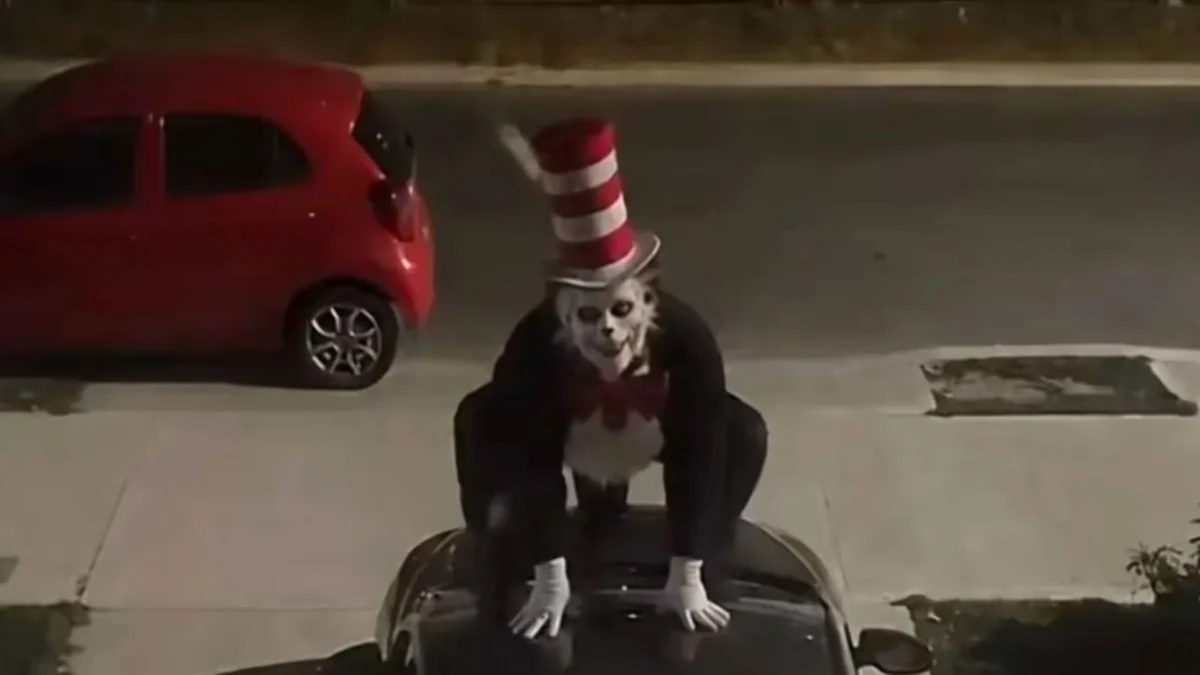
The rapid evolution of generative artificial intelligence has transitioned from a tool of creative convenience to a significant challenge for public safety and law enforcement, as evidenced by a recent viral hoax that paralyzed communities across the United Kingdom and Ireland. Over the past several weeks, a series of hyper-realistic, AI-generated images and videos depicting a towering, sinister version of Dr. Seuss’s "The Cat in the Hat" have circulated on social media platforms, most notably TikTok. These visuals, often framed as grainy "Ring" doorbell camera footage or shaky handheld smartphone recordings, show a seven-foot-tall, elongated figure in the iconic red-and-white hat lurking in residential driveways and staring into bedroom windows. What began as a niche digital art project quickly spiraled into a cross-border panic, forcing multiple national police forces to issue public clarifications to prevent a surge in unnecessary emergency calls and neighborhood hysteria.
The phenomenon underscores a growing vulnerability in the digital age: the inability of the average consumer to distinguish between authentic security footage and sophisticated AI hallucinations. As the "Cat in the Hat" sightings were reported in major urban centers including Sheffield, Glasgow, Dublin, and Limerick, the localized nature of the rumors created a feedback loop of fear. Residents in these areas, conditioned by years of viral "true crime" and neighborhood watch alerts, reacted with genuine alarm, leading to a coordinated response from the Garda Síochána in Ireland and various constabularies across the UK.
The Anatomy of a Digital Hallucination
The hoax relied heavily on the "uncanny valley" effect—a psychological phenomenon where a humanoid figure looks nearly human but is "off" enough to cause a sense of revulsion or fear. The AI-generated Cat in the Hat was not the whimsical character of children’s literature; instead, it was rendered with exaggerated proportions, a frozen, toothy grin, and hollow eyes that reflected the infrared glow of night-vision cameras. By utilizing the specific aesthetic of home security systems—low frame rates, high contrast, and wide-angle distortion—the creators of the content bypassed the usual skepticism applied to high-definition CGI.
The content first gained traction on TikTok under various hashtags such as #TheCatIsWatching and #NightmareFuel. The platform’s algorithm, which prioritizes high-engagement, high-shock-value content, pushed these videos into the "For You" feeds of users specifically in the UK and Ireland. Because the videos were often geotagged to specific neighborhoods, local residents shared them in private WhatsApp groups and on Facebook community pages, where the distinction between "AI art" and "actual security alert" was quickly lost.
Chronology of the Panic
The timeline of the hoax suggests a calculated rollout that maximized public anxiety. In the initial phase, which occurred in early October, the images were presented as "creepypasta" or digital horror stories. However, by the second week, the narrative shifted. Users began posting "reaction" videos, claiming they had heard scratching at their doors or seen the figure in their own gardens.
By the third week, the hoax had migrated from the digital realm to the physical. In Sheffield, local community forums reported "coordinated sightings" of the character, with some residents claiming a group of pranksters was using the AI images as a blueprint for a real-world "killer clown" style movement. This prompted the first wave of 999 calls to the South Yorkshire Police.
The panic reached its zenith when the imagery began appearing in Irish social media circles. Reports of the "Wexford Cat" and the "Dublin Prowler" led to a significant increase in anxiety among parents and elderly residents. It was at this point that law enforcement determined that a public intervention was necessary to mitigate the strain on emergency services.
Law Enforcement Interventions and Official Statements
Police forces across the British Isles were forced to dedicate man-hours to debunking a fictional character. A spokesperson for Wexford Garda addressed the situation with a mixture of exasperation and firm reassurance. "In an unusual turn of events, we are hearing a lot about an elusive Dr. Seuss character doing the rounds online, apparently causing havoc in neighborhoods and towns across the country," the statement read. "Fortunately, we can rule out the issue, which is essentially an AI prompt that places the character into images and videos of familiar places. To be clear, the Cat in the Hat was not in your driveway while you were out."
Similarly, Glasgow Police issued a directive urging citizens to verify the source of "security footage" before contacting emergency lines. Authorities in Dublin and Limerick corroborated these findings, noting that no physical evidence of a costumed individual had been found in any of the reported locations. The Gardaí emphasized that while the images looked "disturbingly real," they lacked the metadata and physical consistency of actual digital video recordings.
The necessity of these statements highlights a new era of policing where "digital crowd control" is as essential as physical patrolling. For law enforcement, the primary concern was not the fictional cat itself, but the potential for real-world accidents—such as homeowners reacting violently to perceived intruders or the clogging of emergency lines that could delay responses to genuine life-threatening situations.
Historical Context: From Killer Clowns to AI Homelessness
The "Cat in the Hat" hoax is frequently compared to the 2016 "killer clown" craze. During that period, individuals across the US, UK, and Australia dressed as menacing clowns to frighten passersby, often filming the encounters for social media. However, a critical difference exists: the 2016 craze involved physical actors and real-world encounters. The current AI hoax is entirely ethereal, yet it produced a similar level of societal friction.
This is not the first time AI has triggered public safety concerns. In 2023, a viral "AI homeless man" prank led to a wave of unnecessary 999 calls in the UK. In one documented instance, a parent called the police in a state of terror, convinced by a deepfake video that a stranger was inside their home while their child was alone. These incidents demonstrate that the human brain is not yet fully equipped to process hyper-realistic synthetic media in high-stress contexts.
Furthermore, the "Cat in the Hat" incident follows a trend of "wholesome" or "benign" AI deception. In early 2026, one of TikTok’s most popular cat accounts, which featured a "talking" feline with millions of followers, was revealed to be entirely AI-generated. While that instance was harmless, it served as a proof-of-concept for how easily large audiences can be misled by synthetic entities.
Supporting Data and the Rise of Synthetic Misinformation
Data from cybersecurity firms indicates a sharp rise in the creation of "localized deepfakes"—synthetic media designed to target specific geographic regions. According to a 2025 report on digital threats, engagement with AI-generated misinformation at the local level is 40% higher than with global misinformation, primarily because the familiarity of the setting (e.g., a standard UK driveway) lowers the viewer’s critical guard.
TikTok’s role in this ecosystem is significant. Internal data from social media monitoring tools suggests that the "Cat in the Hat" videos reached over 15 million views within a 72-hour window across the UK and Ireland. Of those views, a significant portion of the comments sections showed users asking for specific addresses or expressing genuine fear, rather than recognizing the content as a digital fabrication.
Implications for Public Safety and Digital Literacy
The "Cat in the Hat" hoax serves as a stark reminder of the urgent need for enhanced digital literacy. As AI video generators like Sora, Kling, and Runway become more accessible, the barrier to creating convincing "evidence" of paranormal or criminal activity has vanished.
The implications for the justice system are profound. If the public can no longer trust "Ring" camera footage—long considered a gold standard for neighborhood security and evidence—the social contract regarding community safety may begin to erode. There is also the "Boy Who Cried Wolf" risk: as the public becomes aware that many viral "threats" are AI hoaxes, they may become desensitized to real warnings or actual footage of criminal activity.
Experts in forensic digital analysis suggest that the public should look for specific "AI artifacts" in suspicious videos. These include:
- Inconsistent Lighting: Shadow directions that do not match the primary light source.
- Morphing Extremities: Fingers or limbs that appear to merge with the environment or change shape during movement.
- Looping Backgrounds: Environmental elements like trees or rain that repeat in a mechanical fashion.
- Lack of Metadata: Authentic security footage contains timestamps and camera-specific data that AI exports usually lack.
Conclusion
The "Cat in the Hat" hoax of 2026 will likely be studied by sociologists and digital forensic experts as a landmark case in the weaponization of generative AI for social disruption. While no physical injuries were reported as a direct result of the "sightings," the incident exposed the fragility of public perception in an era of synthetic reality. As police forces in the UK and Ireland return to their standard duties, the digital specter of the Cat remains a cautionary tale about the power of a prompt to turn a childhood icon into a catalyst for national panic. The challenge moving forward lies not just in policing the streets, but in policing the increasingly blurred line between the real and the rendered.




 Jia Lissa
 Yuyun Lusiyani
 Joko Widodo
 Eva Lovia