
 Amara Maple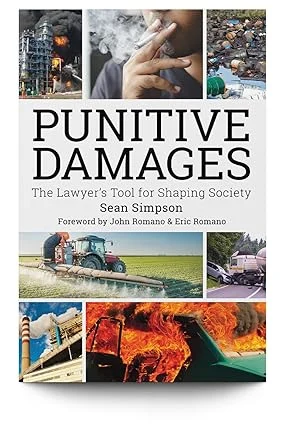
The alarming decline in corporate criminal prosecutions has ignited a critical debate among legal experts and public watchdogs: how can society effectively deter corporate wrongdoing when traditional enforcement mechanisms appear to be weakening? This pressing question is at the heart of a new discourse, championed by San Diego-based trial lawyer Sean Simpson, who argues that punitive damages in civil cases represent one of the last viable tools for shaping corporate behavior. His recently published book, Punitive Damages: The Lawyer’s Tool for Shaping Society, posits that a robust pursuit of punitive damages is essential to combat corporate greed and recklessness, especially in an era where systemic criminal accountability seems increasingly elusive.
Simpson’s central thesis is straightforward yet provocative: "Because the criminal justice system prosecutes relatively few white-collar crimes, and the fines levied by civil agencies such as the Food and Drug Administration (FDA), the Insurance Commissioner, the Equal Employment Opportunity Commission (EEOC), and so on are relatively rare and modest, punitive damages in our civil cases are some of the only remaining forces we have to combat corporate greed and recklessness." This statement underscores a perceived void in corporate accountability, where neither governmental criminal enforcement nor administrative civil penalties sufficiently deter illicit activities.
The Retreat from Corporate Criminal Enforcement
For decades, the specter of criminal prosecution served as a formidable deterrent against corporate malfeasance. However, data from various sources, including the Department of Justice (DOJ), indicate a noticeable trend of fewer criminal charges brought against corporations. While precise statistics can fluctuate year-to-year and depend on categorization, reports from legal think tanks and academic studies consistently point to a decline in significant corporate criminal enforcement actions since the early 2010s, following a peak in the aftermath of the Enron and WorldCom scandals.
This shift is often attributed to several factors. Prosecutors face immense challenges in pursuing complex corporate cases, which demand extensive resources, specialized expertise, and lengthy investigations. The sheer power and financial might of large corporations allow them to mount robust defenses, often overwhelming government agencies with limited budgets and staff. Furthermore, there has been a growing reliance on alternative resolution mechanisms such as Deferred Prosecution Agreements (DPAs) and Non-Prosecution Agreements (NPAs). While these agreements often involve substantial financial penalties and commitments to compliance reforms, critics argue they frequently allow corporations to avoid the stigma and broader consequences of criminal convictions, thus blunting the deterrent effect.
Simpson, echoing a sentiment widely shared among consumer advocates and some legal scholars, asserts that prosecutors often "don’t want to take on the monsters." He suggests that this reluctance stems from a combination of factors: the monumental workload involved, the potential for political backlash, and an inherent societal and judicial desire to protect large corporations, perhaps due to their economic significance or even personal financial interests. He highlights the stark reality that "the last time a major American corporation was criminally prosecuted for homicide in a products case was the Ford Pinto prosecution more than forty years ago now," illustrating the rarity of severe criminal accountability for corporate actions resulting in death or grave injury.
Punitive Damages: A Historical and Legal Perspective
Punitive damages, unlike compensatory damages which aim to reimburse victims for actual losses, are designed to punish egregious conduct and deter similar actions in the future. Their roots trace back to common law, where courts recognized the need to penalize defendants whose actions were particularly malicious, willful, or reckless. For centuries, these awards served as a powerful tool for social control, sending a clear message that certain behaviors would not be tolerated.
However, the legal landscape for punitive damages has evolved dramatically, particularly in recent decades. A significant turning point came with landmark U.S. Supreme Court decisions that sought to rein in potentially "excessive" awards, citing due process concerns. Key among these was BMW of North America, Inc. v. Gore (1996), which established three "guideposts" for assessing the constitutionality of punitive awards: the reprehensibility of the defendant’s conduct, the disparity between the harm suffered and the punitive award, and the difference between the punitive award and civil penalties authorized or imposed in comparable cases.
The most impactful decision, and one frequently cited by Simpson, is State Farm Mutual Automobile Insurance Co. v. Campbell (2003). In this case, the Supreme Court scrutinously examined a punitive damages award that was 145 times the compensatory damages. While the Court refrained from establishing a bright-line rule, it suggested that "few awards exceeding a single-digit ratio between punitive and compensatory damages… will satisfy due process." It further stated that a ratio of more than 4:1 might "approach the line of constitutional impropriety" and that "an award of more than four to one might be close to the outer limit." However, the Court also acknowledged that a higher ratio could be justified when "a particularly egregious act has resulted in only a small amount of economic damages."
Simpson laments that this critical ruling has been widely "misinterpreted" by lower courts. He argues that the Supreme Court’s suggestion of a single-digit ratio, particularly the mention of 10:1 as a point for scrutiny, has been erroneously adopted as an "absolute max" rather than a flexible guidepost. This misinterpretation, he contends, has severely curtailed the potential for meaningful punitive awards.
Hurdles and Judicial Skepticism
Simpson acknowledges the substantial challenges faced by trial lawyers seeking punitive damages. These include a "heightened burden of proof" required in most states, often demanding "clear and convincing evidence" rather than the lower "preponderance of evidence" standard typical in civil cases. Furthermore, "challenges in collectability" and the common "lack of insurance coverage for punitive damages" (in most, though not all, policies) present practical obstacles.
Beyond these technical hurdles, a pervasive "judicial skepticism" towards punitive damages often manifests in the courtroom. Simpson notes that judges "tend to inherently be negative about punitive damage cases." He attributes this reluctance to several factors:
- Alignment with Insurance: Punitive damages are typically not covered by liability insurance, making settlements more difficult and increasing financial risk for defendants, which judges, in their role as "referees," may wish to avoid.
- Desire for Predictability: Judges often prefer orderly proceedings and predictable outcomes, and punitive damage claims, with their potential for large, emotionally driven jury awards, introduce an element of unpredictability and "fireworks" that many judges wish to circumvent.
- Quasi-Criminal Nature: Punitive damages, by their very nature, serve a penal function, blurring the lines between civil and criminal law. Some judges may believe that punishment is solely the realm of the criminal justice system.
- Outdated Views: Simpson suggests some judges are simply "not up to date with the current state of law," failing to recognize the existing restrictions and the difficulty of sustaining large punitive awards.
Simpson’s personal experience starkly illustrates this judicial tendency. He recounts a case where a jury awarded $180 million in punitive damages in a pregnancy discrimination case, only for the judge to reduce it to $6 million, citing State Farm v. Campbell. The original case involved egregious conduct, including a supervisor threatening to "punch you in the belly and get that damn thing out of you so you can get back to work." Such reductions, Simpson argues, effectively remove "the sting" of the award, undermining its deterrent purpose.
Legislative Caps and Corporate Influence
Adding another layer of complexity are state-level legislative caps on punitive damages. Many states have enacted statutes limiting the amount of punitive damages that can be awarded, either as a multiple of compensatory damages (e.g., Florida’s three times compensatory or $500,000, whichever is greater) or as a fixed monetary amount. These "tort reform" measures, often championed by corporate lobbying groups and insurance industries, are predicated on arguments that excessive punitive awards stifle economic growth, increase business costs, and lead to "frivolous lawsuits."
The cumulative effect of judicial interpretations, state caps, and heightened burdens of proof is, according to Simpson, that "in most instances, corporations are protected from getting hit with more than a slap on the hand." This environment creates a system where corporations can, in effect, calculate the cost of potential punitive damages as a mere "cost of doing business," rather than a genuine deterrent against misconduct. Simpson asserts that "we have seen firsthand examples of companies laughing off punitive damages awards and continuing to engage in despicable conduct – because they can."
The Broader Implications and Call to Action
The implications of this erosion of corporate accountability are far-reaching. When corporations perceive minimal risk of significant financial or criminal penalties, the incentive to prioritize profit over ethical conduct or public safety can become overwhelming. This not only harms individual victims but also erodes public trust in institutions, both corporate and legal.
Simpson’s book serves as a "how-to" guide for trial lawyers, aiming to equip them with the strategies and insights needed to navigate the complex landscape of punitive damages. He candidly admits that even experienced lawyers often "overlook or intentionally avoid punitive damages for a variety of reasons." He estimates that "twenty to twenty five percent of tort cases that could include punitive damages" are not pursued in that direction. This represents a significant missed opportunity for victims to achieve full justice and for society to enforce corporate responsibility.
The challenge extends beyond lawyers’ willingness to pursue these cases. Simpson also points to a broader "apathy" and a pervasive "cultural aversion to bringing lawsuits," exacerbated by a well-funded corporate campaign against "lawsuit abuse." He argues that "the corporations have won the political argument over tort reform," with figures like Elon Musk, Larry Ellison, Jeff Bezos, and Mark Zuckerberg wielding immense influence in shaping public perception and legislative outcomes through lobbying efforts. This "brainwashing" of the public, he contends, demonizes plaintiffs’ lawyers and undermines the very mechanisms designed to hold powerful entities accountable.
Simpson’s ultimate call is for collective action: "We must break the pattern of letting someone else take on the big corporations. We are all in this together. The only way we can make a difference is to collectively work to keep corporate corruption in check." He hopes that by sharing his expertise, lawyers can "continually build a stronger front to challenge corporate abuse and other bad behavior deserving of punishment."
In a climate where criminal prosecutions of corporations are declining and the efficacy of civil penalties is under question, Simpson’s advocacy for a renewed focus on punitive damages offers a critical perspective. It highlights the ongoing struggle between corporate power and the pursuit of justice, underscoring the imperative for legal professionals to push back against forces that diminish accountability and allow corporate misconduct to go unchecked. The battle to restore meaning to punitive damages is not just a legal one; it is a societal struggle for fairness, deterrence, and the integrity of the rule of law.




 Jia Lissa
 Yuyun Lusiyani
 Joko Widodo
 Eva Lovia

 Pevita Pearce